Road building
Historic development: work starts on the M1 - Interview

The MKIF Magyar Koncessziós Infrastruktúra Fejlesztő Zrt. is a <a href="https://magyarepitok.hu/aktualis/2024/08/coordinated, comprehensive programme. Since September 2022, the Company has been responsible for the high-quality operation, maintenance and development of 1,237 km of domestic expressways. Over the past two years, a significant part of the road network has been renewed and brought up to the standard required by the contract. In 2023, MKIF Zrt. replaced 3.6 million square metres of asphalt, in several layers where necessary, and this year the goal is to renovate (level) an even larger volume, another 3.9 million square metres of road surface. In practice, this means that while last year the main track 19% was renewed, this year another 20% will receive new pavement. CEO Tamás Németh spoke to our newspaper about the details.
The upgrading of the motorway, which you call "levelling", is now in its second year. Looking at the numbers, it seems no small task...
The travelling public can already see that many motorways across the country have been resurfaced. Of course, this has meant inconveniences, traffic has had to be diverted, but the works could not wait. According to our contract with the state, 43% of the 538 km of the roads taken over for operation, renewal and upgrading on 1 September 2022 must be brought up to the same technical standard as the rest by 2025. The biggest motorway upgrade in Hungary's history started last year.

Photo by Mihály Erdei/magyarepitok.hu
It is important to stress that these reconstruction works do not only consist of resurfacing the asphalt. Where necessary, we replace pavements in several layers. We do not repair in patches (potholes), but replace the damaged asphalt over large areas in a continuous process. You may hear some voices saying that MKIF Zrt. has no risk. I would like to make it clear that it is in the clear interest of the Hungarian State to bring the motorways up to the same technical standard in the highest quality and on time.
It is our risk, however, what kind of damages and lesions we will find in the deeper layers, what kind and how much work will have to be done there, whether more materials will have to be installed, or whether we will have to renovate more sections than we had planned due to the amortization caused by the higher traffic.
Let me take the M1 as an example: here we had to carry out works that we had not anticipated, because we had calculated in advance that the track would last until the widening.

In a number of places, where monitoring measurements showed this, we have penetrated deeper into the track structure. This is also our risk. Of course, there are also many other risks to the concession. But what is certain is that, at the end of the concession period, the network must be returned to the state in such a quality that it does not need to be renewed.
The renovation of the track does not stop with the resurfacing. We're constantly renovating our rest areas, planting 500 saplings at 100 sites across the country, and thanks to an extension, we now collect waste separately at 3/4 of our rest areas.
In addition to all this, we will renovate more than 200 bridges and overpasses by the end of this year. One of the most spectacular elements of this enormous project was the replacement of the bearings on the Kőröshegyi Valley Bridge ( rel="noopener">replacement of the Kőröshegy viaduct, which our colleagues managed to complete five days ahead of schedule, with high quality and precision.

In addition to the renovations that have been carried out and will be carried out, will the M1 extension really start in 2025?
Refurbishments will continue next year, but will not be on such a large scale because we are coming to the end of the levelling work.
The development of the M1 motorway will start in 2025, with preparatory work scheduled to start this autumn, so that the ground is ready and the machines can be deployed by next September, and the actual widening of the road can start as soon as possible.
The handover of the work site to the contractor is ongoing, the necessary permits to start the work are being issued, and once these are in place and the traffic engineering plans have been agreed, they can start the process. It is a very complex task, but let us go through what we are facing. There are two important pieces of work that need to be done simultaneously during the preparation period.
What are they?
Due to the timetable, the transplanting and transplanting of protected and highly protected crops is a priority. If this is not done within the timeframe, the next time we can get permission to do this will be next autumn, but it is too late, as this would delay the start of the expansion. The salvage of these plants follows a very strict protocol and can only be carried out by a botanist.

Nature has already conquered some areas of the reservation near the motorway. In addition, of course, there are bushes and small forests that would impede expansion, and these will have to be cut down. In their place, so-called replacement forests of the same area as the felled forests will be established where the state requests it, and more trees will be planted in the rest areas.
This is a serious legal and environmental challenge. Few people may think so, but here too we have to meet strict professional requirements, in close cooperation with environmental experts. Transplanted plants will be monitored for a period of time.
Will the hedges in the dividing strip between the two tracks be retained?
Studies have also been carried out on the green vegetation and hedgerows in the separation strip. It is currently envisaged that these will be removed during the expansion (i.e. not now, but next year) as they are ecological traps for animals and also an accident hazard. Our own experience has shown that tracks with hedges take five times longer to operate and thus to work on than roads without them. In addition, the maintenance of vegetation causes traffic delays and, in some cases, congestion.
There are plans to build a concrete divider in place of the plants, with a drainage system underneath. This will make maintenance easier, operation more cost-effective and traffic safer. But the motorway will not be left without a green surface: trees and shrubs will be planted closer to the fence, outside the carriageway, replacing the central, dividing strip vegetation that has been removed.

But I suppose this is only part of the preparatory work.
Replacement of public utilities is a priority. To do this, we first need to determine whether the utilities are located exactly where they are registered, and then we will prepare an accurate implementation plan. On the basis of this, we can then rebuild the utilities and, if necessary, extend the intersecting utilities so that they no longer constitute an obstacle to construction. This is very important, because if the utilities are in order, then we can proceed with the extension on schedule.
The archaeological excavations should also be started as soon as possible, because if finds are found somewhere, it could significantly hamper the project. Discussions are already underway with all stakeholders, including representatives of the archaeological site. We know where and in what areas the researchers will be working.

This year's preparatory work will also affect bridges. There will be some structures (bridges, overpasses) that will require trial piling this year, but the more serious work will take place next year, during the actual development period.
On average, there are about two bridges or flyovers over or under the M1 near Budapest every kilometre. The widening of the road will make the rebuilding or replacement of bridges a priority.
What will happen to traffic during the preparatory works? Will traffic be allowed?
The development of the M1 is an investment on a huge scale, the likes of which have hardly been seen in Hungary before. However, the extension has been long awaited by everyone. We are working to ensure that motorists feel the impact of these works as little as possible, but closures and diversions will be unavoidable - especially around bridges. These works will have to be carried out, so we ask for the patience of road users to ensure that in a few years' time they can travel on a safe, high quality road.
When will the M1 motorway expansion actually start? When will the machines be on the road?
The actual work on the M1 motorway extension is scheduled to start on September 1, 2025. From the M0 motorway to the Concó rest area, about 80 km of the road will be resurfaced and extended to 2×3 lanes + ITS lanes. We originally undertook the extension from Bicske to Concó, but following a contract amendment, the state transferred the almost 24 km section between M0 and Bicske to us.
We have divided the M1 extension into 8 development phases (but this may change if the process requires it), with work expected to start from the M0 motorway. These development phases have been identified based on the location of the junctions.
In addition, we have also taken into account the need to ensure 2×2 lanes of traffic throughout the development; and, in the event of an accident, the availability of emergency routes and rest areas.

So after the extension there will actually be 8 lanes?
The 2×3 lane motorway between the M0 and Concó rest area will also have a so-called Intelligent Stopping Lane (ITS), which will only be opened when traffic or the traffic situation warrants it. The ITS will be equivalent to the other lanes, i.e. the same width of 3.75 metres. This means that at peak times, traffic will be able to use up to 2×4 lanes.

When to open and close the ITS, at what times and in what sections is a traffic engineering issue that can only be planned for now. We are even in discussions about where to locate the ITS lane centre, from where the entire camera-equipped track can be seen and the ever-changing traffic can be directed in and out of the ITS lanes by digital information signs. Consideration will also need to be given to whether, for example, the joint section of the M0 and M1-M7 can cope with the morning rush hour traffic from the dual 4 lanes.
Even in Europe, there is not a long history of intelligent stop lanes. We plan to add similar ITS lanes to the M7 and then the M3. On the M7, the situation will be somewhat easier because of the more predictable summer traffic growth, while the M1 is virtually congested day and night, weekdays and weekends.
What about road safety? What can MKIF Zrt. do for road safety during the enlargement?
We are making it a priority to ensure that the development, which will start in autumn 2025, will allow traffic to move safely on 2×2 lanes and the fewest possible accidents on the track.
In our experience, traffic jams are caused by the fact that after the diversion, on the so-called breathing sections (ed: where there is no traffic diversion), traffic suddenly starts to move, motorists accelerate up to well above the speed limit to catch up, and then traffic slows down again due to unjustified braking, sometimes even stops. This is what we call a phantom plug. In other words, traffic often slows down and stops for no real reason.

This accident risk could be eliminated by introducing average speed measurement on the entire motorway during this period, which would make traffic flow smoother and safer. Most accidents are caused by speeding. This is still being discussed with the authorities, so it is not a done deal.
The MKIF Zrt. has a good relationship with the police - we would like to have a permanent police presence on the track, and we are also planning to install new traffic cameras to see what is happening where, when and where.
But how, for example, can a rescue, be it a life or technical rescue, work during enlargement?
Saving lives and technical rescue are another important element of safe driving: the aim is that if an accident or a vehicle breaks down on the diverted sections, we can carry out the rescue as quickly as possible. A motorcycle ambulance is already stationed at Bicske Engineering (as well as in Martonvásáro and Gödöllő)
The main thing is to be able to react quickly and avert situations arising from accidents, even those that could cause another accident, and to recover the damaged car. To this end, we would also set up technical rescue stations at rest areas where possible. Planning and preparations are underway.
What exactly will the process of extending a section look like in practice?
Two works will start in parallel on the sites of the extension phases. One is the reconstruction of the bridges, as this is the most time-consuming task because of the need to test-pile, build and support the new structures. We have an idea of how we could build safe, good and easier to operate bridges in half the time using a different method, but this is still under discussion.

The other is the replacement of the utilities, relocation, and the widening of the trail after the construction of the earthworks. We will start the foundation and construction of the road, removing the old asphalt and the
divider lane, and tearing up the old foundations. First, the temporary lanes will be prepared to direct traffic, and then the road will be finished with a uniform layer of asphalt, lane by lane.
This operation will bring this long stretch of the M1 up to standard, as for the first two years it was only resurfacing work. The upgrading was originally planned to coincide with the widening.
In order to build, the M1 also needs to be demolished. What will happen to the demolished materials?
Demolished materials will be delivered on the traffic lanes, but the raw materials for the widening works will be transported to the sites on separate roads for construction traffic whenever possible, thus avoiding the current plans to put pressure on the motorway network.
An additional logistical challenge is where to transport the demolished materials - be it asphalt or ribbon railing - and how to recycle them. We have a strong environmental commitment to ESG (ed. Environmental, Social and Governance), so we recycle as much material as possible, wherever and whenever possible: we use some of the asphalt we mop up for the new layer. This is also a contractual obligation. We have to set up separate landfill areas for the unused material, where it will be transported. This is all the property of the Hungarian State, and we have to account for everything accurately.
This is just the track and the work on it. Will the expansion also affect the rest areas?
We will also renovate the rest areas, providing a high level of service. We will green their areas, install electric charging points and modernise the buildings. There will be dedicated family-friendly rest areas, where we will create playgrounds - these rest areas will be off-limits to trucks. At the same time, we expect to have to provide adequate rest areas along the motorway for trucks during the truck stop, because there is also a problem now that when these car parks are full, trucks stop and pull onto the road, which is very dangerous for accidents.
We haven't talked about it yet, but MKIF Zrt. is also reportedly building a new junction on the M1.
The extension also includes a new junction for the future M100 motorway. The construction of the motorway linking Esztergom to the M1 is only a project and not the responsibility of MKIF Zrt., but we will build the associated junction system at the same time as the widening of the motorway, so that it is ready by the time the M100 is completed.

Everyone wants to know: when will the M1 extension be ready?
The full implementation will last until 31 August 2029, so it will take four full years. The section between M0 and Bicske should be completed by 31 August 2028 by MKIF Zrt., but in the meantime the M7 extension (also to 2*3+ITS lanes between the M0 and Szabadbattyán) will start in 2027, and in 2028 the M200 will be built (from Komárom via Székesfehérvár to Sárbogárd, and then the M8 to the north of Kecskemét).
It is in the concessionaire's best interest to perform the contracted tasks on time and to the highest possible standard, as the Company will only receive the amounts stipulated in the contract from the Hungarian State afterwards and in full if it fulfils the agreed terms and conditions one hundred percent and performs the operation without any errors.
Over the ten-year development period starting next year (2025-2034), we will widen 299 km of existing roads (M1, M3, M7) and build 279 km of new motorways. The value of these improvements will exceed HUF 4,000 billion. The Company is practically pre-financing this with its own resources and loans.
The Hungarian State, the contractor, regularly checks the roads on a daily basis and if it finds something is not right, we get penalty points and it is deducted from the amount we are owed.
For us, every day counts. The replacement of the Kőröshegyi viaduct and the renovation of the M4 motorway junction at the airport show that a well-coordinated workflow can complete a project days ahead of schedule if all parties involved are committed and complete their work. Getting the job done on time and to a high standard is in our interest and in the interest of the state.
MKIF Zrt. will keep motorists informed of the works on the M1, as it has done for all interventions, in a timely manner for the coming years. The company is keen to ensure that the travelling public is informed in good time about any diversions, closures, where, when, what is happening and how long it will take. In the future, residents in the area will be informed about the details of the project through public forums.Source : Link




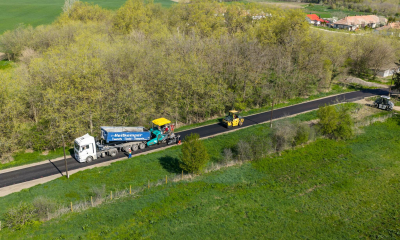





A new national road is being built near Iváncsa

The renovation of the Balaton water control gate has been recognised with a professional award

The modern poultry processing plant in Szentes is being built at record speed

Roadworks in the Tamási area were completed months ahead of schedule

Hungary's biggest motorway upgrading programme is underway

Perhaps the world's most elegant McDonald's restaurant opens in Budapest

Szeged to become one of Europe's leading industrial centres with the construction of the BYD factory, the city strengthens its position with a worthy investment package

Viablokk porous concrete masonry element from a Hungarian factory, as a Hungarian product, is set to conquer the world
-

 Road building 2026. 04. 07.
Innovation on the motorway: digital models, drones and future-proof solutions in operations
-
What is being built? 2026. 04. 07.
Budapest’s Citadel has opened – Renovation of the Citadel is complete
-
Industry news 2026. 04. 02.
The flagship of the Austrian construction industry has launched its largest investment project in Nyíregyháza
-
Current at 2026. 04. 02.
Where there’s a checklist for everything: how Imperial Holding organises safe and predictable house building