Road building
M7 renovations - end of restrictions within days

Even in the intense heat, MKIF Magyar Koncesszió Infrastruktúra Fejlesztő Zrt. is working to ensure that the M7 motorway can be used without restrictions as soon as possible, according to the company's latest Facebook post.
They list: on the M7 motorway between the M0 and Balatonvilágos, work is underway on 2 sections that started earlier:
- Martonvásár area (between 28-35 km, expected completion: 07.10.-11.)
- In the Lepsény area (between 64-73 km, expected completion: 07.03.-04.)

Both sites will also replace the bond and wearing courses: 7 km on the former and 9 km on the latter, while taking care to ensure that the "step", or difference in level, between the new and old pavement is no more than 3 mm.
Two-lane traffic is maintained despite diversions
MKIF indicates that the two sections mentioned above are continuously worked on by their staff, even on weekends. However, despite the diversions, two-lane traffic is guaranteed throughout the renovation work towards Lake Balaton, and on the three-lane section of the M7 towards Budapest, three lanes are available as if there were no work.

How to resurface a motorway lane
They also provide a list of reasons why diversions are needed even where no work appears to be taking place. The main reason is to respect the technological times and sequences: pavement replacement, once the diversion has been installed, consists of 6 basic steps:
- First, the old pavement is milled off, the edges are cut (important because the milling machine makes the edges slightly concave, and the new asphalt material can easily be pushed out in this area during subsequent rolling).
- The dust is then thoroughly removed - a dry surface is required for the next step (if the surface is wet, you will need to wait for it to dry out).
- Bitumen emulsion is then applied to the surface, which takes about 12 hours to dry.
- This is followed by fresh asphalt, which reaches 170 °C when spread. The cooling time between the layers (e.g. binder and wearing course) must be taken into account, which can be up to 12-24 hours in such hot conditions.
- Pavement signs may only be painted on asphalt below 60 °C.
- A bitumen strip is placed at the junction of the old and new pavement to prevent water infiltration.
Only after this can the diversion be dismantled and traffic then be allowed onto the new section of road.

Source : Link

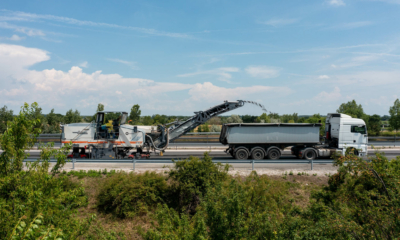






A new binder and wearing course is to be laid on a 1.3-kilometre stretch of Road 67

Preparations for the refurbishment of the main railway line in Pécs are set to begin

The renovation of Hajnóczy Street in Szeged is focusing on climate-adaptive and sustainable solutions

A section of a street spanning two districts is to be renovated in Budapest

Rain gardens are coming to Budafok, with over 3,000 square metres of green space set to be developed

Four new bridges to be built in the heart of the former industrial city

Contemporary art deco in Csopakon

Safer driving on the motorways: new digital signs for the MKIF
-

 Bound track 2026. 10. 07.
Aurora beneath the Apennines – Another tunnel is being built on the Naples–Bari railway line
-
Road building 2026. 10. 13.
A consortium comprising STRABAG and Duna Aszfalt has been awarded the contract to build the North Macedonian motorway
-
Current at 2026. 10. 05.
Sofitel Hotel is the only Hungarian project in the running for the Dalux Award 2026 award – Watch the video too!
-
What is being built? 2026. 10. 09.
One of Budapest’s oldest nurseries is being renovated whilst preserving its timber roof structure