Road building
The new road transport regulations have been drawn up with a focus on water management

The previous Technical Specifications for Roads were riddled with outdated design and conceptual requirements. They did not address environmental issues at all, nor did they cover the design principles and tasks arising during road refurbishments and reconstructions.
It was therefore necessary to adapt the regulations to the technical solutions and climate adaptation measures in use today through a complete shift in approach, with the focus now on water retention.
Six years of work
Back in February 2020, a working committee was formed under the leadership of László Tárczy, which served as a broad-based professional platform for updating road engineering standards. The shared objective of designers, investors, operators, authorities, contractors and university lecturers was achieved when, whilst endeavouring to address the shortcomings of the current regulations, they adapted the basic concept of the regulations to the now-changed approach to water management:
Instead of draining water at all costs, the focus has shifted to retaining it locally, whilst also taking into account the effects of climate change.

They drew on examples from both home and abroad
The working committee began its work on the basis of the UME in force at the time, essentially retaining its structure. Domestic and international research findings were utilised for the new standard, but the working committee also looked to international technical standards on the same subject. Finally, decades of design and operational experience were taken into account when drafting the standard.
For reasons of length, the draft has been divided into two parts: one part came into force on 15 April 2026 as the new Road Engineering Technical Specification e-UT 03.07.15:2026 on the design of road drainage, which contains only the operational design specifications. The other part of the regulation deals with the specifications for construction and maintenance works, which will come into force in the near future.
It is important to note that, in the case of contracts concluded prior to the new regulations coming into force, the road builder or operator may declare in writing that the design must be carried out in accordance with the previous regulations.
Radically new in many respects
During the hydrological design of rural and urban roads, design probabilities were determined for each type of drainage feature (ditches, box culverts, culverts, drainage kerbs, etc.) by road category.

The updated rational dimensioning method has been incorporated in accordance with the instructions of the National Water Authority. Accordingly, based on nationally applicable rainfall intensity values, the design discharge rates for the given catchment must be determined from the rainfall data processed by HungaroMet Zrt., taking into account the prescribed climate risk factor.

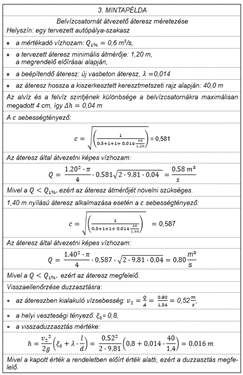
There has also been a significant change in the management of watercourses: detailed specifications for the hydraulic design of drainage elements (ditches, streams, canals, bridge openings, etc.) – including illustrative examples – are now an integral part of the regulations. In the case of small watercourses, in addition to the use of the flood calculation guide for small watercourses in mountainous and hilly areas, updated in 2020, the regulations now also include calculations of design flow rates for lowland catchments and dimensioning procedures for reservoirs of various types and functions.
The operational planning guidelines set out technical solutions that take into account the specific characteristics of catchment areas in both flat and hilly terrain, with the focus shifting from drainage to water retention.
The regulation places particular emphasis on regional water management considerations: it treats the road and its stormwater drainage system as part of the catchment area.

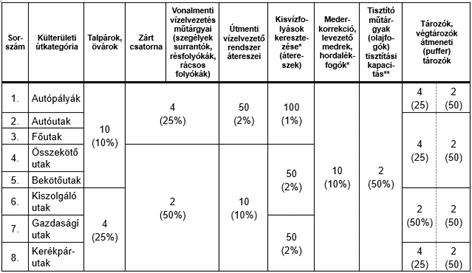
The minimum dimensions of culverts and the criteria for the use of water-conducting kerbs were determined taking into account hydraulic and operational considerations; the spacing of slope drains was also provided in tabular form to facilitate the work of designers.
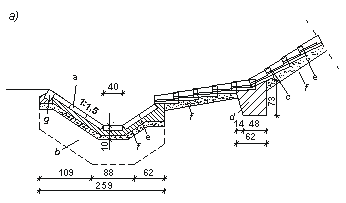
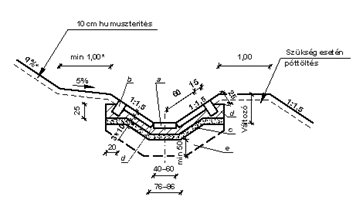
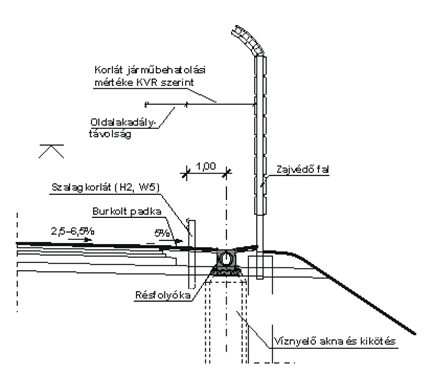
The standard also presents the basic hydraulic engineering solutions applicable to the most typical road cross-sections in the form of sample cross-sections, the scope and content of which have been significantly expanded compared to the previous standard. Among other things, it includes drainage elements for use in the central reservation of dual carriageways, and even provides drainage solutions for the use of noise barriers.


The design principles and technical solutions were established taking into account the specific characteristics of urban catchment areas, incorporating the key principles of urban stormwater management.
The new regulations also address the specific design challenges that arise during the planning of road modernisation, pavement reinforcement and road rehabilitation, as well as drainage issues relating to bridges and their surroundings; a separate chapter is also devoted to environmental protection, with particular emphasis placed on a shift in approach to stormwater management.
Source: Link



A Hungarian specialist in railway turnouts has won the MÁV billion-forint contract

The new water treatment system at Koppánymonostor will improve the water supply to Ács and the surrounding area

Debrecen could get a southern city centre

The ground beneath the M1 motorway is being reinforced using piles of varying diameters depending on the soil layer

Hungary's biggest motorway upgrading programme is underway

Perhaps the world's most elegant McDonald's restaurant opens in Budapest

Szeged to become one of Europe's leading industrial centres with the construction of the BYD factory, the city strengthens its position with a worthy investment package

Viablokk porous concrete masonry element from a Hungarian factory, as a Hungarian product, is set to conquer the world
-

 Current at 2026. 06. 01.
The M5 motorway is in tatters – can the M6 save the day?
-
Industry news 2026. 06. 02.
The domestic construction industry could see a boost – there is potential to unlock €16.4 billion in EU funding
-
Current at 2026. 06. 01.
Project KÉSZ Csoport has refurbished six treatment rooms at Bethesda Children’s Hospital
-
Climate-X 2026. 06. 02.
Who is taking the lead in the construction industry’s green transition?