
Water management
Is there another way to build a road?

Csaba Szarvady is an active participant in shaping road transport regulations as a member of STRABAG Magyarország and MAÚT, he plays an active role in shaping road transport regulations. From his decades of experience, we can discern not only the problems but also possible ways forward. We spoke to him about the most important issues in road construction.

He has spent his whole life working in road construction. What is your view of the country’s road regulations?
I suppose I can now say that I have seen and experienced a great deal, including from a regulatory perspective, but during my first 10 years working on the KPM (the predecessor to the Magyar Közút), I also gained an insight into the operation and maintenance of the railways.
In the 1970s, I studied in what was then the GDR, and then, in the late 1980s, I managed to work as a self-employed person in West Germany. Both of my stays in Germany played a significant part in shaping my outlook, which differs somewhat from what is customary here at home. I have been returning to Dresden ever since, and I am a regular participant in the further training events organised by Drezdai Műszaki Egyetem – particularly Drezdai Aszfaltnapok, where one can listen to lectures by leading German experts in person. Well, one might say I have been deeply influenced by the German mindset and work culture.
Turning to the subject of regulations, I would like to make one thing clear straight away: I do not wish to criticise road construction regulations – all the more so because I myself sit on the committee responsible for drawing up the Technical Specifications for Roads relating to asphalt.
However, bearing in mind that from 1990, as the chief site manager of the German-backed STRABAG project, I worked on various sections of the M1-es autópálya, and following the completion of the M1, I moved into the field of asphalt production and am now responsible for organising and managing the production of nearly 35 million tonnes of asphalt; I may therefore have some insight into certain fundamental problems and their possible solutions.

Some of these align with my philosophy, which is simply to build durable, comfortable and, above all, safe roads for road users. The other half, however, concerns the realm of empirical knowledge. Just think about how our technical regulations are often based on 2,000 years of empirical knowledge. What should the gradient of a slope be, or how should water be drained away? For a long time, we could only rely on experience in these matters.
Well, the study of asphalt – which road users recognise as the road surface itself – is still considered an empirical science, even though we are steadily getting closer to formulating a material law governing asphalt.
Road defects, however, are usually attributed to those responsible for the tarmac, even though the problems typically do not originate there, but – quite literally – much deeper down, at the foundations – and, of course, particularly in the drainage of the road structure. There are, of course, plenty of problems that can be traced back to human error. Let’s take another German example: as early as the 1920s, Fritz Todt set out in bullet points the mistakes that can be made during asphalt laying, and we are still making exactly the same ones today. We do not learn from the mistakes of our predecessors! I think a remark made by Professor Wellner a few years ago says a great deal about the situation:
„You’ve been building this road for five thousand years… and you still haven’t learnt your lesson!” – referring to the cracks, subsidence and other defects.

So what is the fundamental problem with our roads?
Perhaps the most fundamental point I could make is that our roads are not durable enough and may not meet the demands of today’s traffic, both in terms of cross-section and load-bearing capacity, as well as in terms of travel comfort. This obviously does not primarily affect our motorway network, but it does have a very serious impact on all our other roads. Drainage and the frost-protection layer also pose a serious threat to the durability of our roads and, consequently, to their sustainability. This also includes maintenance shortcomings, such as the failure to repair verges and roadside ditches. Take, for example, the M1-es autópálya, which we built in the late 1980s and early 1990s and which lasted right up until recently, when it began to deteriorate rapidly. With proper drainage, this might not have happened.
As with any man-made structure, water is one of the greatest enemies of roads.
This is taught in the very first lectures at university, yet this is where we make the most mistakes. If the solution for keeping water out isn’t perfect, it can seep into the surfacing, right down to the tarmac, where it can even dissolve the bitumen from the stone.
If water finds its way across a road, it destroys everything.
Whilst keeping water out or draining it away remains important, retaining water – particularly in reservoirs – has also become crucial. We are in the midst of climate change, which was also the cause of the water shortages experienced this summer. Numerous effective solutions for water retention have already been developed around the world, and it is worth taking these into account when constructing roads. In addition, there are two further areas for improvement: durability and the closely related issue of insufficient load-bearing capacity – we can still make improvements in these areas, just as we can in the area of travel comfort.

How should resilience be reflected in regulations and implementation?
Within Europe, we must, of course, comply with European standards. It is the responsibility of pan-European bodies, as well as those in individual Member States, to continuously update the regulations and ensure they keep pace with developments and changes in the world. This is carried out by MAÚT and by experts commissioned by the organisation. Naturally, the regulations lag somewhat behind research.
If a research project proves successful (we are currently developing an asphalt mix that promises to be better than any before), it takes years or even decades for the results to be incorporated into the regulatory framework and, from there, into the public consciousness.
Despite 2,000 years of empirical knowledge regarding road foundations, we do not have nearly as much experience with asphalt. And if regulation succumbs to the comfort of habit, progress will certainly slow down. We must remain open to the new, for this can help bring about the essential change: adapting to the present age. A few years’ ago, a renowned German professor began his lecture by telling us to forget our past experience, because our planet’s climate is changing and what has worked so far will not work in the future. This caused quite a stir amongst the largely German audience.
New design principles are needed, which will require research, development and a great deal of experimental road construction. We are rather behind the times when it comes to research in this country, although, fortunately, state-funded experimental construction projects are to some extent evident.
Taking ecological considerations into account is therefore already a key issue in road construction. In this context, the use of secondary raw materials – that is, the use of demolished or milled asphalt – is of primary importance. Moreover, there is no need for specific research in this area, as the European asphalt industry has long since addressed this and the necessary experience is already available.
I believe that the reason for our country’s considerable lag in recycling – even compared with neighbouring countries – lies primarily in the legal framework and the poor practices that have become established.
There is a wealth of research material available worldwide, and studies on asphalt are even being carried out here in Hungary; indeed, it is perhaps no exaggeration to say that solutions already exist for most current road-construction problems, yet a complete overhaul of the system would be required in order to make use of these findings. Although European regulations are uniform, the quality of roads and tarmacs can vary significantly due to financial and natural conditions, as well as mineral resources. We must therefore shape everything ourselves; to do so, however, we must overcome our ingrained habits.
And, of course, there are economic constraints, which do not always allow engineers to “let their imaginations run wild”. What I brought back with me from Germany is that, according to the ideal three-way division of labour, in road construction – as in other fields – the engineer specifies what needs to be done; it is the task of the finance team to secure the funding and manage the accounts; whilst politicians are responsible for providing the overarching framework for all of this. Somehow, this has now been turned on its head, and not just here: politicians and the banks dictate how much money is available for road construction – indeed, they even set a limit higher than that – whilst the engineers try to come up with the best possible technical solution within that budget. In many cases, even the tender specifications are flawed, and it is very difficult to do a good job under such circumstances.
This is clearly evident from the fact that the German motorways built in the first half of the 20th century served road users for 70 years, whereas such a lifespan is not even conceivable for today’s roads.

Should we design our roads differently?
We certainly need to change something, and that is, above all, our mindset. Striving for a longer service life, analysing the entire life cycle, carrying out proper maintenance, and raising our technical standards to a higher level – to name but a few things – and I also feel that road users’ involvement in the system is lacking.
As the tarmac is the topmost layer of the road surface, any defects in it are obvious to everyone; however, these are usually not due to a poor tarmac mix: the deeper down I go in the road structure, the more durable it should be. And the sub-base is the most durable of all. After all, if the wearing course wears out but the sub-base is stable, it is sufficient simply to replace the former. This is a mere fraction of the cost compared to constructing a road with a complete layer sequence.
However, improving the durability of road foundations – and thus of the entire road structure – is now strictly an economic issue, leaving engineers with very little room for manoeuvre.
How are we coping with the damage caused by extreme weather events, which are becoming more frequent due to climate change?
Our current standards and dimensions are based on two thousand years of empirical knowledge. For example, we construct road foundations in accordance with principles that have been taking shape since Roman times and refined through experience. Of course, the Via Appia, for instance, still fulfils the role for which it was built two thousand years ago; yet if we were to build a road today – albeit for a completely different load – it would not even come close to matching the lifespan of a Roman road.
It is not that we have forgotten how to build roads, but rather that roads constructed in accordance with standards based on past experience simply do not cope with extreme weather conditions. How could we amend these regulations whilst ensuring that the cost of the road remains the primary consideration?
The short answer is: not at all.
I believe we need to change our standards. If a stream has washed away a section of road somewhere, it will do so again next time – and not once every hundred years, as we currently base our disaster risk assessments on. It is no longer certain that the ‘once-in-a-century’ return period model holds true. When rebuilding a road destroyed by a flood, we should not build one with the same capacity as the original, but one with a capacity up to five times greater. And I would emphasise once again: it is no longer certain that simply draining water away is sufficient; retaining it is also important. Planning must be adapted to anticipated events, because there will be more disaster situations, not fewer. I feel that research in this area is lacking in our country, even though new developments could help make our roads more resilient.
To what extent can the current regulatory framework deal with these problems?
Once again, I’ll cite the German example, where some 260 pieces of legislation set out German road traffic regulations across roughly 12,000 pages, and the Hungarian system is not much smaller. On top of these, at least 500 further pieces of legislation need to be brought into line. This shows that it will take years before anything changes here.
We must also recognise that our road-building operations are being carried out within a system that is entirely unsustainable: what is the point of building motorways if, as a result of ever-increasing repair work, all we end up with is more traffic jams? Before I am accused of basing my views on the current situation of the M1 motorway because of a personal interest, I would like to point out that I am referring to a presentation given by German government officials several years ago. It is true that we are slowly reaching the same point as they did.
When something goes wrong, we shouldn’t sweep it under the carpet, but rather highlight it so that it doesn’t happen again. By analysing cause and effect, we can get to the root of the problems, and from there all we need to do is finally learn from the past. Let me give an example of this: the M1 motorway, right-hand carriageway, between junctions 60 and 106 (Tatabánya–Győr): I’m sure many of us still remember that in 1991, just one year after it opened, it developed ruts within a matter of two to three weeks. Where can we find a detailed analysis of this? Staying with the M1: a few years ago, it also became potholed within a matter of weeks. Are the professionals and the road administration aware of the causes of these faults?
The latter is all the more interesting because the anti-freeze layer played a significant role in its escalation, even though we have been aware of this fault for quite some time.
Should we build things differently? Yes, for example, we mustn’t skimp on the frost-protection layer, even if we know that the stone required for it is not cheap and our supply is by no means infinite – but it can be continuously recycled later on.
Years ago in Sicily, I came across priority roads that had been built not because of the topography, but to protect arable land and ensure durability; I might also mention the Austrian S1 or the section of the Brussels inner ring road that runs through a tunnel, which were constructed for similar reasons. All in all, we can say that, whichever solution we choose, building a more durable road will certainly be more expensive than what we are used to.
A slide from one of Professor Markus Oeser’s lectures in Dresden is particularly telling; it illustrates how, by reinforcing the track structure, the service life can be extended from 30 to 60, or even 100 years. Of course, the decision on this always rests with the client – ultimately the state itself – but its hands are tied, as it too is bound by standards, design specifications and the available financial resources.
In my view, change can only be achieved by involving the wider travelling public and through a high degree of transparency. Now would be the time to do this, as I have yet to meet anyone who is satisfied with the state of the country’s roads. It is no bad thing for the road administration – the relevant ministry of the day – to be aware of who the road is being built for and the extent of the prior social and professional consultation that has taken place regarding it.

To give an example: the heaviest traffic in our country is from the M1 onto the M5. Why wasn’t the M200 built first, instead of extending the M1? The Danube bridge has been in place for quite some time now.
Following these critical remarks, I would like to conclude by saying that we can be proud of our current road network, which we could only have dreamt of in the 1970s: our major cities are, almost without exception, accessible via motorways or expressways. Of course, it is debatable whether we have carried out the necessary expansions to meet domestic and European network requirements over the past decades, but let us be pleased nonetheless; and if adjustments are needed, let us carry them out as soon as possible, taking into account current – and, even more so, future – expectations.
I have just one message for the construction industry right now: work on developing ever more efficient methods, because without them there will be no change.
Source: Link



A new Youth Cultural Centre is being built in the city centre of Nyíregyháza

Speed restrictions are being imposed on the Hatvan–Szolnok railway line

The refurbishment of Citadella has won an international award – 14,000 square metres of historic stonework have been restored

Sofitel Hotel is the only Hungarian project in the running for the Dalux Award 2026 award – Watch the video too!

Rain gardens are coming to Budafok, with over 3,000 square metres of green space set to be developed

Four new bridges to be built in the heart of the former industrial city

Contemporary art deco in Csopakon

Safer driving on the motorways: new digital signs for the MKIF
-

 Current at 2026. 08. 25.
Apples and pears: according to MKIF, no valid conclusions can be drawn about the operation of the M6 from technical parameters that are not comparable
-

 Current at 2026. 08. 26.
Grab your tools – The large-scale workshow for builders and gardeners is about to begin
-
 What is being built? 2026. 08. 25.
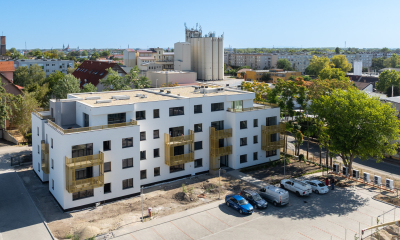
They haven’t skimped on the technical specifications: this is what the Insula Residential Park in Komárom will look like, featuring the Leier solutions
-
 Industry news 2026. 08. 25.
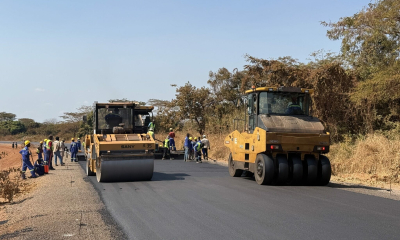
The Duna Aszfalt redeems the bonds issued under the GED Africa project


