Climate-X
Environmentally friendly asphalting on the M60

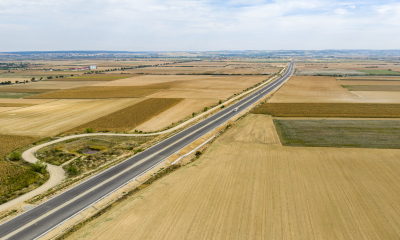
The experts at STRABAG experts are carrying out major maintenance work on the M60 motorway from April to October on behalf of Mecsek Motorway Concession Zrt.. During this time, wear surface renovations will be carried out on sections of varying lengths (1-4 km) on the fast lane and the passing lane, as well as on the exit and entrance ramps, and where the condition of the road requires it, more extensive work will also be carried out.

On the left-hand section of the M60 between kms 9+500-6+700, the wearing course was milled and the binder course replaced where necessary. The WMA, or moderately hot asphalt, was placed on the binder course for 700 metres and on the wearing course for 1400 metres.

At STRABAG's in-house construction testing laboratory, TPA, research and development is ongoing to produce an asphalt mix that can be produced and applied with the same properties as hot mix asphalt, but with less energy consumption and emissions.
With advances in manufacturing technology, warm mix asphalt (WMA), a moderately hot asphalt mix, can be produced at temperatures up to 10-15 degrees Celsius lower than conventional asphalt mixes, resulting in fuel savings of 20-30 percent.

The two asphalt mixes differ in production technology
On the section before the Bóly junction, WMA, a less energy-intensive mix than conventional hot mix asphalt, was used during the reconstruction. The surface preparation was identical to the operations carried out before the conventional hot mix asphalt paving.

The surface was cleaned with a high-pressure water washer, and crack repairs were carried out by cutting and modified bitumen pouring. The new pavement was then constructed using WMA. The emulsion used for the mix - a polymer modified bitumen emulsion to road specifications - is the same as for hot mix asphalt. The composition of the two asphalt layers is therefore the same, but the production processes are different.
What are the advantages of WMA asphalts?
The lower production temperature reduces the initial ageing of the bitumen, which also results in a longer service life, which is mainly to the benefit of the customer. In the case of WMA, the homogeneous coating of the aggregate can be ensured in a similar way to hot mix asphalt, and its compactability is also comparable to that of conventional asphalt.

Overall, emissions can be reduced significantly, by up to 50 percent, which is also important from an environmental point of view.
Another advantage of WMA blends is that, because they have a lower temperature limit for workability, the viscosity time required for spreading and compaction is longer, thus increasing the delivery distance.
In the event of a machine failure, the asphalt can continue to be processed either on the truck or in the bunker.

Less harmful vapour is produced during processing
The available measurement data show that lower energy mixes can also meet the requirements for hot mix asphalt production and installation. The lower production temperature prolongs the duration of resistance to cracking due to thermal fatigue, i.e. increases the service life. The lower temperature means less harmful vapours are generated during the paving process, thus improving working conditions.

When using WMA, the evaporation time of the water in the mixture is increased, so the finished pavement can be loaded later than conventional pavements. Its disadvantage is that it is difficult to apply by hand, so it is not optimal for gateways, junctions and road joints. It is well suited for the construction of motorways and new roads.

The renovation was carried out with the same machine chain used for traditional asphalt paving
The renovation of the M60 is served by the Pécs mixing plant. The pavement of the work area will be constructed in the same way as the original pavement structure. The application of the moderately hot asphalt does not require any different machinery than conventional asphalt. Approximately 9,300 tonnes of durable, aggregate asphalt were used for the wearing course and approximately 11,300 tonnes of asphalt for the binder course, the latter containing 15 percent recycled material. This will further reduce the environmental impact.

Temperate asphalt is being used in more and more places
STRABAG has already used moderately warm asphalt, which offers a more environmentally friendly solution, in numerous projects, such as the road renovations in Szentlőrinc. The company is committed to significantly reducing the harmful emissions associated with its activities. The latest asphalt mixing plant in Orosháza has also started operating with a number of technological solutions that contribute significantly to climate protection.
Source : Link








The town centre on the banks of the Tisza is being regenerated

The Market has fulfilled its promise: it has delivered the 10,000 tonnes of natural stone offered for the raising of the bottom sill at Paks

The construction industry is both vast and marvellous – the Duna Group Szabadegyetem has been launched

ESG is now a business issue for suppliers in the construction industry too

Rain gardens are coming to Budafok, with over 3,000 square metres of green space set to be developed

Contemporary art deco in Csopakon

Four new bridges to be built in the heart of the former industrial city

Safer driving on the motorways: new digital signs for the MKIF
-

 Industry news 2026. 08. 18.
Students were introduced to the high-tech construction industry at BME’s field camp in Göd
-
Bound track 2026. 08. 17.
New pedestrian crossings and a junction with traffic lights are being built in Angyalföld
-
What is being built? 2026. 08. 18.
Hungary’s new McDonald’s restaurant has moved into a modernist listed building in the centre of Budapest
-
What is being built? 2026. 08. 18.
New paving, a playground and visitor facilities are being planned for the Várkör area in Pannonhalma