What is being built?
The new logistics hall at Alsónémedi, connected by a bridge, is being built based on the design of the MERKBAU

The new hall at the GLS General Logistics Systems Hungary Kft. logistics centre in Alsónémedi has reached its highest point. One of the most distinctive features of the development, which is being constructed by MERKBAU Építőipari és Kereskedelmi Zrt. development, one of the most distinctive features is the 127-metre-long enclosed bridge supported by steel pillars, which will connect the existing and new halls via a conveyor belt system.
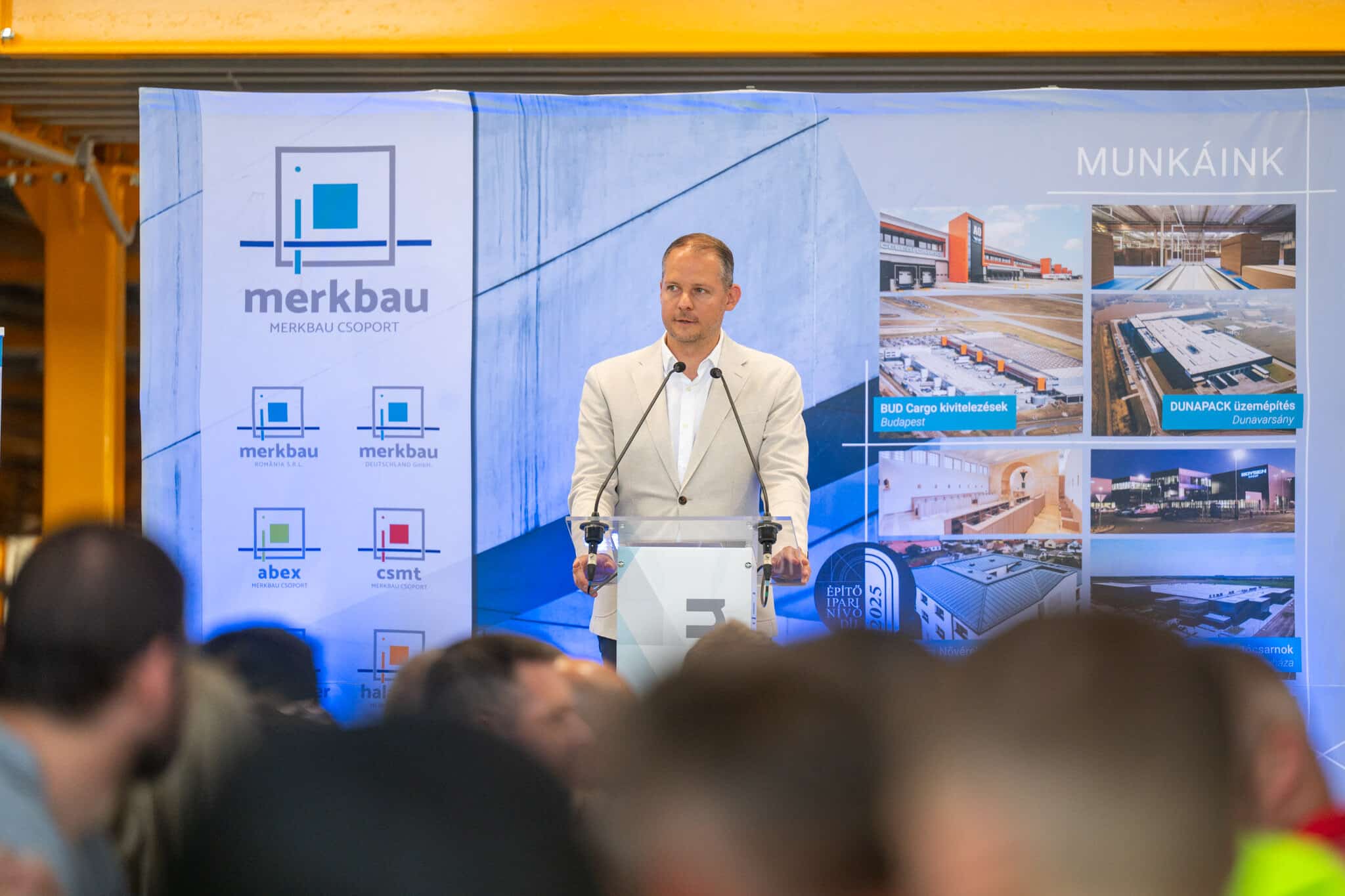
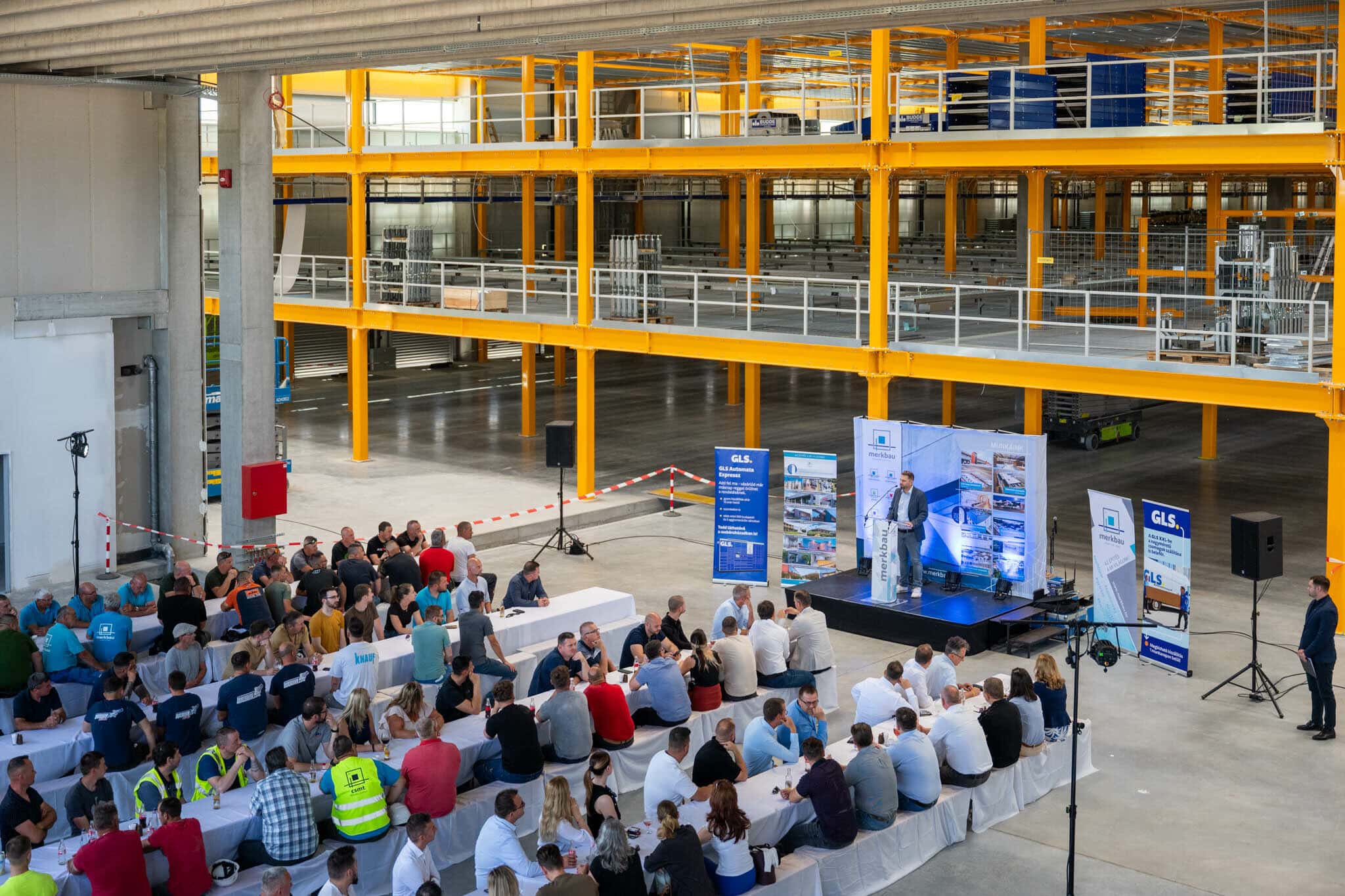
The official topping-out ceremony for GLS’s new logistics hall, office block and reception building was held on 27 May.
It also serves as an Eastern European hub
At the event, Attila Balázs, the Hungarian managing director of GLS, emphasised that the investment extends far beyond domestic operations.
„This building is not just about the Hungarian market. The GLS Hungary site in Alsónémedi also serves as a regional hub for seven countries. The new building will help us to increase our capacity and strengthen our role in the region’s parcel logistics,” he said.

The head of GLS also spoke about how the logistics market has undergone significant changes in recent years.
„Around three or four years ago, significant changes began to take place in e-commerce and, consequently, among the logistics providers serving this sector. Parcel locker solutions have come to the fore. GLS sees this not only as a market trend, but also as an important opportunity for innovation; it is able to maintain its market-leading position through continuous, forward-looking developments.”
The company is therefore building a next-generation logistics centre designed to support operational processes that adapt to market changes.
The expansion was prepared through land consolidation
The expansion is driven by the need to link the existing and new logistics units. GLS has already begun the process of merging plot no. 3062 – where the current development is taking place – with plot no. 3067, the site of the existing GLS warehouse complex.
The aim of the merger was to connect the new hall and the existing logistics centre via a covered bridge supported by steel pillars. A conveyor belt system on the bridge will transport parcels between the two buildings.
When redesigning the project, a key priority was to ensure that the new building could remain connected to the existing logistics system in the long term.
The project is 80 per cent complete
Attila Mészáros, Deputy Director of Operations at MERKBAU Zrt., said that the project is currently around 80 per cent complete.
The interior of the hall is practically complete, apart from some minor electrical installation work. This section of the building has already been handed over to the subcontractors responsible for the technical installations so that they can carry out further work.
In the office areas, specialist works are now nearly 70 per cent complete, whilst outside, the insulation of the canopies and the installation and surfacing of Phase IV of the bridge still remain to be done.
Another important milestone in June
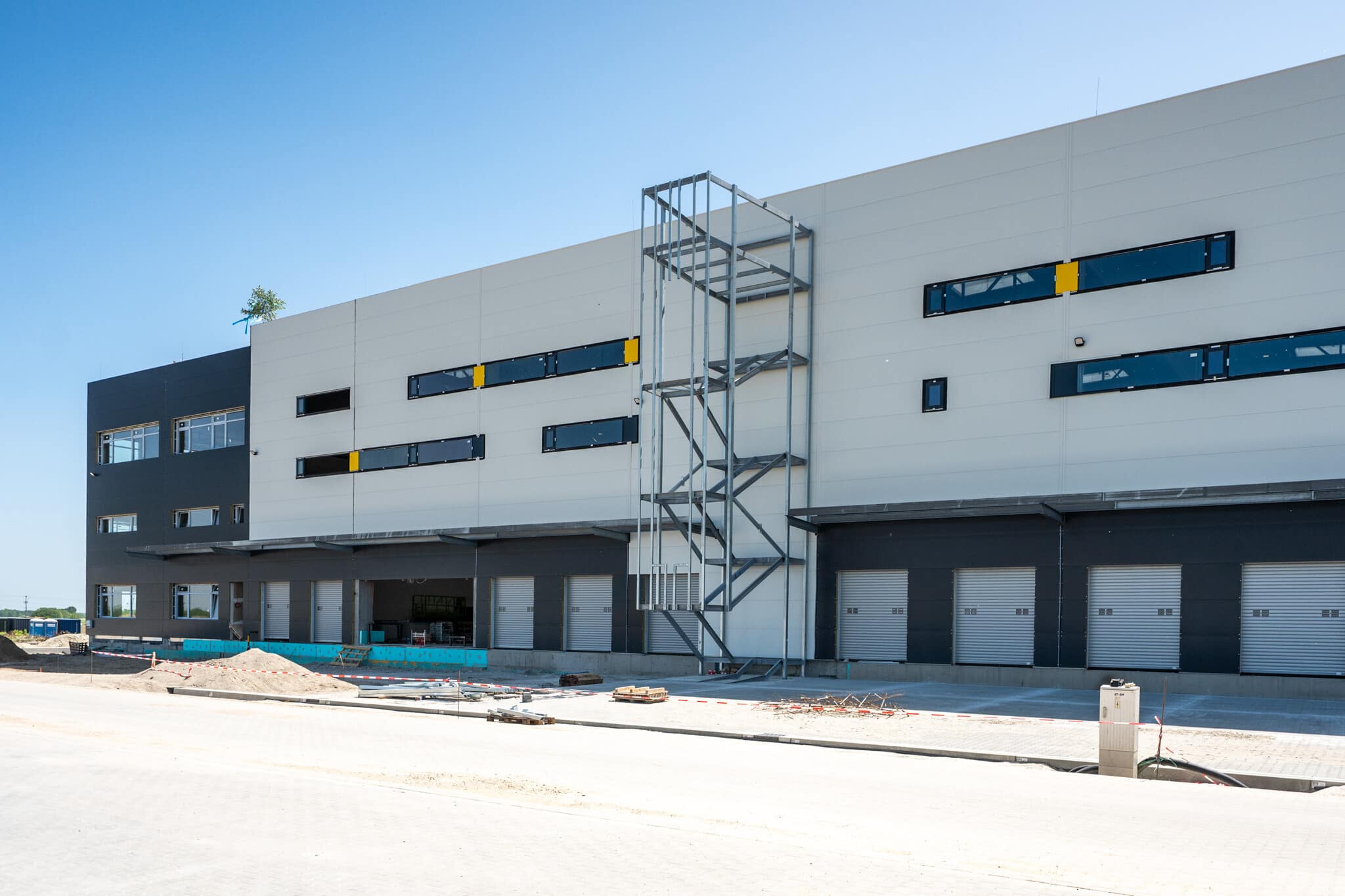
Now that the structural work is complete, the project is entering another crucial phase. The hall is currently watertight, but the office building is still only partially enclosed.
From mid-March onwards, the contractor has been handing over the industrial floor to the plant and equipment contractors in stages on an ongoing basis.
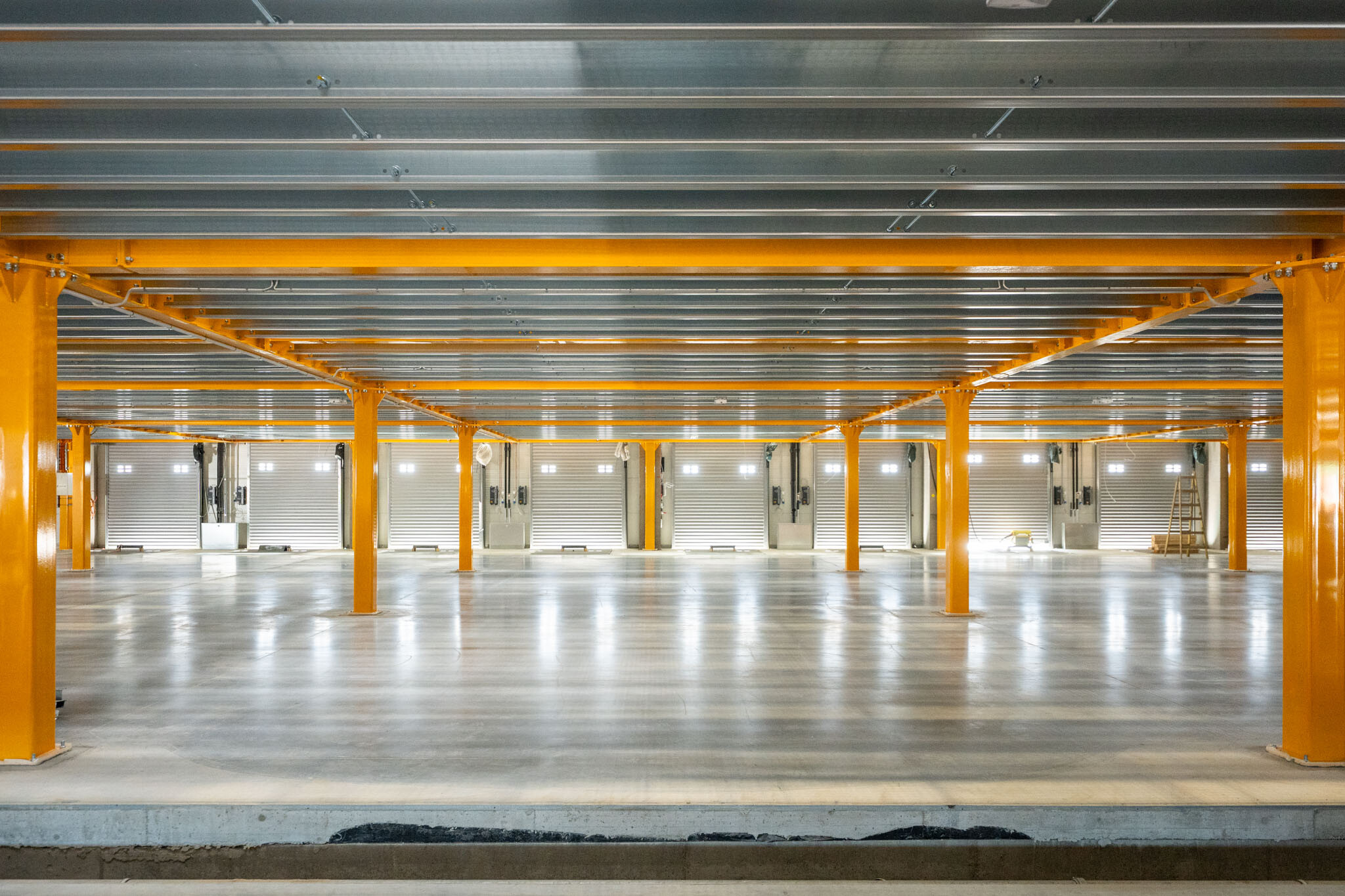
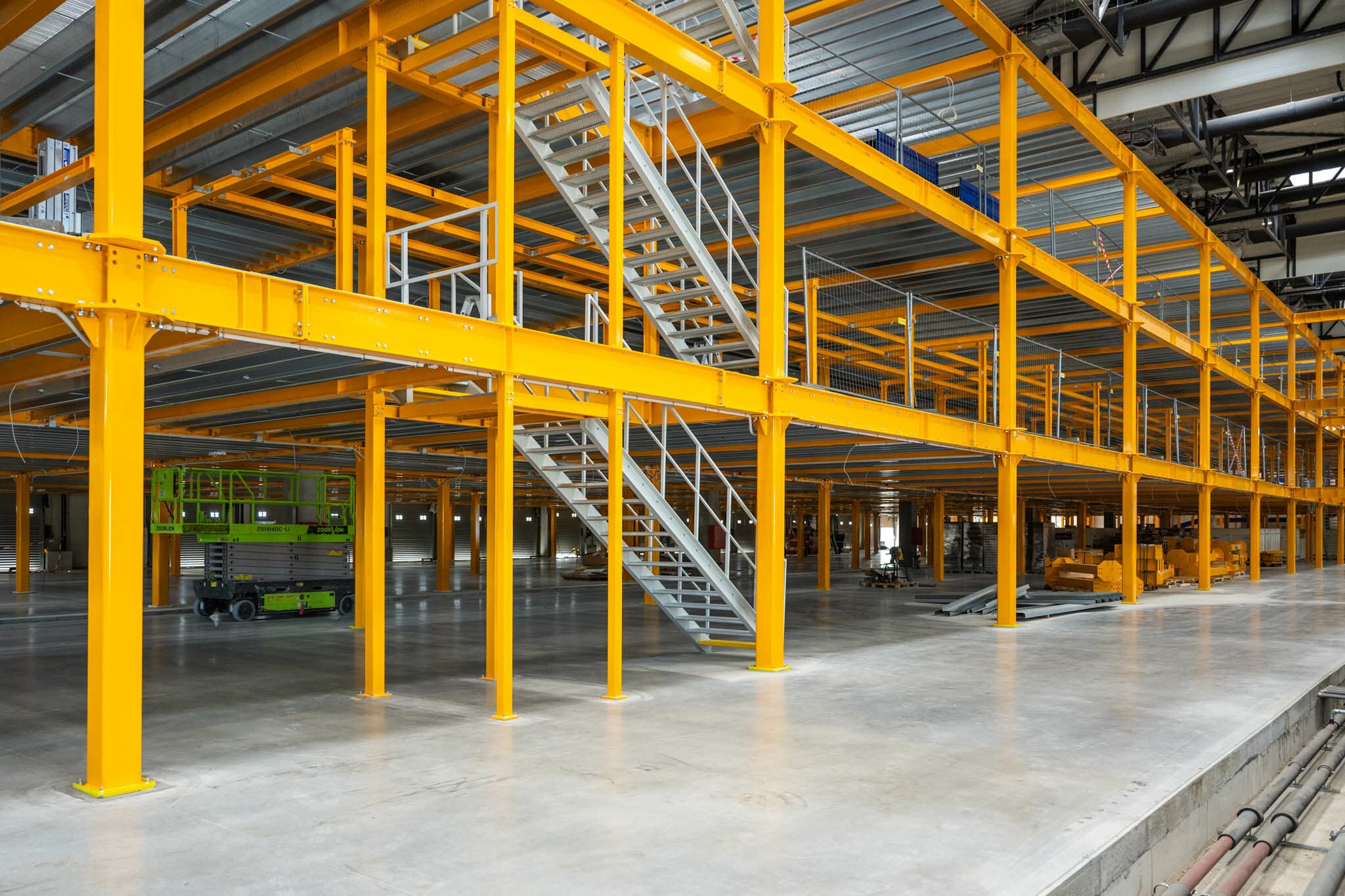
The contractors involved in the project have already begun erecting the steel-framed podium levels whilst the industrial flooring is being laid, with the installation of the technical systems set to follow closely behind.
The next important milestone will be when the first three sections of the bridge are handed over to the structural assembly team.
A logistics centre covering nearly 11,500 square metres is under construction
The new building has a net floor area of 11,467 square metres, with 47,263 square metres of green space.
As part of the project
- 254 car parking spaces,
- 17 lorry parking spaces,
- 39 longer vehicle parking spaces,
- and 27 outdoor charging points will be installed.
The total paved area is 52,128 square metres, consisting mainly of paving stones and, to a lesser extent, CP concrete.
The hall’s structure is made of precast reinforced concrete, and its distinctive feature is that the entire roof structure consists of a steel truss.
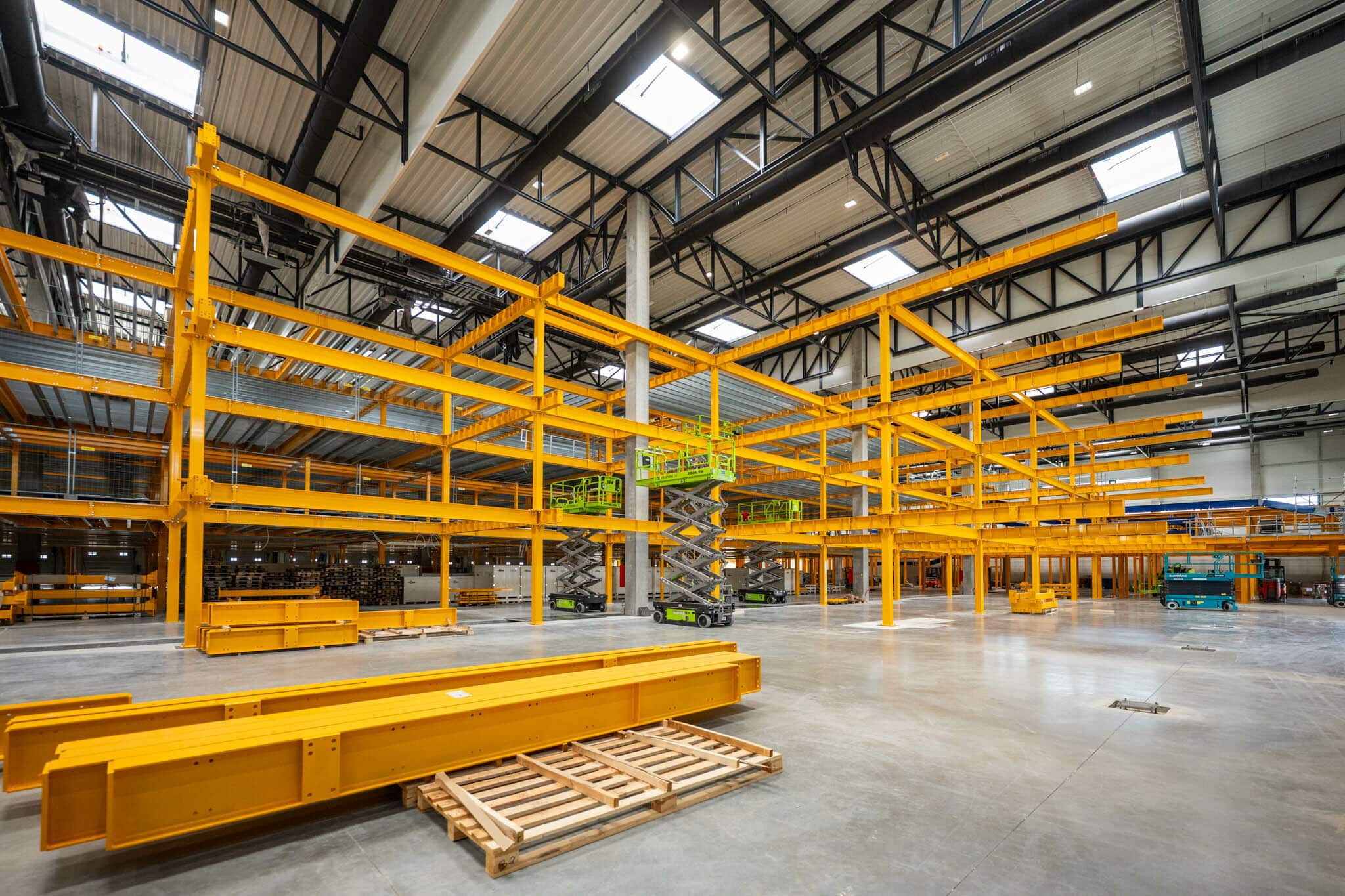
Heated industrial flooring and three-tier process systems
A heated industrial floor is being installed in the hall, comprising 126 technical base units.
The technical contractors began work on site back in March, so the installation of the steel-framed podium levels and the preparation of the technical systems took place in parallel with the laying of the industrial flooring.
At the topping-out ceremony, Attila Mészáros emphasised:
„This is not your average logistics project, but a truly unique development.”
Complex mechanical engineering and a high-capacity power supply are being developed
A 1 MW heating system is being installed on the office’s roof, powered by 18 heat pumps. The system is capable of both heating and cooling the office and the hall.
In addition, a 1 MW gas boiler system will be installed, and solar panels will be used to help generate domestic hot water.
A 1.6 MW transformer is being installed to meet the energy requirements of the building and its technical systems, whilst a substation with a capacity of nearly 6 MW will be constructed to meet the eventual final energy demand.
The roof of the hall will also be suitable for solar panels, which could be installed during a future expansion phase.
Automated security and building management systems
The logistics facility will be equipped with fire alarm, heat detection and smoke extraction systems, each with its own control centre.
Mobile partition walls that move automatically are being installed at the junctions between the smoke partition walls and the conveyor tracks.
The office building will be fitted with a basic BMS system, which will control the mechanical services – primarily the ventilation system – and will be capable of displaying fault alerts as well as data on electricity and water consumption.
The system will also feature wind and rain sensors to ensure the smooth operation of the comfort ventilation system, and will provide continuous feedback to the operations team regarding the condition of the equipment.
Sustainable solutions with a swallow hotel
Throughout the project, particular attention is also being paid to sustainability considerations.
In addition to the heat pump system that provides heating and cooling for the hall and the office, rainwater is channelled into a 3,150-cubic-metre surface drainage basin, half of which serves as a reservoir. An open fire-water reservoir is also being built.
As part of the project, a 3–4-metre-high swallow hotel was also constructed on the south-eastern side of the construction site to protect migratory birds, using around 2,300 cubic metres of earth.
Furthermore, during the construction work, building waste will be sorted and removed.
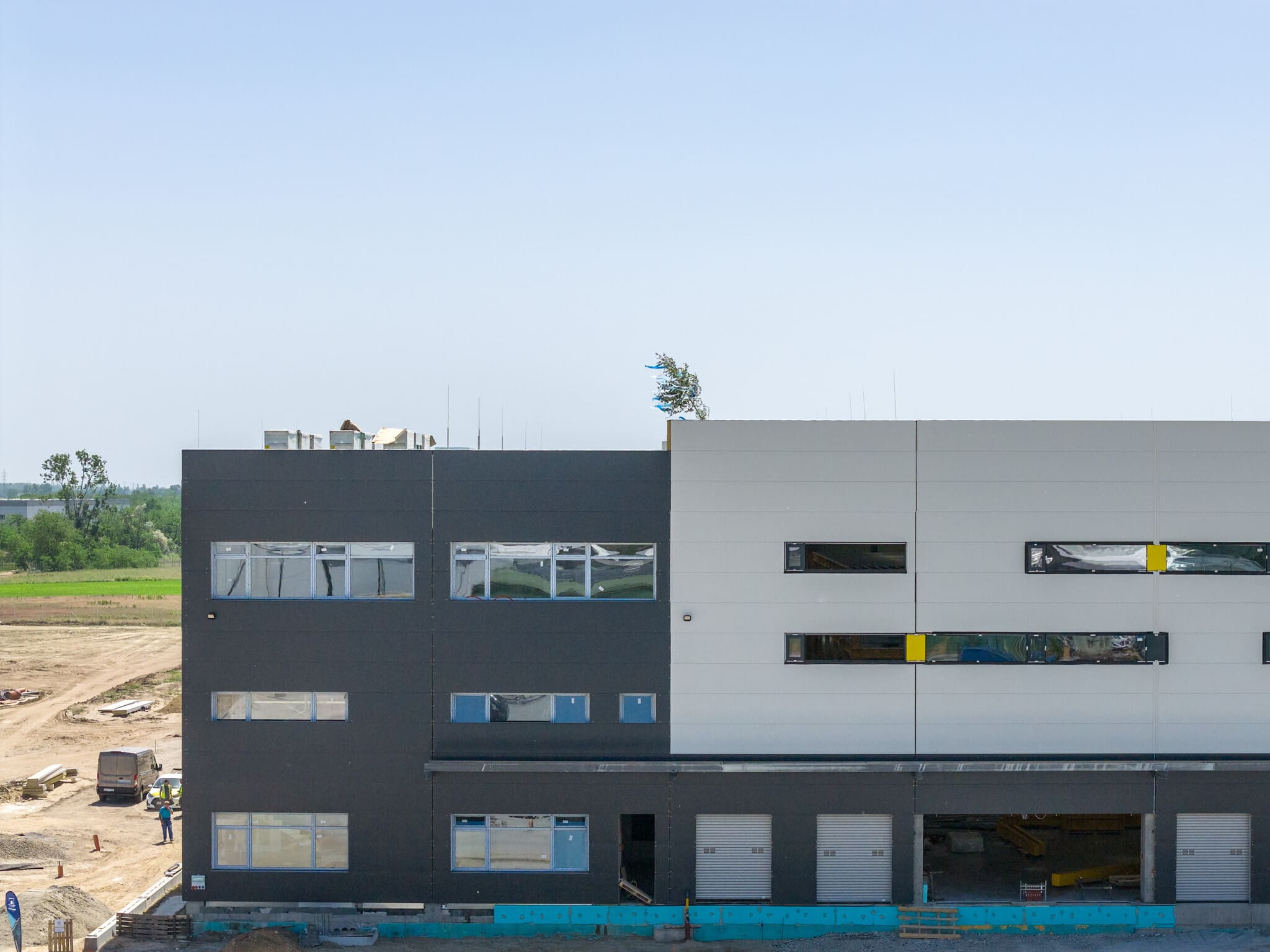
Spectacular façade designs are also being developed
Several architectural decorative elements are also incorporated outside the hall. These include the sandwich-panel and fixed aluminium sunshade facades of the four emergency stairwells, as well as the fibre-cement and sandwich-panel cladding of the connecting bridge, which features alternating facade planes.
Concealed lighting will accentuate the bridge’s appearance.
On the east side, 30 roller-shutter industrial doors are being installed, 26 of which are fitted with loading ramps, whilst a further 32 roller-shutter industrial doors are being installed on the west side.
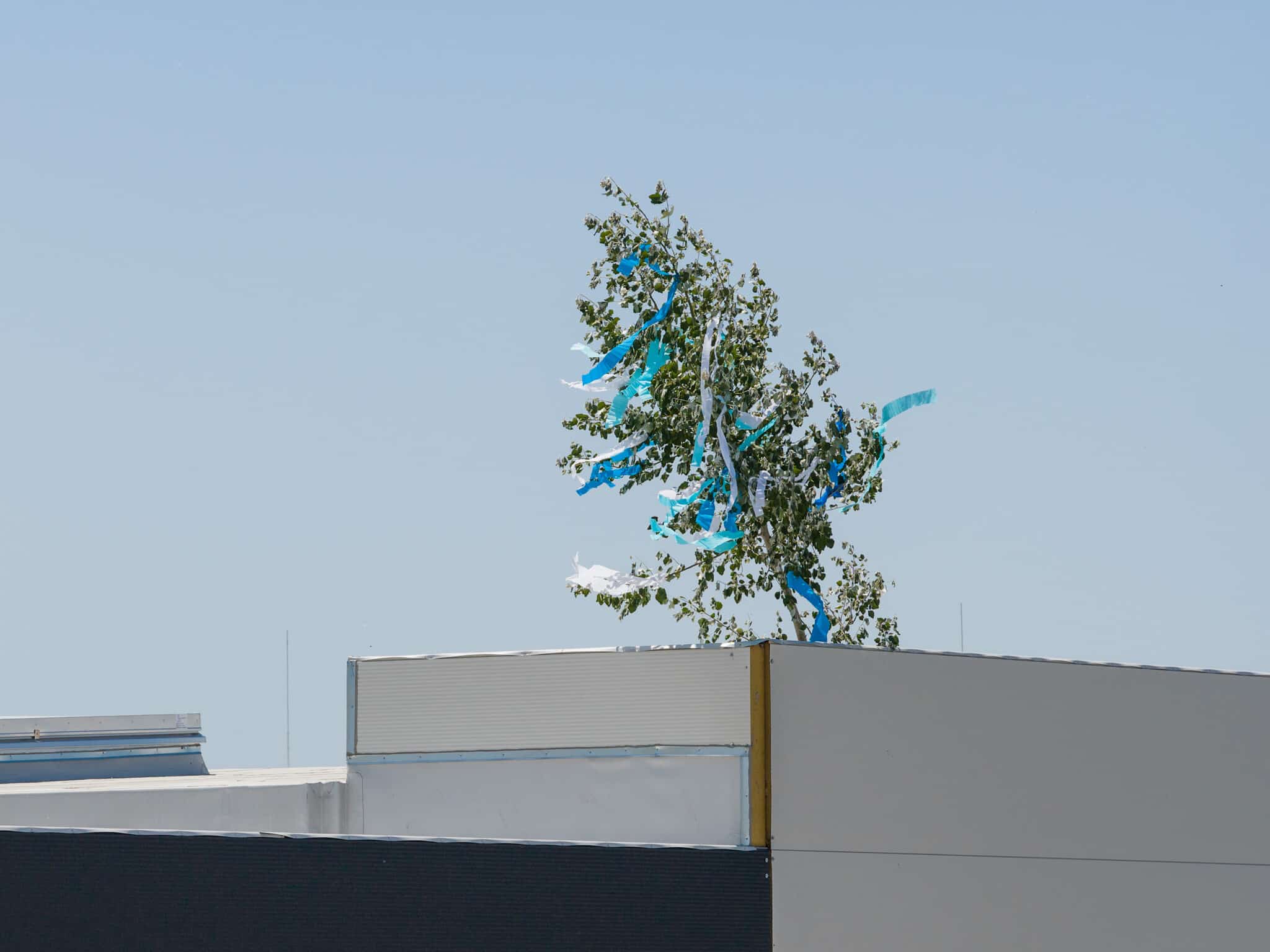
The structural work was completed with a topping-out ceremony
At the end of the topping-out ceremony, Norbert Rimóczi, the project manager, recited the traditional topping-out poem, which paid tribute to the work of the builders and wished the building every success for the future.
The event concluded with the traditional breaking of a glass, symbolising the end of an important construction phase and the start of the next stage of the project.
Source: Link









The Buda interchange could also be extended northwards

A railway bridge will link the sections of the Tokaj-kör route: cycling infrastructure development in the wine region continues

Many people from the capital are also choosing it as their new home: four buildings are being constructed in Gárdony using a special foundation system

One of Abony’s most important transport routes is to be redesigned

Four new bridges to be built in the heart of the former industrial city

Rain gardens are coming to Budafok, with over 3,000 square metres of green space set to be developed

Contemporary art deco in Csopakon

Safer driving on the motorways: new digital signs for the MKIF
-

 Current at 2026. 09. 09.
A first-hand look at a career in engineering – Duna Group Szabadegyetem is back
-
Climate-X 2026. 09. 09.
Nyíregyháza Spartacus FC goes green – four hundred solar panels to be installed on the stadium roof
-
Bound track 2026. 09. 15.
Nearly 50,000 people travel on it every day – the refurbishment of the Cegléd main line continues
-
Current at 2026. 09. 09.
Rental flats, Rákosrendező, decentralisation – important ideas were put forward on the Real Estate Beach Conference stage