Road building
M1 motorway extension at the front line

One of the largest domestic road development projects of recent decades will begin in autumn: the expansion of the M1 motorway to two three-lane carriageways. The motorway will also be expanded with a full-value intelligent hard shoulder (ITS) on each side. We discussed the preparations for this large-scale project, safety during construction and the financing of this huge development with Tamás Németh, CEO of Magyar Koncessziós Infrastruktúra Fejlesztő Zrt..

The final preparatory work is already underway
Two important things are happening simultaneously on the M1 motorway: preparatory work not affecting the main road began in autumn 2024 and is currently ongoing; on 8 July, preparatory work affecting the main road may also begin.
These are the last steps before the extension is built, and will also affect the separation of the two tracks.
The MKIF is officially scheduled to begin on 1 September begin construction on both the M0 and Bicske sections, as well as the Bicske-Concó section. The work will be carried out simultaneously, but the Company will have three years to complete the work from the ring road to Bicske and a total of four years from Bicske to Conco (editor's note: MKIF Zrt. must be completed by 31 August 2028 for the section to Bicske and by 31 August 2029 for the section to Conco).

"There are two reasons why we are starting the work now: firstly, we have a contractual commitment to complete the levelling work by 31 August this year, so that the capacity used can be transferred to the new development; and secondly, we had to have our financial closure, in which we prove that we have the resources to finance the development.
On 14 May, the Concession Company submitted the documents certifying this to the Hungarian State, so we can start the development" - emphasized Tamás Németh, CEO.
He further stressed that "the entire amount needed for the expansion is provided by the Concession Company - of course by borrowing, but the owners are also contributing a lot of their own resources to the project."

Tens of kilometres of service roads built
We are all aware of the volume of traffic on the M1 motorway, which is considered the western gateway to our country. Therefore, the expansion work must be carried out in such a way that traffic can continue to flow in two lanes in each direction. „To ensure this, we will only use the motorway for heavy goods vehicles when necessary. Where possible service roads to support the construction work. In other words, we plan to carry out the work using these roads wherever possible during the construction period. We have already completed several tens of kilometres of these roads,” the CEO revealed.
Plants are replaced with concrete dividers for safety
„As we have previously informed the public, we are replacing the plants between the two lanes with concrete dividers in order to make driving on the M1 as safe as possible. There are countless videos available online for those who are curious about what a guardrail and a concrete divider can do in the event of an accident. The main problem here is not with passenger cars, but if a lorry loses control, concrete dividers are able to stop vehicles weighing up to several tonnes more safely than guardrails. Their installation can therefore significantly reduce the number of collisions, as vehicles are more likely to remain on their own side of the road and not cross into the oncoming lane,” said Tamás Németh, explaining the need for concrete barriers.
To do this, the vegetation separating the central lane must be removed and, under the supervision of a botanist, the protected plants growing next to the track had to be transplanted. A drainage system will be built under the concrete elements, and in the future, colleagues will have to spend a fifth of their time on the pitch due to operational tasks, as the hedges will no longer need to be maintained, thus causing less obstruction to traffic. The track will not be left without green space. After construction, the part of the track closer to the fence will still have trees, bushes and shrubs as there are now.
Among other things, archaeological excavations and explosive ordnance disposal have begun in the development area, which are essential for the start of the real work in September.
"We have done what we could, at our own risk and with our own resources, because the goal is that from September we really only have to deal with the concrete construction", the CEO stressed."

Drones will also be used to control traffic
Currently, there are still sections of motorway that do not have cameras, so dispatchers cannot see what is happening everywhere. However, in order to be able to react quickly to such heavy traffic, it is necessary for the operator's colleagues to have a view of the entire motorway. The MKIF Zrt. contract also stipulates that road inspectors continuously monitor the motorway.
"However, it would be unfortunate to allow road patrol cars into the construction-heavy traffic (unless absolutely necessary), so we want to do some of this work using 21st century technology with drones, especially during the expansion works.
We are confident that drones will allow us to intervene effectively; this will also serve to make the M1 safer and more manageable even during the expansion of the motorway", the CEO pointed out.
Special equipment equipped for tow trucks
To allow contractors to move flexibly during the preparation of the construction site, they are not using concrete dividers in temporary baffles for the time being, but so-called Klemfixes: plastic modular units.
"We are also preparing for the heavy traffic: we will create emergency bays where defective vehicles can be parked; we will also build special rescue access points where rescue units can access the motorway from the side of the track, making the motorway accessible from dirt roads, in addition to junctions, where possible."
„There will be moments when we need to be able to intervene, and quickly,” Tamás Németh points out. „It is important that we are prepared to deal with problems at the Bicske engineering depot with additional car rescue vehicles, where motorcycle ambulances are already stationed in order to be able to respond as quickly as possible in the event of an accident. The ambulance motorcycles stationed at our engineering offices not only enhance the safety of those travelling on the track, but the National Ambulance Service can also dispatch these units to residents living in the surrounding area. This has happened on numerous occasions over the past year, not only in Bicske, but also in the Martonvásár and Gödöllő areas. We have provided the fire brigade with special equipment to speed up rescue operations: we have made available mobile battery-powered spreader-cutters and fire lances, which are essential for extinguishing electric car fires.”
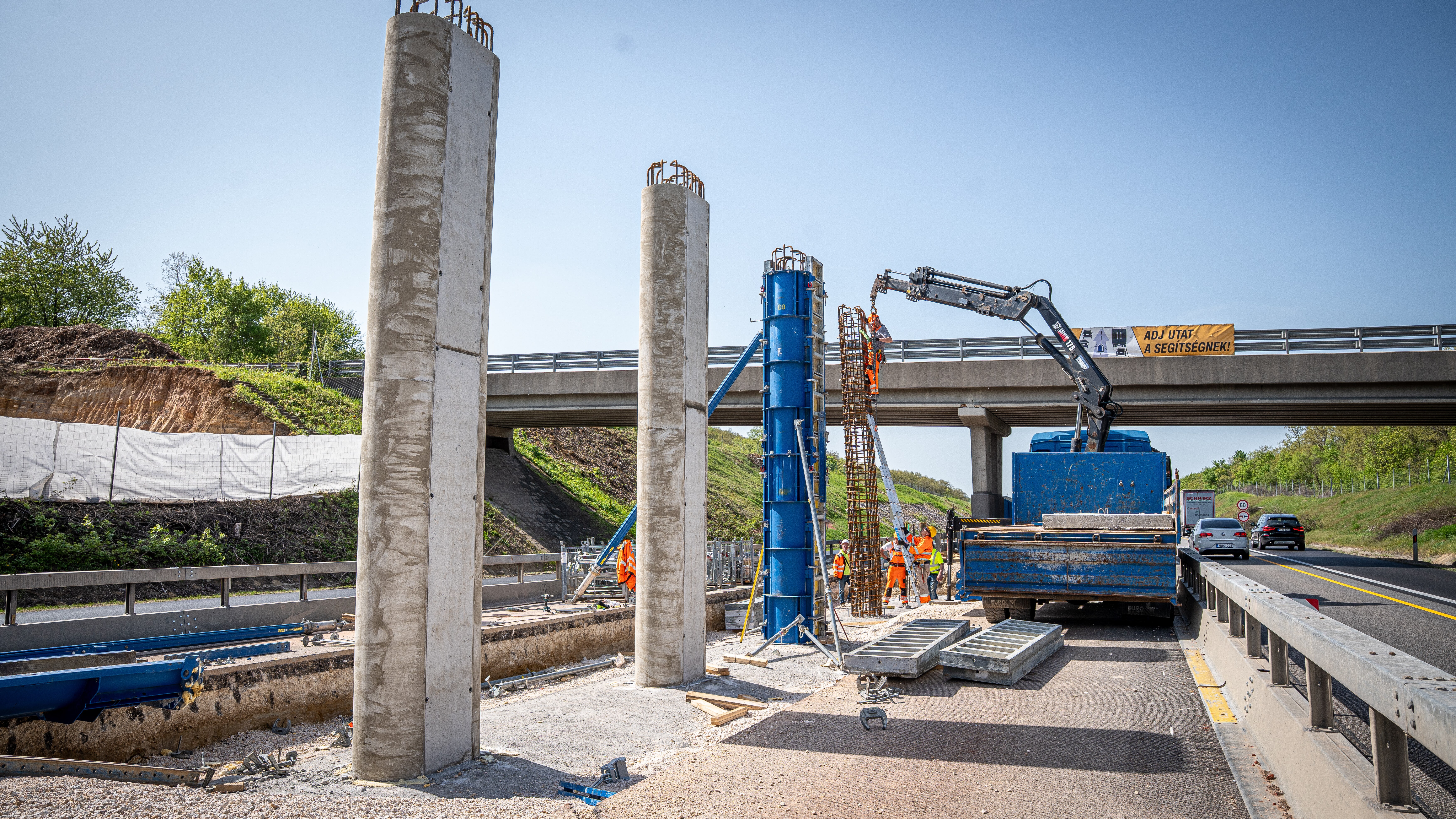
Technological innovations are also being used on the M1
The MKIF will build a complete system that includes truck parking, rest areas and all the ancillary IT systems.
„Our development will result in a motorway that will function well in the long term, with several elements that are considered innovative technologies in this country new technology. I would like to illustrate this with a few figures:
- there are currently 5 kilometres of noise barriers along the motorway on the section to be widened, and 45 kilometres of noise barriers will be built on a section nine times longer than the current one, with a surface area 12 times greater than at present (they will be higher in several places)
- We are talking about a complex system, which means that we are not just adding new lanes to the M1 motorway, but also adding technical content of a length never seen before in Hungary, and intelligent stopping lanes that can be digitally opened to traffic in the event of traffic jams, accidents or work:
- 72 existing underpasses and overpasses will be rebuiltto meet the new cross-sectional requirements. They would simply not fit under the widened track;
- 11 existing junctions will be upgraded and 4 new dedicated junctions will be built;
- 6 complex rest areas will be completely rebuilt and the rest will be extended and modernised;
- around 300 new truck parking spaces will be created, along with family-friendly recreational facilities.
- We are expanding and modernising 2 engineering sites.
- Bicske
- Komárom.
- We build modern drainage and reservoir systems,
- 7 at-grade sub-nodes will be transformed into modern roundabouts.
The CEO also mentioned that an excellent example of risk-taking is the renovation of the M1/M0 junction, where the road is in such poor condition that it needs to be dug up to a depth of 140 cm and rebuilt in order to be able to open it to traffic with a satisfactory level of quality. Until now, almost all motorway construction in Hungary has been greenfield development, so many people try to compare the M1 expansion to that. „However, it would be more appropriate to measure the development against European expansions, which are significantly cheaper to build,” emphasised Tamás Németh.

The cost of building a motorway is influenced by several factors
It is very difficult to compare how much a kilometre of motorway costs. Building a greenfield motorway costs considerably less than widening the M1 from the M0 to Concó, because it requires a lot of additional activities. Even during the public procurement process and at the time of contracting, the Hungarian State checked the prices, which were found to be in line with European benchmarks in all respects. In Germany, the Czech Republic or England, motorways with such technical content are built at significantly higher prices.
"The kilometre yardstick is very deceptive: it makes a difference whether you can build a 2×2 lane motorway in one kilometre, in open space, without traffic, or, as here, 2×3 lanes with an ITS lane plus the complex elements mentioned above. So if you look at the road surface alone, it will be nearly double the size of a normal motorway, while it is hard to list how much will be built.
Of course, the costs will also be greatly influenced by the type of embankment and road structure needed for the road, or by the fact that concrete elements will be used to separate the traffic lanes instead of a barrier. There are also huge additional costs for maintaining the traffic, as the performance of the machinery is significantly reduced compared to a completely empty surface, and the thickness of the asphalt layer is also worth mentioning," the CEO of the maintenance and operation company explained.

The M1 will have more capacity than other motorways
We also learnt that the average asphalt layer on Hungarian motorways is 20 cm, while on the M1 the MKIF Zrt. will lay a much thicker 32 cm. The end result will be a significantly more durable, more load-bearing and better quality road, but of course at a significant extra cost.
It may seem like a minor detail, but the amount of milled asphalt that needs to be recycled is important. (In a previous article, Domonkos Koch, innovation engineer at MKIF, described this process in detail.) Milled asphalt appears to be cheaper, but in fact it generates additional costs. Similarly, little is said about the fact that numerous junctions will also be rebuilt during the development, and so this is not usually taken into account in the calculations.
"Construction materials are not considered waste in the first instance, but secondary construction and demolition materials. This is an important step towards a circular economy." - concluded Tamás Németh.
Source: Link









The town centre on the banks of the Tisza is being regenerated

The Market has fulfilled its promise: it has delivered the 10,000 tonnes of natural stone offered for the raising of the bottom sill at Paks

The construction industry is both vast and marvellous – the Duna Group Szabadegyetem has been launched

ESG is now a business issue for suppliers in the construction industry too

Rain gardens are coming to Budafok, with over 3,000 square metres of green space set to be developed

Contemporary art deco in Csopakon

Four new bridges to be built in the heart of the former industrial city

Safer driving on the motorways: new digital signs for the MKIF
-

 Industry news 2026. 08. 18.
Students were introduced to the high-tech construction industry at BME’s field camp in Göd
-
Bound track 2026. 08. 17.
New pedestrian crossings and a junction with traffic lights are being built in Angyalföld
-
What is being built? 2026. 08. 18.
Hungary’s new McDonald’s restaurant has moved into a modernist listed building in the centre of Budapest
-
What is being built? 2026. 08. 18.
New paving, a playground and visitor facilities are being planned for the Várkör area in Pannonhalma