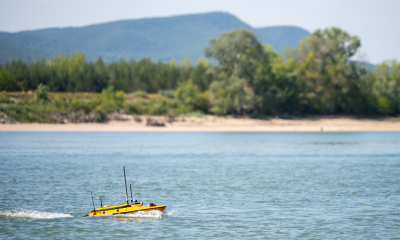
Water management
Wild island restoration on the Danube

There are more than 900 islands in the Danube, of which only 147 remain in their natural - wild - form. They are a lifeline for many animal and plant species and are also key to biodiversity conservation.
Europe united to save the last islands
To protect the "last remaining wild islands", the DANUBEPARKS network of protected areas along the Danube has launched a project. Launched under the coordination of the Danube-Auen National Park in Austria, the LIFE WILDisland programme involves an investment of €14.2 million up to 2027, in partnership with waterway managers, forestry authorities and power plant operators.
The aim is to restore the natural state of 34 islands in the Danube through comprehensive restoration measures, contributing to the revitalisation of 48 km of river water and 1267 ha of river banks.
The activities in Hungary are implemented by the Lower Danube Valley Water Management Directorate, the Danube-Drava National Park Directorate, the Danube-Ipoly National Park Directorate and the Fertő-Hanság National Park Directorate.

All Danube countries have joined the programme
All countries along the Danube are represented in the WILDisland project. Thanks to international cooperation, the rehabilitation of Korpádi Island can be carried out in two phases. The public procurement notice published at announcement published in the public procurement notice reveals that the first phase of the construction work, the reconstruction of the river regulation defences, will be carried out by KÉSZ Csoport and the MA-HARD Hajózási és Vízépítő Kft..
Two phases to rehabilitate the island
On behalf of the Danube-Drava National Park, the following works are planned to be carried out in the area of Őcsény and Sükösd at the Danube1493+300 and 1494+000 km in order to rehabilitate Korpádi Island:
Part 1: Rebuilding of river control works
Part 2: Dredging for habitat rehabilitation
Four islands have formed in the section affected by the works, between the groynes and the T-shaped retaining walls.
These islands form the largest sandbar complex in the Danube-Drava National Park, with sandbars up to 50 metres wide at low tide.
The islands represent different stages of succession, from open sandy areas to soft grasslands, willow bushes and softwood gallery forest.
Partial demolition of the quarry is carried out from the water
According to the notice published in the contract notice, only the first operation can start at this stage. The dredging of the riverbed can be carried out at a later stage due to lack of funds.
In order to improve the longitudinal
crossing of the right bank of the Korpádi meander, the correction of the existing right bank flow control stoneworks in the Danube sections 1493+300 and 1494+000 fkm is necessary. During the construction work, their crown level will be demolished in phases. The stone material from the bank closure will be used to stabilise the bank of the dredged tributary and to protect it against erosion by creating a 60 cm layer.
The notice also stipulates that the rebuilding of the embankment must be carried out from the water by a floating machine.
Main technical parameters of the planned crossing reconstructions:
- Total length: 42,71 m
- Quarrying: 1981 m3
- In the case of coastal protection stone fences, the
- Total length: 151,98 m
- Paving for coastal protection: 1981 m3.

Source: wildisland.danubeparks.org
Dredging will also take place at nearly 1700 metres
The project also includes scrub and brush clearance and the removal of accumulated sediment in the riverbed.
In order to improve the longitudinal
transitibility of the reefed embankment fields of the Korpádi meander towards the right bank, it is planned to carry out minor bank scouring of the filled sections. Main parameters of the tributary dredging:
- total length: ~1668 m
- total basin excavation: ~ 31364 m3
- dredging bottom width: 8.00 m
- bending: 1:3; 1:2
- Dredging level: between 82.40 - 82.49 m B.F., DB'2006
- 40 cm below and parallel to the water surface curve.
Still to wait for the floating scooters
As stated in the call for tenders, the contractor may carry out the dredging using either a hydro-mechanisation system (suction-push) floating dredger or a hydraulic dredger mounted on a floating dredger. For both technologies, the working area is accessible by water from the Danube.
The technologies used involve working and transport by water, the use of terrestrial habitats for working is limited to the access of personnel to the workplace.
Hydromechanical excavation involves the transport of the dredged material after excavation on a conveyor pipe placed on floating
tanks on the water surface, so no geodetic lift height is required to be overcome. Maximum transport distance: 856 metres.
The notice indicates that the resources required to award the contract are not available on the basis of the tenders received.

Photo: wildisland.danubeparks.org
Experts monitor the extent of the dredging and the protection of plants
The notice states that any planned over-excavation in excess of the designed bottom level is prohibited. It also provides for the removal, prior to dredging, of in-stream vegetation only to the extent necessary, with the involvement of the Danube-Drava National Park authorities. The dredged sediment will be deposited in the Danube drift line.
Source : Link








The town centre on the banks of the Tisza is being regenerated

The Market has fulfilled its promise: it has delivered the 10,000 tonnes of natural stone offered for the raising of the bottom sill at Paks

The construction industry is both vast and marvellous – the Duna Group Szabadegyetem has been launched

ESG is now a business issue for suppliers in the construction industry too

Rain gardens are coming to Budafok, with over 3,000 square metres of green space set to be developed

Contemporary art deco in Csopakon

Four new bridges to be built in the heart of the former industrial city

Safer driving on the motorways: new digital signs for the MKIF
-

 Industry news 2026. 08. 18.
Students were introduced to the high-tech construction industry at BME’s field camp in Göd
-
Bound track 2026. 08. 17.
New pedestrian crossings and a junction with traffic lights are being built in Angyalföld
-
What is being built? 2026. 08. 18.
Hungary’s new McDonald’s restaurant has moved into a modernist listed building in the centre of Budapest
-
What is being built? 2026. 08. 18.
New paving, a playground and visitor facilities are being planned for the Várkör area in Pannonhalma