Current at
There can be no construction industry without building services engineering! – an interview with István Barótfi

As a construction trade journal, we observe year on year that building services engineering is playing an increasingly significant role in the implementation of major construction projects, whilst also performing ever more complex functions in buildings already in use. It is no wonder that this year this sub-sector has established its own division within the industry’s representative body. We spoke to Prof. Dr István Barótfi, the new section’s managing director and media officer, about the background to the establishment of the ÉVOSZ Building Services Engineering Section, its strategic objectives, and the domestic market situation for building services engineering.
Before the section was established, other organisations had also done a great deal to represent the interests of the field. What experiences and lessons did you gain from this work, particularly within the Magyar Épületgépészeti Koordinációs Szövetség (MÉgKSZ) that you led? Why, then, did you decide to establish the ÉVOSZ section?
Nowadays, it is inconceivable to use our buildings without building services engineering; yet the sector has not managed to achieve the level of attention and recognition it deserves from other professions and society at large. Therefore, when we redefined the association’s remit and vision nearly ten years ago, our primary objective was to improve the field’s visibility, recognition and prestige, and, more generally, to deepen its integration into society.
As part of this, we have established a wide-ranging series of professional events known as the National Hungarian Building Services Engineering Days (OMÉN), and we have created the profession’s emblem, which is now widely used; we organise events as part of the Building Services Engineers’ Sports Days, among which the sailing cup is now recognised as a national competition; and, last but not least, for the past six years we have been publishing the Building Services Engineering Yearbook, a representative publication summarising the profession’s annual performance – from its economic efficiency and significant achievements to its social activities within the sector.
All of this has significantly and tangibly strengthened our professional identity and, in many cases, even elicited envy from other professions. Despite all this, we have not witnessed an increase in the profession’s prestige or standing; building services engineers remain merely subcontractors to the construction industry, and when assessing the outstanding achievements of the construction sector, the quality of building services engineering work is never taken into account; letters and proposals sent to the relevant authorities and ministries often go unanswered. I had to realise that without building services engineering there is no building, but without a building there is no building services engineering; thus, if we wish to give our field greater weight, a major opportunity may lie in working together with, yet separately from, the key players in the construction industry – whilst specifically naming them – to achieve our goals and give voice to our concerns.
According to their statement, the problems facing building services engineering require the combined efforts of significant economic forces. To what extent is this being realised within the division? If it is possible to provide figures or approximate proportions (any market data), what proportion of this sub-sector do the founding members represent?
The world is not a social playground; interests, and the way problems are managed and resolved, are fundamentally determined by economic power relations. Building services engineering can account for nearly a quarter of the construction sector’s GDP, comprising the output of a large number of small and medium-sized enterprises, as well as the work of a smaller number of companies that nevertheless represent significant economic clout. It was precisely to demonstrate this economic clout that we approached Hungary’s largest building services engineering firms, and they agreed to establish the division.

What has been your experience of the consultations and cooperation to date within the framework of the ÉVOSZ section? To what extent have the synergies hoped for from this new form of representation been realised?
The section was formed a few months ago, and the time that has elapsed so far has only been sufficient to gain an insight into the ideas and the involvement and activity of those involved. One such insight is the receptiveness of ÉVOSZ, which, thanks to the personal involvement of its chairman, László Koji, is always very helpful, active and efficient. Another lesson is the work of the section’s executive committee, which we are currently establishing, and in which the members’ level of activity is developing in line with expectations.
What specific plans do you have for this year?
When the division was established, a clear objective was set out: to involve the largest companies in order to demonstrate the economic strength of the sector. The views of the leaders of such companies carry significant weight precisely because of their day-to-day economic activities; however, they do not have the time to systematically process various analyses and evaluations or to compile studies. For this reason, the division appointed an executive director to carry out the operational work.
As Managing Director, I drew up a programme and an itinerary for its implementation. In accordance with the programme, we first identified, within the context of the current issues and proposals for the ÉVOSZ sector, which topics were also relevant to building services engineering and which required profession-specific additions or the formulation of new topics. We then drew up this year’s programme, which includes vocational training, higher education, and the development of regulatory proposals to exclude drinking water network components that do not meet quality standards – components which have a significant impact on competitiveness and health. A key consideration in organising the section’s work is careful planning and thorough preparation for consultations, as these form the basis for effective and efficient operation.
Specifically, they need advocacy in the areas of legislation, lending and subsidies – how can the section take a leading role in the legislative process? Are there plans to produce professional materials similar to those usually published by ÉVOSZ for a similar purpose?
The stated aim of the section is to familiarise itself with the problems facing the sub-sector, identify and formulate proposals for solutions, convey these to decision-makers, and organise media support within the professional and social context conducive to finding solutions. It is precisely in this area that ÉVOSZ has extensive experience and an established network of contacts; the Chair has already suggested that we make use of these resources, and we intend to do so.
Through our work, we aim to ensure that the section takes a proactive approach, that we identify the issues facing the sub-sector, and that our proposals facilitate the work of decision-makers, all within the sphere of interest of our field. My decades of experience with various social organisations has shown that organisations regard it as an honour when decision-makers seek their views during the decision-making process. This is right and necessary, but it assumes that the decision-maker knows everything and merely wishes to corroborate this with the organisations’ views. Through its proactive approach, the section aims to contribute to the creation of a more effective and efficient regulatory environment.
The issue of unauthorised workers has also been highlighted. How widespread is this problem, in which areas does it occur, and how might it be addressed?
We do not have any precise data on this issue. ‘Kontár’ work – that is, building services engineering work carried out by those without professional qualifications or licences, or without an invoice – is estimated to account for 15–25 per cent of all such work. Such activities pose a wide range of problems, from economic consequences through to property security and health implications; therefore, a solution must definitely be found, and this could be the establishment of what ÉVOSZ has previously referred to as an ‘architectural police force’ or a dedicated police unit.
Nowadays, in the construction industry, sustainability and reducing environmental impact are increasingly becoming fundamental requirements in projects, which may also bring high-quality building services engineering into the spotlight. How can the Hungarian building services engineering profession benefit from this, and how can it prioritise quality standards?
In the search for solutions to global problems, building services engineering has a multifaceted role to play. Today, the focus is on energy use, but the world is increasingly realising that the issue of water is even more important, and that the issue of waste cannot be overlooked either. All these challenges create a long-term and economically sound position for building services engineering companies.
As one of the key figures representing the interests of the profession, you have a wealth of information and experience regarding the domestic building services engineering sector. Overall, how do you view the market position of domestic companies?
The market situation in building services engineering depends in part on the momentum of investment and subsidy schemes. At present, these are undergoing change as a result of the change of government. The economic outlook for investment is not yet clear, but one area where action must certainly be taken with great vigour is the refurbishment of the existing housing stock. Renovation poses an even greater technical challenge for building services engineering than new construction. At present, we envisage this being carried out mainly by SMEs, but a genuine solution will only be achieved if large companies are also able to undertake this on an industrial scale in line with market conditions.
Source: Link

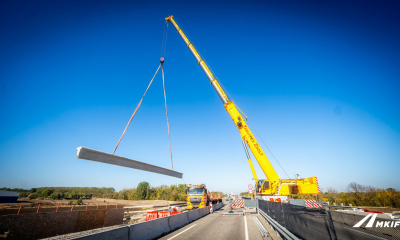







Reconstruction of the M1 motorway’s carriageway towards Győr can begin under the new traffic arrangements

Alpine engineering techniques are also being used to protect the railway in the Danube Bend

Instead of patchwork repairs – large-scale refurbishment work is under way on the dilapidated main roads in the Transdanubia region

The expansion joints on the Buda side of the Erzsébet Bridge were installed overnight

Four new bridges to be built in the heart of the former industrial city

Rain gardens are coming to Budafok, with over 3,000 square metres of green space set to be developed

Contemporary art deco in Csopakon

Safer driving on the motorways: new digital signs for the MKIF
-

 Current at 2026. 09. 09.
A first-hand look at a career in engineering – Duna Group Szabadegyetem is back
-
Climate-X 2026. 09. 09.
Nyíregyháza Spartacus FC goes green – four hundred solar panels to be installed on the stadium roof
-
Bound track 2026. 09. 15.
Nearly 50,000 people travel on it every day – the refurbishment of the Cegléd main line continues
-
Current at 2026. 09. 09.
Rental flats, Rákosrendező, decentralisation – important ideas were put forward on the Real Estate Beach Conference stage