Engineer of the month
„This is why it's worth doing!” – we asked the Engineer of the Month about the latest section of the M4 motorway.

There were no engineers in his family, yet road construction became the life of January's Engineer of the Month. Miklós Nicoara most recently made his mark on the Törökszentmiklós-Kisújszállás expressway section, which was completed ahead of schedule in December last year. rel="noopener">the Törökszentmiklós-Kisújszállás expressway section, which was completed ahead of schedule last December. We spoke with the project manager of the M4 motorway, Duna Group, at the group's project office in Szolnok.

Fewer machines, less technology, invaluable experience
„There was no engineering background in our family, so my interest in physics and mathematics led me towards a technical career. It was only during my college years that I finally decided to pursue a career in public roads,” said the expert. He graduated from Széchenyi István College in 1993 with a degree in transport engineering, and a year later he also obtained a degree in structural engineering. „There were several directions I could have taken at college, but it was road construction that really grabbed me. It has tangible, immediate results,” he said.
He began his career in 1994 in Békéscsaba, at Hódút Útépítő Kft., after moving to Gyula due to his marriage. In the early years, he learned the basics of the profession: his tasks included city roads, pavements, minor renovations and pothole repairs. „In the nineties, construction was completely different. There were fewer machines, less technology, and a lot depended on experience.”
He learned from older foremen and colleagues how to not only plan a job, but also actually carry it out. „College provides theory, but the trade can only be learned in the field.”
If a decision had to be made, it had to be made there and then.
After his years of study, his responsibilities grew rapidly: he worked as a foreman and then as a site manager, taking on increasingly complex county and national tasks. At that time, site management work had much less digital support.
„There were no mobile phones in the field, so we had to manage the tricky business of asphalt mixing and raw material delivery at weekly meetings and from telephone booths.” According to his memories, the world was a little calmer back then, but people were also more left to their own devices. „When we got stuck, we couldn't ask someone for help within a minute. If we had to make a decision, we had to make it there and then and solve the problem on the spot.”
This approach was also applied to subsequent major investments.
His first truly complex project was the reconstruction of downtown Gyula in 2006. The task went far beyond classic road construction: public spaces, parks, fountains, paving and utility replacements all appeared in the work at once. „This was urban development, not just asphalting; Gyula's old image was completely rebuilt.” During the project, it was necessary to learn how to coordinate the various disciplines, material procurement and construction in such a way that the city remained liveable. „It was then that I first felt that this profession was not only an engineering task, but also an organisational and human one.”
The cohesion of the professional core that has developed on the M44 is worth a lot.
The next step came in 2013 with the section of the M43 motorway between Makó and the national border, by then as part of the Duna Group consortium, which Hódút had joined in the meantime. It was here that he really came face to face with the enormous scale of motorway construction. „It was a completely different scale: in terms of materials, machinery and people. There was no room for improvisation here; everything had to work at a systemic level.” Logistics, material procurement, the operation of mixing plants and the continuous supply of materials required a new way of thinking: „For many of my colleagues and me, this was our first experience of this kind.”

This was followed by the M44 expressway, where he played a leading role in the construction: „I joined the team as the chief construction manager in Békéscsaba, which first worked on the Tiszakürt-Kondoros section, then on the Kondoros-Békéscsaba section, which started later than the first but was carried out in parallel.”

He emphasised that these projects had formed a professional core group that has since been able to work together effectively on the largest projects. „Teamwork is key in this kind of work. If everyone knows what they are doing, problems can be dealt with much better and faster.”
You wouldn't believe what a matrix county road renovations form.
The M44 project was followed by a period of road renovations that were much smaller in scale but no less significant in terms of experience. „We typically worked in the counties of Békés, Csongrád, Jász-Nagykun-Szolnok, Bács-Kiskun and Pest. There were times when we had more than 20 projects running simultaneously, and we completed as much as 70-80 kilometres of road renovation per year. This period was matrix-like in nature, as it required the simultaneous coordination of several mixing plants and numerous smaller and larger project teams.”
They worked with different cross-sections
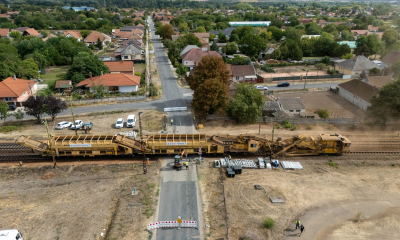
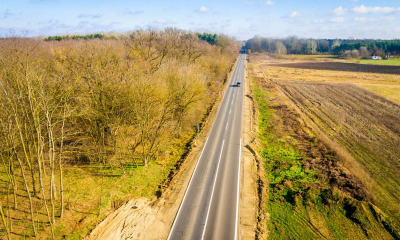
The 34-kilometre section of the M4 motorway between Törökszentmiklós and Kisújszállás marked another milestone in its history. Construction began in 2023, with a planned project duration of 36 months, and the section was finally opened to traffic in December 2025.
The previous section of the M4 motorway between Abony and Törökszentmiklós was also built by Duna Group. The project manager described the project in a podcast, saying, everything that can happen in the road construction industry happened. According to Miklós Nicoara's experience, this was no different for the section that was built continuously.

The special nature of the project was evident from the outset: the investment was a kind of hybrid project. In the case of the bypasses around Törökszentmiklós and Kisújszállás, the existing two-lane main road had to be renovated, while a new road was built alongside it. However, the middle section, approximately 20 kilometres long, was built on a completely new, greenfield route. „In addition, we worked with three different cross-sectional designs within a single project. This is rare in itself, but it also required a completely different approach in terms of organisation, technology and scheduling.”
Traffic, contractor and legal aspects had to be taken into account simultaneously.
The most complex task was to maintain continuous traffic flow on the bypass sections. „Traffic on Main Road 4 could not be stopped, so most of the work had to be carried out while traffic was flowing,” he said. In practice, this meant that part of the new road was first built up to the asphalt binder course, and then traffic was temporarily diverted onto it. The existing road was then resurfaced. Once this was complete, the new road could be finished after another diversion.

The junctions posed a particular challenge, as five or six different temporary traffic conditions had to be planned and implemented. „Temporary roundabouts, track crossings, narrowings – this was a very serious professional task in terms of traffic management.”
The diversion concepts were developed with the involvement of traffic engineers, but the implementation logic was developed by the on-site team.
„The legal framework is in place, but within that framework, we had to find a solution that would allow traffic to flow, enable us to work, and not compromise safety.”
Greenfield section: getting to the work site
Although the greenfield sites involved fewer traffic conflicts, they presented other challenges. Just to access the work area, approximately 40 kilometres of temporary transport routes were built so that machinery and materials could reach the construction sites in all weather conditions.

Logistics were further complicated by the Nagykunsági main canal, which cut the route in two. „There was no way to cross it, so the transport routes had to be reconnected to main road 4. Of course, this required a series of consultations with water authorities, local governments and road operators.”
A forward-looking solution was applied to the track structure.
One of the most significant technical innovations of the M4 project was the road structure used. Unlike previous practice, a more flexible road structure was used instead of a cement-bound concrete base (CKT). „A 20-centimetre-thick crushed stone base was built over the protective layer, and a four-layer asphalt surface thicker than usual was laid on top of it,” he explained. This meant an average of nine centimetres more asphalt than previous solutions.

Implementing the technology was a learning process for the team as well. They built several test sections using different compaction and construction methods. „We had to find out how long it could be exposed to the weather, when the next layer could be applied, and how to achieve the right load-bearing capacity and shape.”
The aim was to create a more flexible structure that could better withstand traffic loads and reduce the risk of long-term damage. „We are confident that this solution will continue to set the standard in the future.”
He was never interested in what was on his business card.
As the scale of the projects grew, Miklós Nicoara's role shifted increasingly towards organisation and coordination. Instead of day-to-day operational decisions, he is now more involved in the overall running of the system.
Meanwhile, he continued to climb the career ladder, but this was never a central issue for him.
„I've never cared whether I'm called a foreman, site manager or project manager. I know what my job is, I have the background to do it, and I want the project to be successful!”
These two words will get you through any situation.
When we asked what motivates him in situations fraught with conflict and compromise, his answer was simple. „I enjoy doing it! There's always something new.”
He emphasised that whether it is a motorway, road renovation or the reconstruction of an inner-city roundabout, each task requires a different approach and solution. „The end result is the same, but the path to get there is always different. Just think of the M44: two sections, both in the Great Plain, only 40 kilometres apart, but with completely different characteristics, requiring a completely different approach to construction.”

The moments of handover provide the greatest confirmation for him.
„When the M44 was opened, we were able to drive at the front of the traffic, and we saw the local residents waving at us from the crossroads – it was a touching and memorable moment. These are the things that make it all worthwhile.”
Source: Link







Reconstruction of the M1 motorway’s carriageway towards Győr can begin under the new traffic arrangements

Alpine engineering techniques are also being used to protect the railway in the Danube Bend

Instead of patchwork repairs – large-scale refurbishment work is under way on the dilapidated main roads in the Transdanubia region

The expansion joints on the Buda side of the Erzsébet Bridge were installed overnight

Four new bridges to be built in the heart of the former industrial city

Rain gardens are coming to Budafok, with over 3,000 square metres of green space set to be developed

Contemporary art deco in Csopakon

Safer driving on the motorways: new digital signs for the MKIF
-

 Current at 2026. 09. 09.
A first-hand look at a career in engineering – Duna Group Szabadegyetem is back
-
Bound track 2026. 09. 15.
Nearly 50,000 people travel on it every day – the refurbishment of the Cegléd main line continues
-
Climate-X 2026. 09. 09.
Nyíregyháza Spartacus FC goes green – four hundred solar panels to be installed on the stadium roof
-
Current at 2026. 09. 09.
Rental flats, Rákosrendező, decentralisation – important ideas were put forward on the Real Estate Beach Conference stage