Industry news
The firm, which has worked on all three Oscar-winning architecture projects

When it comes to individual projects – particularly award-winning buildings – attention tends to focus primarily on the designers and contractors. The engineering consultants and project managers, who carry out a wide range of tasks behind the scenes, tend to receive less attention. In connection with the three award-winning projects, we spoke to Óbuda Group, we also discussed this behind-the-scenes work.

Budapest's first skyscraper, MOL Campus, designed by Foster + Partners and Finta és Társai Építész Stúdió, was built by Market Építő Zrt. and was the winner of the FIABCI Award of Excellence in both the sustainable building and office building categories. The project management of the project was carried out by CÉH Zrt. and Óbuda Group, in addition to preparing the project, setting up the design programme, tendering the designers and managing the permit process until the building permit was obtained, supported the MOL project from the beginning as sustainability consultants; participated in the development of the sustainability strategy and its implementation during design, construction and handover.

The consortium of ZÁÉV Építő Zrt. and Magyar Építő Zrt. in the framework of the Liget Project has realized the Ethnographic Museum and Visitor Centre, voted by the jury as the best public building in the world. In this development, Óbuda Group, in consortium with Főber Zrt., was responsible for project management, technical supervision and cost management.

The silver medal-winning Hungarian House of Music was also built by Magyar Építő Zrt., while the project was also carried out by Óbuda Group and Főber Zrt.

Photo by Magyarepitok.hu / Tamás Dernovics
The awards are also recognition of a new approach to real estate investment
The three projects that have been awarded the Oscar in architecture have two things in common: the participation of Óbuda Group in the implementation and the commitment of the investors to quality and sustainability, said Nándor Kovács. The strategic director of Óbuda Group told our portal,
These awards are the results and confirmation of the new approach to real estate investment in Hungary that has become visible since the 2010s.
He added that the Liget Project is a milestone in public investment and MOL Campus is a milestone in private investment for a number of reasons. Nándor Kovács recalled that the buildings of Liget Budapest were selected in a fierce international design competition, but the concept of MOL Campus was also designed by a star international architect. Like them, Óbuda Group had to fight to be part of these projects.
A new investor approach, which insists on high architectural and technical quality all the time, has once again made the Hungarian design competitions, in which Hungarian architects compete with national partners, interesting for international star architects. The quality-raising effect of this approach has spread to all segments of the industry.
The Hungarian design, engineering and construction professions have also shown what they are capable of on a global scale. The strategy director highlighted the examples of the horizontally divided glass surfaces bordering the ground floor of the Hungarian House of Music, for which in the past it would have been said that it was unlikely that glass of this size could be produced in Hungary. It turns out that it is possible. Nándor Kovács added that the MOL Campus raised the stakes even further with its double-curved glass surfaces.

The situation is similar in terms of sustainable architecture: when the design of the Museum of Ethnography and the Hungarian House of Music started in 2013, the investor Városliget Zrt. set significantly higher targets than the standards in force at the time, asking for buildings with near-zero energy requirements. Nándor Kovács said,
The Liget Project paved the way for advanced building automation and ground probe solutions, which are also reflected in the MOL Campus.
According to Óbuda Group's Strategy Director, these three projects have shown the sector that an overall improvement in standards can be achieved if investors are committed and do not sacrifice quality and forward-thinking engineering solutions at the altar of short-term savings.
The Liget Project could be made loveable
In 2013, Óbuda Group joined the preparatory work for the development of the City Park. Gábor Horváth, the director of the project management area, told our portal that the Liget Project not only included the construction of two new buildings, which won a series of awards, but also the renovation of the surrounding museums, the creation of sports fields and green spaces, and the implementation of a comprehensive programme.

Photo: magyarepitok.hu / Tamás Dernovics
Gábor Horváth pointed out that the project management faced numerous challenges during the two construction projects, which also included extraordinary technical solutions. For a project in a big city, in a downtown environment, a lot of external aspects, factors and interests have to be taken into account and coordinated alongside the daily tasks during the construction.
For example, the works could only be carried out in a limited time and space, and the accessibility and usability of the City Park had to be ensured at all times. The construction and project management were made challenging not only by the closures due to the coronavirus epidemic, when often only video calls were available to coordinate the works, but also by the fact that the City Park was one of the venues for the FINA World Swimming Championships.

Gábor Horváth said that the biggest challenge for him professionally was the cooperation with the design offices selected in international design competitions, the integration of new technical solutions and the issue of social acceptance of the project. He added that the FIABCI award, which is the Oscar of the real estate development profession, stands out among the awards won so far.
The gold and silver medals awarded by the property developers are a testament to a well thought out and carefully prepared project, to the investor's commitment to sustainability and high standards of architectural quality, and to the work done in terms of social acceptance and how to make a project likeable to the majority.
Gábor Horváth added that project management is mostly an invisible force for the outside observer.
When awards are given, the work of designers and contractors is usually highlighted, while the work of project managers and engineers involved in the implementation remains in the background, although their contribution is just as important.

The consultancy work will continue after the handover of the building
In the case of MOL Campus, which also won two firsts, Óbuda Group also carried out the sustainability advisory and certification tasks, resulting in, among others, the highest ever dual certification of BREEAM and LEED in Hungary. Barnabás Herényi, head of the sustainability team, told us that their experience of the past ten years is that projects can achieve really serious sustainability results if this system of criteria is part of the strategic planning and then follows through all project phases.

Photo: magyarepitok.hu / Tamás Dernovics
For the MOL Campus, sustainability requirements have been built into the design programme.
The Óbuda Group experts supported and verified the achievement of the sustainability objectives throughout the preparation, design and implementation of the project. They will also monitor the status of the 143 m high building.
Barnabás Herényi gave an example,
At the outset of the concept design, an ecological survey was carried out to identify areas to be protected in the vicinity of MOL Campus and a detailed strategy was drawn up for proposed ecological improvements to enhance biodiversity.
The head of the sustainability team added that if we walk around MOL Campus, we can see that most of the recommendations in the strategy have been implemented, with the multi-storey vegetation cover, the green spaces created, the insect world at home and the diversity of species.
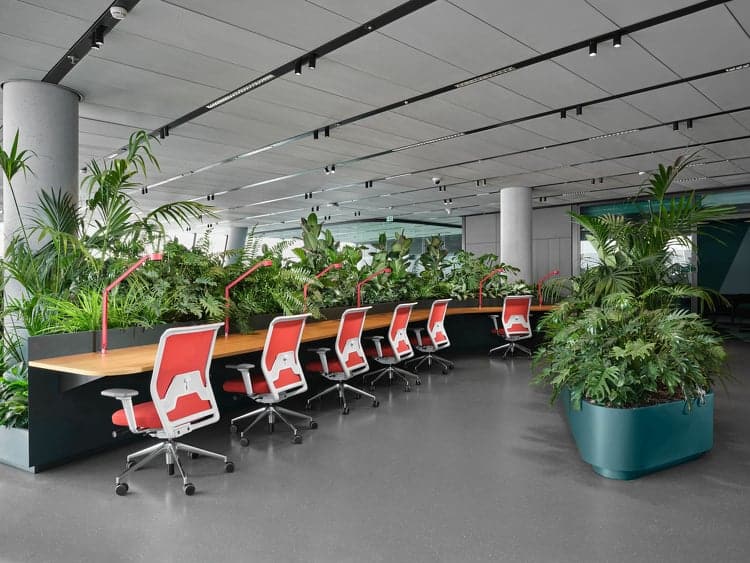
Sustainability is much more than an energy issue
In the early design phase, dynamic building energy simulations were carried out to see exactly what the annual energy consumption of the building would be under Budapest weather conditions, based on the estimated building occupancy and the building's use pattern. They then used targeted optimisation to design a ground source heat pump system to supply the cooling and heating system of the headquarters, which will cover around 40 per cent of the total heating and cooling energy demand of MOL Campus.
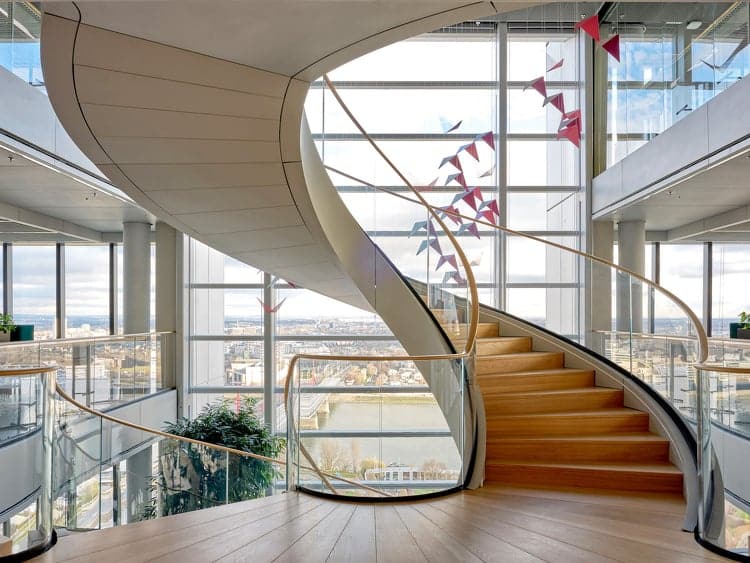
Sustainable architecture goes beyond the energetics of buildings. Indoor comfort, which includes the preservation and safeguarding of people's health and well-being in enclosed spaces, is becoming increasingly important.
We include visual, thermal and acoustic comfort, as well as accessibility and indoor air quality. These factors have become particularly important since the outbreak of the coronavirus, and building occupants are being lured back from the home office to the office by providing them. This can only be done by providing employees with a sustainable solution, even better than home, and a range of services available in-house.
Source : Link









The town centre on the banks of the Tisza is being regenerated

The Market has fulfilled its promise: it has delivered the 10,000 tonnes of natural stone offered for the raising of the bottom sill at Paks

The construction industry is both vast and marvellous – the Duna Group Szabadegyetem has been launched

ESG is now a business issue for suppliers in the construction industry too

Rain gardens are coming to Budafok, with over 3,000 square metres of green space set to be developed

Contemporary art deco in Csopakon

Four new bridges to be built in the heart of the former industrial city

Safer driving on the motorways: new digital signs for the MKIF
-

 Industry news 2026. 08. 18.
Students were introduced to the high-tech construction industry at BME’s field camp in Göd
-
Bound track 2026. 08. 17.
New pedestrian crossings and a junction with traffic lights are being built in Angyalföld
-
What is being built? 2026. 08. 18.
Hungary’s new McDonald’s restaurant has moved into a modernist listed building in the centre of Budapest
-
What is being built? 2026. 08. 18.
New paving, a playground and visitor facilities are being planned for the Várkör area in Pannonhalma