Industry news
Construction of the world's longest underwater tunnel to be completed with special solutions

The world's longest underwater tunnel, 18 kilometres long, is scheduled to be completed by 2029, linking Central Europe and Scandinavia. The Fehmarnbelt tunnel will provide fast road and rail links, significantly reducing journey times between the two European regions. The construction has reached an important milestone: the 79 tunnels, which will be built using the PERI formwork solution, a well-known formwork solution in Hungary, are now being produced on five production lines, the company said in a press release.
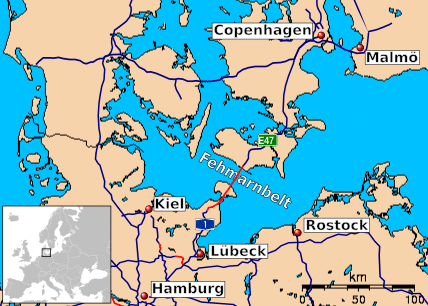
They point out that once the project is completed, it will take ten minutes by car and seven minutes by train to get from northern Germany to Denmark, and that the Fehmarnbelt Tunnel, the largest infrastructure project in northern Europe, could be completed by 2029.
Submerged tunnel system
At 18 kilometres, it is the longest submerged tunnel system in the world, consisting of five tunnel corridors with a total width of 42 metres. Two of them will be used for dual carriageway roads, the other two will be used for rail traffic, but a service and escape route will also be built. The underwater motorway and dual railway will reduce journey times by about an hour in each direction compared to the current ferry crossing.
We have developed a unique formwork for the efficient and stringent safety production of tunnels 217 metres long and weighing 73,000 tonnes. Each module consists of 9 sections 24 metres long, and a total of 79 of these units will be used to build the tunnel
- said Miklós Izsiás, CEO of PERI Magyarország.
11 thousand tonnes of formwork delivered by PERI
The more than 11,000 tonnes of formwork material were produced in PERI's factories in Germany, Poland and Italy, and transported by twelve ships and more than 275 trucks to the centre in the Danish port of Rødbyhavn, where the 79 tunnels are now being produced in three halls on five production lines. Thanks to a special formwork solution, using around 3,300 cubic metres of concrete each, several segments have already been completed. After the initial phase, the production lines will be converted to continuous series production. After production, the segments will be transported by sea to their place of immersion and sunk.
Not an ordinary project, but standard solutions will also play a role
As the brochure points out, in addition to the specific formwork system, the PERI engineering team is helping the project with several standard solutions: the PERI UP modular racking system is adaptable to the individual steel formwork and allows safe access to the production lines, while the PROKIT fall prevention grid provides reliable protection against accidents. Concrete pressure monitoring is supported by the PERI InSite Construction's measuring device and sensors, which also allow efficient testing of concrete temperature and maturity.
Finally, the company emphasises that thanks to the precise logistics concept developed by the PERI team, deadlines can be met accurately, and regular maintenance ensures that production lines can operate at maximum capacity. The announcement concludes by reminding readers that the PERI team has already contributed to the successful construction of numerous tunnels: their engineers played an important role in the construction of the recently completed Sopron tunnel in Hungary, which is part of the M85 motorway (you can read several articles about the tunnel in our newspaper here).
Source : Link








The first municipal thermal power station in Transylvania is under construction

A huge brush was driven through the Sopron tunnel on the M85 – with video

The town centre on the banks of the Tisza is being regenerated

The Market has fulfilled its promise: it has delivered the 10,000 tonnes of natural stone offered for the raising of the bottom sill at Paks

Rain gardens are coming to Budafok, with over 3,000 square metres of green space set to be developed

Contemporary art deco in Csopakon

Four new bridges to be built in the heart of the former industrial city

Safer driving on the motorways: new digital signs for the MKIF
-

 Industry news 2026. 08. 18.
Students were introduced to the high-tech construction industry at BME’s field camp in Göd
-
Bound track 2026. 08. 17.
New pedestrian crossings and a junction with traffic lights are being built in Angyalföld
-
What is being built? 2026. 08. 18.
Hungary’s new McDonald’s restaurant has moved into a modernist listed building in the centre of Budapest
-
What is being built? 2026. 08. 18.
New paving, a playground and visitor facilities are being planned for the Várkör area in Pannonhalma