What is being built?
The largest railway bridge of the Budapest-Kelebia railway line is built

The bridge with the largest span on railway line 150 will be built as part of the double-tracking and electrification of the Soroksár–Kunszentmiklós–Tass–Kelebia railway line. On the section between Dunaharaszti and Taksony, the structure built by Colas Út Zrt. will play a key role not only in international and domestic rail transport, but also in the completion of the entire line, as the materials required for railway construction – crushed stone, rails, sleepers, etc. – required for railway construction will also be transported via this route.

Ensure traffic flow during bridge construction
The two-span, single-span bridge over the Danube-Tisza canal will be built on combined spans, but with two separate structures. The reason for this is that during the construction of the bridge, construction traffic on the railway line must be maintained. The right- and left-track bridges can therefore only be built consecutively, which also means that multi-stage workspace delimitations are required on the site," said Huba Melkovics, chief engineer of Colas Út Zrt.. He also said that the structural elements, bridge abutments, piles and reinforced concrete pile girders for the separately constructed bridge decks were also being prepared in phases to match the construction schedule.

Two bridge structures are being built over the canal, one of which is already under construction
The bridge is a conventional railway structure with a symmetrical truss girder structure and a ballastless track design. The upper belt of the lattice girders is made of high-strength structural steel, while the other elements are made of plates of material thicknesses corresponding to the intended stresses, we were informed about the main characteristics of the bridge.
The self-weight of the finished bridge will be 260 tonnes, and the total weight of the ballast and rails will be about the same.
Construction started almost immediately after the Colas Út Zrt. took over the test piling site on 11 April 2023. Of the two bridge structures, the one on the right was already completed and, after the successful trial loading, was opened to construction traffic on 12 December 2023. The construction work on the left bridge deck was then started.

Bridge elements are transported to the canal at night, with intermittent road closures
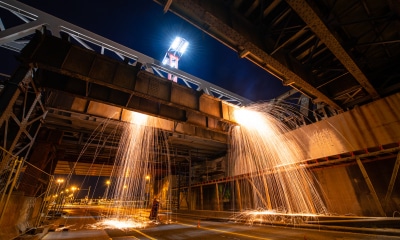
Since March, one of the most spectacular phases of the construction of the left bridge deck has been underway: the lifting and assembly of the bridge elements into place. Gábor Borbély, Colas Út Zrt. foreman, said that the transport of the assemblies to the site required a lot of organisation and attention.
The 5.8-metre wide steel structural elements, weighing 31-33 tonnes each, will be delivered to the site in oversized loads, loaded onto trucks in eight loads.

The bridge elements hang asymmetrically from the transport vehicles, 3 metres in one direction, so transport is carried out at night with intermittent road closures, under police traffic control and escort.
Mobile reversible lanes: A clever solution to reduce construction costs and time
The steel structure is fabricated and erected on site by Steel Bridges Kft. as a subcontractor of Colas Út Zrt..

The bridge elements are removed from the truck on site by a 250-tonne crane. The assemblies are erected before being lifted into position and then aligned with a rotating bench on the receiving side of the assembly area. The crane then places the bridge elements on an assembly bench that continues with a sliding platform.
The sliding track is placed on walkways supported on piles built on both banks of the canal and on reinforced concrete slabs behind the bridge piers. This will be used to move the bridge elements into position.

As the on-site manager of the steel structure assembly, he highlighted the many professional challenges of steel structure construction, including the precise implementation of the on-site alignment and pre-shifting process of the bridge elements. The auxiliary structure used for these operations was completed before the first bridge elements arrived, in less than two weeks, during the construction of the right bridge deck. The yoke blocks and the section of the slipway above the river were pulled across the cross-tracks between the tracks after the right-hand track was completed, to join the left-hand track, which is being built in the second phase. This solution significantly reduced the time and cost of the transition between the construction of the two bridge structures.

Bridge structure to be assembled in two months
The cross-section of the crossing was 13-16 metres, with the longitudinal fitting of one piece of the fittings. The four sections of the bridge will be connected by three cross-joints to reach a length of 52 metres.
The architect told us that:
The bridge will be assembled in 2 months from the delivery of the first steel structural elements.

Then the piles are placed, which ensure the proper support of the bridge deck, even in cases where the structure undergoes deformation due to loads or changes in length due to temperature.
Three of the five phases of the project are almost complete
Three of the five main phases of the work are almost complete. The construction of the right-hand track has been completed and, after a successful trial run, it has been opened to construction traffic. Then the provizorium on the left track was dismantled to allow the construction of the left track bridge to begin.

Once both bridge decks are completed, Gábor Borbély told us, the final phase of the works will involve the demolition of the yokes used for construction, the old bridge abutments and the backfill under the finished structures. This operation, like the insertion and fitting of the bridge elements, also requires great care and attention. The final phase of the project will involve the construction of the embankment wall, the paving of the embankment cones and, after other finishing works, the handover of the completed structure.

Bridge to be tested with 326 tonnes of weight in early summer
Structural test loading of the bridge is expected to take place in summer 2024. At that time, an M62 locomotive weighing 116 tonnes and three wagons loaded with 70 tonnes of crushed stone each, totalling 326 tonnes, will be placed on the bridge.
Four data are then measured simultaneously:
- the bending of the structure,
- the elongation (stress) at the typical points of the main girders of the bridge,
- the degree of displacement of the heels,
- and the extent of subsidence of the two supports (bridgeheads).
The maximum calculated deflection for this structure is 18.4 mm, or almost 2 cm.
The importance of the project
The new bridge over the Danube-Tisza canal will carry traffic from the Budapest-Belgrade (BuBe) railway line. This railway is one of the busiest between Western Europe and the Balkans. The BuBe will connect to the Salzburg - Belgrade - Thessaloniki rail corridor, which serves the southern Carpathian Basin and the northern Balkans, and will provide a direct link to Western and Northern Europe via Budapest.
Source : Link



A Hungarian specialist in railway turnouts has won the MÁV billion-forint contract

The new water treatment system at Koppánymonostor will improve the water supply to Ács and the surrounding area

Debrecen could get a southern city centre

The ground beneath the M1 motorway is being reinforced using piles of varying diameters depending on the soil layer

Hungary's biggest motorway upgrading programme is underway

Perhaps the world's most elegant McDonald's restaurant opens in Budapest

Szeged to become one of Europe's leading industrial centres with the construction of the BYD factory, the city strengthens its position with a worthy investment package

Viablokk porous concrete masonry element from a Hungarian factory, as a Hungarian product, is set to conquer the world
-

 Current at 2026. 06. 01.
The M5 motorway is in tatters – can the M6 save the day?
-
Industry news 2026. 06. 02.
The domestic construction industry could see a boost – there is potential to unlock €16.4 billion in EU funding
-
Current at 2026. 06. 01.
Project KÉSZ Csoport has refurbished six treatment rooms at Bethesda Children’s Hospital
-
Climate-X 2026. 06. 02.
Who is taking the lead in the construction industry’s green transition?