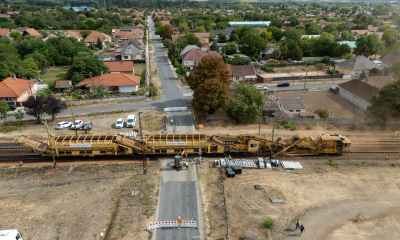
Road building
A comprehensive project for the Gyöngyös bypass

On 20 December, the Gyöngyös bypass project was inaugurated near Gyöngyös. The various parts of the overall Építési és Közlekedési Minisztérium (ÉKM) project were carried out by a consortium of HE-DO and Colas Út Építőipari Zrt..

The project included the construction of a 4.5 km bypass linking the Szurdokpüspöki-Gyöngyös link road 2406 with the main road 3.
Friday's event was also attended by Zoltán Nyul, Deputy State Secretary for ÉKM, László Horváth, Member of Parliament, and Péter Szókovács, Mayor of Gyöngyös.
The first phase involved road reconstruction, the second the construction of a new road
The Építési és Közlekedési Minisztérium project started in May 2022, Phase I involved the rehabilitation of the almost 3 km bypass section starting at the 2406 Gorge Bypass, which was built 15 years ago in an abandoned project. In addition to resurfacing, the superstructure of the structure above the Tarján stream has also been rebuilt.
As we mentioned in our latest report (https://magyarepitok.hu/utepites/2024/10/a-befejezo-munkak-zajlanak-a-gyongyosi-elkerulon-fotok), the road renovation work carried out during phase I posed a particular challenge in terms of implementation. rel="noopener">our latest report, a particular challenge during construction was that, during the first phase of road renovation, it became apparent that the previously constructed road did not have sufficient load-bearing capacity, so after redesigning it, the entire road was demolished and rebuilt from the ground up.

As a continuation of the investment, the Phase II of the two-lane Western bypass of Pearl was built up to the main road 3, for a length of about 1.5 km - this section was realized as a new road.
Also part of the project was the development of the Gyöngyös inner area, which was completed in an earlier phase last year. In addition to the resurfacing of several streets, this included the reconstruction of an intersection, the creation of parking and turning lanes in several places, a new roundabout junction and a bus bay. In addition, on the 2406 road (Gyöngyös, Vachott Sándor utca), the entire superstructure of the bridge over the Nagy stream was replaced.
Two new bridges and three roundabouts
A total of three roundabouts have been built on the 1.5-kilometre new section of the 1.5-kilometre road built in Phase II of the project. The first one is at the junction of the junction of the main road 3, the road 3203 and the bypass. The controlled-passage turbo roundabout junction on the trunk road 3 will make traffic flow on the road more dynamic and safer. In addition, the pavement has been reinforced and widened, and an axle weight measurement facility has been installed.

The second roundabout was built at the junction of the Southern Border Road and the 3203 road, and the third on the bypass, whose southern and northern branches provide links to the outlying development areas.
Two stream bridges were built in the new Phase II project: one with a 12-metre span over the Tarján stream and one with a 15-metre span over the Gyöngyös stream.
Earth roads have also been built in the reservoir area
The project also renewed the Great Creek Bridge on Highway 3, which also included insulation and pavement replacement. In addition to the repair of the superstructure, new kerbs were built.

Two crossing dirt roads were also constructed at the southern part of the Gyöngyös-Rédei reservoir for 182 metres and two parallel dirt roads for 325 metres to access the properties.
Reduced traffic and noise pollution
At Friday's inauguration event, Zoltán Nyul, Deputy State Secretary for ÉKM, recalled that the first phase of the bypass was completed 15 years ago, but the second phase and related improvements have now made it possible to put it into actual use. He stressed that, at last, the bypass had made the city more liveable by reducing traffic and noise pollution.
László Horváth, Member of Parliament for the region, recalled that the first 3 kilometres were opened in the early 2000s. However, during the construction of the new section, it was discovered that the foundation of the previously completed section was missing. "The road, which was 60 centimetres thick according to the specifications, was therefore barely 6 centimetres thick in places," he said. "I thank the government for providing some 10 billion forints over the past three years to improve the road network in Gyöngyös and for paying the price of the nearly 3 billion forints of neglect 15 years ago," he added.
Source : Link










One of Abony’s most important transport routes is to be redesigned

This is how flash floods on the vineyard-covered hills in the Pécs conurbation are being prevented

Order has been restored: production of the new Közlekedési Múzeum can now go ahead as originally planned

We took a look at how the refurbished Igazságügyi palota building turned out

Four new bridges to be built in the heart of the former industrial city

Rain gardens are coming to Budafok, with over 3,000 square metres of green space set to be developed

Contemporary art deco in Csopakon

Safer driving on the motorways: new digital signs for the MKIF
-

 Current at 2026. 09. 09.
A first-hand look at a career in engineering – Duna Group Szabadegyetem is back
-
Climate-X 2026. 09. 09.
Nyíregyháza Spartacus FC goes green – four hundred solar panels to be installed on the stadium roof
-
Bound track 2026. 09. 15.
Nearly 50,000 people travel on it every day – the refurbishment of the Cegléd main line continues
-
Current at 2026. 09. 09.
Rental flats, Rákosrendező, decentralisation – important ideas were put forward on the Real Estate Beach Conference stage