Road building
Capacity expansion on Highway 48 - We show you where the works are!

At the beginning of the summer, construction work began on behalf of Építési és Közlekedési Minisztérium on Colas Út Építőipari Zrt. in the eastern part of Debrecen, at one of the busiest intersections. The aim of the complex development of the junction is to increase the capacity of the 48 main road and thus reduce congestion in the area, especially during the morning and afternoon rush hours.

At one of the busiest intersections of the city, the main road No 48 (Vámospércsi út), Antal Nagy Buda, Hétvezér and Faraktár streets meet. Smooth traffic flow would be facilitated by the construction of right-turn lanes from all directions.
Part of the project is to create safe traffic conditions for the intense cyclist traffic in the area.

Modern transport corridor between the city centre and industrial zones
The complex junction rebuild, as the Colas site manager told us, is indirectly linked to the huge investments in the east and south of the city. Imre Ádám Kiss added that access to BMW and the CATL factory will also be easier and safer with the modernisation and capacity expansion of the intersection.
The intersection affected by the intervention will be crossed by, among others, the traffic of the main road 48, a key corridor as it connects the city centre with the industrial zones.

Turn lanes, new traffic management system to help road users
Colas will build a separate right-turn lane from each direction at the junction of Faraktár Street - Antal Budai Nagy Street - Vámospércsi Road - Hétvezér Street, including the necessary utilities. This will reduce congestion in the straight through lanes. The existing traffic management system will be rebuilt and additional traffic lights will be installed to support the continuous flow of traffic. During peak periods, the throughput of the intersection could be significantly increased.

The investment also includes the modernisation of utilities
The Colas Út Építőipari Zrt. construction manager said that the whole project will be implemented in two main phases. According to the construction schedule, the upgrading of the utility network and related road works will be carried out in three main phases before the start of winter operations this year. The project will involve the construction of 102 metres of hydrocarbon pipelines, 4,250 metres of low and medium voltage lines, 188 metres of sewage lines, 273 metres of storm water drains and 1,958 metres of drinking water lines.

The biggest challenge of the project so far, Imre Ádám Kiss told our portal, was the extremely dense utility network.
In the first phase of the project, the excavation and replacement of pipelines was carried out under the supervision of the utilities
expert. A complicating factor was that the true condition of the utilities
was only known during the excavation. This required flexibility, prompt technical decisions and a lot of on-site consultation. Based on the state of completion, it is expected that only one section will need to be replaced in spring 2026, after which the road works will take priority.

When scheduling the works, the needs of the population, institutions and local communities were taken into account, and the construction schedules were modified in several phases.
Building demolition was also needed to build the new turn lane
A total of 994 metres of existing road will be resurfaced:
- on the main road No 48 (Vámospércsi út) 607,39,
- in Hétvezér street 137,74,
- in Antal Buda street 76,13,
- on Ruyter Street 19,95,
- in Senczi Molnár Albert street 116,37,
- and 37.09 metres in Kolónia Street.

In total, the new lanes will be around 176 metres long. The necessary space will be provided for these roads, and in the junction area of Hétvezér Street and Vámospércsi Street, the demolition of buildings has been carried out to free up space.
The works are taking place in a busy, working urban environment. The phased, scheduled construction phases will ensure the continuity of traffic. For each of these, traffic management plans will be prepared in cooperation with the municipality and Magyar Közút Nonprofit Zrt..

Zsuzsi will also walk differently
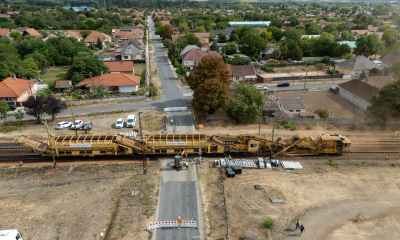
The capacity expansion of the Vámospércsi road is a major challenge in itself. What makes the project even more special is that the Zsuzsi Forest Railway runs parallel to the main road. Originally designed for industrial use, the railway was opened in July 1882 between Debrecen-Fatelep-Nyírmártonfalva. Its unique feature was that it was built with a 950 mm gauge and only converted to 760 mm in 1961. In 1995, the line was closed down due to lack of funds and the city of Debrecen decided to close it down. However, the Friends of the Zsuzsi Forest Little Railway and Foundation was established, which has been operating the railway as a non-profit subsidiary of DKV since 2008. With the development and widening of the roads, it became inevitable to correct the track of the railway.

The reconstruction will modernise the railway line
The latter task requires several specific technological solutions. The correction of the track is achieved by curved and straight sections, moving away from the existing track and then reconnecting it. The superstructure will also be upgraded and the wooden girders replaced with reinforced concrete, thus providing the track with greater structural rigidity. The new section will be built with S49 rails and will be AT-welded to the existing rail system.

To increase stability, the curved sections are also widened. As part of the construction, a special road crossing will be built with twin-slab reinforced concrete sleepers and a guard-rail system to improve road-rail safety.

Traffic lights are controlled on real-time basis
A modern traffic light system will be installed on the road section to speed up the passage of traffic. This will provide a green wave between junctions, which will significantly improve throughput, reduce congestion and increase throughput, especially at peak times.

The dynamic control of the traffic lights takes into account the announcements of vehicles, pedestrians and the railway (e.g. Zsuzsi Forest Railway), so it can adapt flexibly to traffic situations. With the help of traffic surveillance cameras, radar sensors and countdown devices, the system works on the basis of real-time data.
The complex development of the busy junction, including the upgrading of utility systems, is scheduled for completion in autumn 2026.
Source : Link







Reconstruction of the M1 motorway’s carriageway towards Győr can begin under the new traffic arrangements

Alpine engineering techniques are also being used to protect the railway in the Danube Bend

Instead of patchwork repairs – large-scale refurbishment work is under way on the dilapidated main roads in the Transdanubia region

The expansion joints on the Buda side of the Erzsébet Bridge were installed overnight

Four new bridges to be built in the heart of the former industrial city

Rain gardens are coming to Budafok, with over 3,000 square metres of green space set to be developed

Contemporary art deco in Csopakon

Safer driving on the motorways: new digital signs for the MKIF
-

 Current at 2026. 09. 09.
A first-hand look at a career in engineering – Duna Group Szabadegyetem is back
-
Bound track 2026. 09. 15.
Nearly 50,000 people travel on it every day – the refurbishment of the Cegléd main line continues
-
Climate-X 2026. 09. 09.
Nyíregyháza Spartacus FC goes green – four hundred solar panels to be installed on the stadium roof
-
Current at 2026. 09. 09.
Rental flats, Rákosrendező, decentralisation – important ideas were put forward on the Real Estate Beach Conference stage