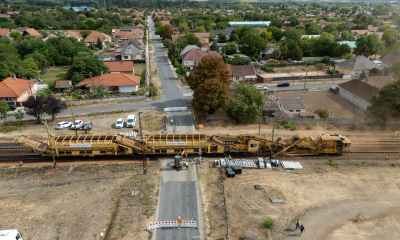
What is being built?
After three decades, the Várpalota sewage treatment plant has switched to new technology

The development of one of Várpalota’s key urban infrastructure projects has been completed by a consortium led by STRABAG Vízépítő Kft.. As part of the investment, worth nearly 6.3 billion forints, the town’s wastewater treatment and drainage system has been modernised.

Preparatory design and planning work for the project began in 2023, and construction on site commenced in the spring of 2024.
The aim of the project, which was implemented with funding from the KEHOP PLUSZ programme, was to ensure that the plant could continue to operate reliably over the coming decades and comply with environmental regulations.

They have installed more modern technology with increased capacity
The project covered three main areas: the No. 1 municipal sewage pumping station and the associated pressure pipeline system were refurbished; the sewage treatment plant, which was built over three decades ago, was modernised; and new, environmentally friendly sewage treatment technology was installed. The investment also involved an expansion of capacity, resulting in the commissioning of technology with a hydraulic capacity of 3,500 cubic metres per day and a biological capacity of 25,000 population equivalents.

A multi-stage cleaning process has been developed
As a result of the modernisation, the treatment of wastewater arriving at the plant now begins with a multi-stage pre-treatment process. Mechanical treatment is now carried out by a new stone trap, a new screen house and a mechanically operated step screen. Experts have also refurbished the sand and grease traps.
The project also included a comprehensive refurbishment of the sewage lift station; following mechanical pre-treatment, the wastewater enters the biological treatment stage. During this process, phase separation is achieved through sedimentation.
The treated water also passes through a newly installed post-filter, which further reduces the suspended solids content. The water then flows through the disinfection tank into the receiving body. As part of the process line, sludge treatment has also been upgraded: the sludge generated during the process is fed into thickening tanks and then dewatered using state-of-the-art centrifuges.

They worked at the site without interrupting operations
One key feature of the project was that the work had to be carried out whilst the wastewater treatment plant remained in continuous operation. During the project, new buildings and structures were constructed, and the existing facilities were modernised in terms of architecture, mechanical engineering and electrical systems. As part of the development, two biological treatment units were also constructed, each capable of handling 3,800 cubic metres of wastewater.

More than just a major technical development; an investment in the city’s future
The facility, which has been modernised with funding from the EU and the Hungarian government, was officially handed over. At the event, the Mayor of Várpalota, Márta Campanari-Talabér, thanked the staff of STRABAG Vízépítő Kft., who carried out the construction work, as well as the experts from Bakonykarszt Zrt., who are responsible for operations, for their dedicated and high-quality work.

Following a brief overview of the technical aspects of the project, the mayor emphasised that the treated water can be returned to the natural environment to a standard that meets modern requirements, thereby contributing to the protection of our environment and sustainable operation. He added:
„Today marks not only the completion of an investment project, but also the start of a new era for the city’s infrastructure. A major technical upgrade has been completed, laying the foundations for a cleaner, safer and more sustainable future.”

Source: Link








One of Abony’s most important transport routes is to be redesigned

This is how flash floods on the vineyard-covered hills in the Pécs conurbation are being prevented

Order has been restored: production of the new Közlekedési Múzeum can now go ahead as originally planned

We took a look at how the refurbished Igazságügyi palota building turned out

Four new bridges to be built in the heart of the former industrial city

Rain gardens are coming to Budafok, with over 3,000 square metres of green space set to be developed

Contemporary art deco in Csopakon

Safer driving on the motorways: new digital signs for the MKIF
-

 Current at 2026. 09. 09.
A first-hand look at a career in engineering – Duna Group Szabadegyetem is back
-
Climate-X 2026. 09. 09.
Nyíregyháza Spartacus FC goes green – four hundred solar panels to be installed on the stadium roof
-
Bound track 2026. 09. 15.
Nearly 50,000 people travel on it every day – the refurbishment of the Cegléd main line continues
-
Current at 2026. 09. 09.
Rental flats, Rákosrendező, decentralisation – important ideas were put forward on the Real Estate Beach Conference stage