Road building
Nagykanizsa is rebuilding one of its busiest junctions

The long-awaited element of the development of Nagykanizsa's transport infrastructure is the upgrading of the intersection of Hevesi Sándor Street (connecting road No. 6101) and Rózsa Street. The project will include the construction of a roundabout with prefabricated elements and the rehabilitation of the pavement.

One project, two builders
A special feature of the project is that the public spaces involved in the development are partly state-owned and partly municipally-owned. For this reason, Nagykanizsa County Municipality and Magyar Közút Nonprofit Zrt. are jointly listed as the developer in the building permit.
The two parties have concluded a Consortium Cooperation Agreement to implement the reconstruction and modernisation of the municipal and state road sections simultaneously.
The financing is entirely provided by the municipality, while Magyar Közút is responsible for the technical specifications and quality standards for the national road and for the professional supervision of the construction.
Prefabricated elements reduce construction time
The works affect both municipal and state-managed areas. The outer diameter of the new roundabout at the junction of Hevesi and Rózsa streets is 12.75 metres, the width of the roundabout varies between 6.0 and 7.5 metres, and the width of the traffic ring is 2.5 metres. The central island is made of prefabricated elements and has an external radius of 3.5 metres. It is not exactly in the centre, but offset 75 cm to the south-east. The islands, kerbs and pedestrian crossings for the roundabout will be designed in accordance with current standards.

Various technologies are used to renew road sections
The slope of the junction has been designed to ensure drainage: the roundabout slopes from the east side of Rose Street to the west with the existing 2.5% slope, and the height of the roadway structure is minimally different from the current design.
Several asphalt resurfacing technologies are used in the construction process:
- Milling + new wearing and bonding course construction - 45 mm wearing course after milling, 55 mm asphalt concrete wearing course and 25-60 mm bonding course.
- No-marking carpeting - a new wearing and bonding layer is laid over the existing pavement.
- Replacement of the wearing course only - the old course is removed at a thickness of 0-55 mm and a layer of similar thickness is formed.
In all technology versions, bitumen modified with PmB 45/80-65 polymer and bitumen emulsion C 60 B 3 RG ensure the durability of the pavement.
Road safety project tailored to the traffic in Nagykanizsa and through traffic
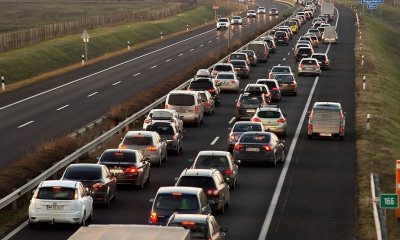
The investment will increase traffic flow and safety. The implementation is expected to take 2.5 months. This was reported by the mayor on his social media page. Jácint Horváth also mentioned that they had signed the contract with Magyar Aszfalt Kft., which had won the public procurement procedure.
Source : Link



A Hungarian specialist in railway turnouts has won the MÁV billion-forint contract

The new water treatment system at Koppánymonostor will improve the water supply to Ács and the surrounding area

Debrecen could get a southern city centre

The ground beneath the M1 motorway is being reinforced using piles of varying diameters depending on the soil layer

Hungary's biggest motorway upgrading programme is underway

Perhaps the world's most elegant McDonald's restaurant opens in Budapest

Szeged to become one of Europe's leading industrial centres with the construction of the BYD factory, the city strengthens its position with a worthy investment package

Viablokk porous concrete masonry element from a Hungarian factory, as a Hungarian product, is set to conquer the world
-

 Current at 2026. 06. 01.
The M5 motorway is in tatters – can the M6 save the day?
-
Industry news 2026. 06. 02.
The domestic construction industry could see a boost – there is potential to unlock €16.4 billion in EU funding
-
Current at 2026. 06. 01.
Project KÉSZ Csoport has refurbished six treatment rooms at Bethesda Children’s Hospital
-
Climate-X 2026. 06. 02.
Who is taking the lead in the construction industry’s green transition?