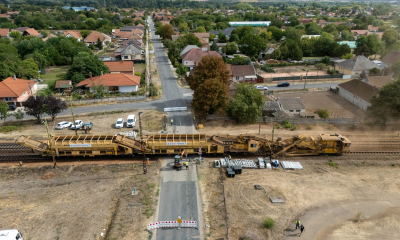
Road building
The gateway to the Diplomatic Quarter and a narrow street that preserves the memory of a 19th-century dispute could also be renovated

The public space regeneration programme in Terézváros continues: the HE-DO and Penta are now working on Lövölde Square and Révay Street.
The renovation of public spaces in Terézváros has resulted in some fascinating examples of urban architecture and history.

From a noisy nightclub to a playground
Lövölde Square lies on the border between Terézváros and Erzsébetváros, where, beneath the huge plane trees, memories of pre-war Pest coexist with the hustle and bustle of the modern city centre. Its name is not a figment of the imagination: there really was a shooting range here – and, what’s more, the largest in the city:
In 1840, to replace the former shooting range that had been destroyed by flooding, the monumental, Classicist-style Lövölde was built here to a design by András Zambelli; it was inaugurated by Palatine József himself.
A huge social and entertainment centre was built here, featuring a shooting gallery with 22 shooting stations, restaurants, a beer hall, as well as smoking and card rooms. Its fate was sealed by the town’s development: the noisy entertainment venue simply no longer fitted in amongst the luxury apartment blocks and villas, so in 1890 the Lövölde building was demolished. In its place, the square as we know it today was created, which was expanded to include a playground in 1982; its renovation will take three months and cost 163 million forints for the staff of Penta Általános Építőipari Kft..
The contractors are required to carry out small-scale regeneration of green spaces and a review of the traffic control systems at the traffic-light-controlled junction on Szív Street. The works include the laying of new road and pavement surfacing, the creation of green spaces, the reconstruction of associated kerbs, the improvement of rainwater drainage, the installation of street furniture, and the construction of a new pedestrian crossing on Szív Street. Another task is the creation of a new micro-mobility hub on the even-numbered side of Szív Street.

Sticks out from the crowd
When, in the mid-19th century – particularly during the planning of Sugár út (now Andrássy út) and St Stephen’s Basilica – work began on establishing the area’s orthogonal street layout, the Marczibányi family’s vast plot simply „got in the way” of the development plans. Although the city authorities urged the owners to comply, the Marczibányis began to subdivide the valuable city-centre plot themselves and sell it off for the construction of tenement blocks.
They simply followed the existing, sloping plot boundaries, thereby confirming the plot boundaries established in the early 1800s.
The HE-DO Építő Zrt. project will now carry out the refurbishment of Révay köz and the section of Káldy Gyula utca running perpendicular to it, between Andrássy út and Révay utca, over the next six months, at a cost of approximately 285 million forints. The works include the removal of the existing road surface, the laying of new road, car park and pavement surfacing, the reconstruction of the associated kerbs, the reorganisation of the stormwater drainage system in line with a new design concept, and the creation of new green spaces.
Source: Link








One of Abony’s most important transport routes is to be redesigned

This is how flash floods on the vineyard-covered hills in the Pécs conurbation are being prevented

Order has been restored: production of the new Közlekedési Múzeum can now go ahead as originally planned

We took a look at how the refurbished Igazságügyi palota building turned out

Four new bridges to be built in the heart of the former industrial city

Rain gardens are coming to Budafok, with over 3,000 square metres of green space set to be developed

Contemporary art deco in Csopakon

Safer driving on the motorways: new digital signs for the MKIF
-

 Current at 2026. 09. 09.
A first-hand look at a career in engineering – Duna Group Szabadegyetem is back
-
Climate-X 2026. 09. 09.
Nyíregyháza Spartacus FC goes green – four hundred solar panels to be installed on the stadium roof
-
Bound track 2026. 09. 15.
Nearly 50,000 people travel on it every day – the refurbishment of the Cegléd main line continues
-
Current at 2026. 09. 09.
Rental flats, Rákosrendező, decentralisation – important ideas were put forward on the Real Estate Beach Conference stage