What is being built?
Introducing the redevelopment of the Hungarian MotoGP track - Soon the world's best motorcycle racers will be racing on the Balaton circuit

From Indonesia to Japan, hundreds of millions of fans of high-speed motorsport around the world will be trying to pronounce the name of Balatonfőkajár, a village of just under 1300 people hidden on the shores of Lake Balaton. After nearly three decades, the Superbike World Championship field will visit the Balaton Park Circuit on 25-27 July, while the MotoGP, Moto2 and Moto3 categories, the pinnacle of the World Championship series, will visit the Balaton Park Circuit on the weekend of 22-24 August.

MotoGP may be particularly dear to Hungarian sports fans, as we were able to celebrate the world championship title of Gábor Talmácsi in the 125cc category in 2007.
The most striking difference between the two races is that the Superbike races are contested by modified (tuned) versions of street sports bikes, i.e. machines that are mass-produced and available for purchase. Whereas in MotoGP, riders often race well over 300km/h in the saddle of prototypes developed specifically for racing.

The reconstruction of the track started last autumn
The construction industry plays a key role in the preparations for these two prestigious international sporting events. The track, which was completed in spring 2023 and constructed by Colas Út Zrt., had to be upgraded to fully comply with the regulations of the International Motorcycling Federation (FIM). The work, which began last autumn, affected the entire length of the track, with the exception of the home straight. Among other things:
- tripled the number of pitfalls,
- new drains,
- supporting and soundproofing walls,
- a new service road network was built,
- and trail additions at three bends
have been implemented by Colas Út Zrt. experts.

Photo: magyarepitok.hu / Mihály Erdei
Aiming for the highest FIM track licence
The Balaton Park Circuit was built to the standards required for Formula 1 racing, but was initially only aimed at obtaining a Grade 2 licence from the International Automobile Federation (FIA), allowing it to host any domestic and international motor racing event except Formula 1.
The extensive works are a prerequisite for the Balaton Park Circuit to obtain, this time from the International Motorcycling Federation (FIM), the highest FIM Grade A certification required to host Moto GP and Superbike World Championship races.

The two tracks of the circuit will be used for both car and motorcycle racing
Regarding the modification, the Balaton Park Circuit informed our portal that they have kept the original 4115 meters long track with 10 left and 6 right turns. Adrienn Walterné Dancsó, the operational director of the circuit, explained that the aim of the interventions was to maximise safety. With the rebuild, riders will cover a distance of 4,075 metres per lap during the motorcycle races, with ten left and seven right turns.

Preparing to welcome the kings of motorsport
Since its inauguration in 2023, the circuit has hosted Hungarian and regional championship races, as well as brand competitions (e.g. Ferrari Challenge), brand and club events and tests. Discussions on the necessary renovations to host the World Superbike and MotoGP World Championship races started in spring 2024. Plans and simulations were then drawn up in cooperation between the Balaton Park Circuit, the International Motorcycling Federation (FIM), the Hungarian Motorsport Association and the Hungarian Mobility Development Agency (HUMDA), which organises the MotoGP and Superbike races. Events then accelerated, and in September 2024 it became official that from next year, for at least three years, the Hungarian MotoGP and World Superbike races will be held at the Balaton Park Circuit. The following month, after the last event on the track, the contractors took over.

Focus on safety in the redesign
MotoGP riders often exceed speeds of 300-350 km/h, so the rollover areas around the track, which are key in case of a slide or fall, had to be significantly increased. This meant moving the guardrail and fencing system on several sections, and where there was insufficient space, the track was extended.
At turn 7, the curve was narrowed to increase the
slip space behind it. In the curved, long left-hand bend of 11, they
built a decelerator to force riders to reduce their speed. The corner combination before the finish line has been simplified and rebuilt to a narrower curve.
Fifty thousand square metres of space added
We are working on the entire length of the track, except for the final stretch - told our portal Balázs Nemeth. The construction manager of Colas Út Zrt. added,
The gravel beds and bays were tripled in size, with a total of 50 000 square metres of gravel, using around 15 000 cubic metres of gravel with a grain size of 8-16 mm. An important aspect of the gravel bed is that it should have the right thickness and slope to slow down the rider and his machine as they drift off the track. The precise design of the slope is intended to ensure that the gravel bed does not throw the rider or the bike back onto the track.
The increase in the drop zone and the track extension also affected the safety systems on the track. The three-tiered tape barrier and component containment fence system, which forms the first line of defence, were relocated. This structure also includes the Tecpro modularly buildable safety barrier. The modular shield, made of polyethylene elements, absorbs and dissipates impact energy.
Balázs Németh said that efficient drainage is important not only for the track but also for the pitch.
Seven thousand five hundred metres of infiltration system were constructed and the old one was connected to the new stormwater network. The project also included the construction of about 1,200 sq m of retaining walls made of formwork, a 430 m long five-metre high noise barrier and the reconstruction of the service road network.

Photo: magyarepitok.hu / Mihály Erdei
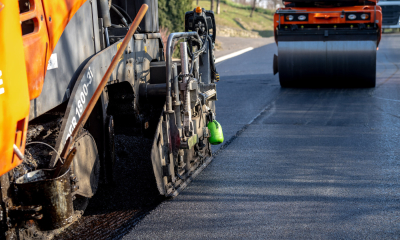
Asphalt, made of special ingredients, forms the wearing course of the track
The most interesting tasks awaited the contractors during the trail extension. At turn 11, they had to fill an existing pond with 8,500 square metres. Balázs Németh also explained that the bends were rebuilt by demolishing the old track and then constructing it with the same layers as the original track.
The old track also received a new wearing course at the intervention points. The main professional challenge was the construction of a wave-free asphalt layer at the joints. We also learned that
The final layer of the race track is built with an asphalt mix using a special bitumen and aggregate. The operation was carried out with special level control and three machine chains.
The renewal of the network of service roads, the asphalt aprons and the wearing course of the track required the application of nearly 13 000 tonnes of asphalt.

The finishing touches
In the final stages of construction, in the last few weeks, the technicians have been installing the low-voltage systems and the led panels. After the final construction of the stairwells and the shaking stones, the painting work was completed.
Adrienn Walterné Dancsó, the Balaton Park Circuit's Operations Director, said that the contractors were ahead of schedule and produced high quality work.
Photo by BPC / Kornél Simon
The modification of the track is regularly monitored by Bartolome Alfonso Ezpeleta, FIM Safety Officer. In the international press, Mr Ezpeleta has expressed his satisfaction with the redesign of the Balaton Park Circuit. He said he was confident that the circuit would receive its FIM Grade A licence.
Source : Link










One of Abony’s most important transport routes is to be redesigned

This is how flash floods on the vineyard-covered hills in the Pécs conurbation are being prevented

Order has been restored: production of the new Közlekedési Múzeum can now go ahead as originally planned

We took a look at how the refurbished Igazságügyi palota building turned out

Four new bridges to be built in the heart of the former industrial city

Rain gardens are coming to Budafok, with over 3,000 square metres of green space set to be developed

Contemporary art deco in Csopakon

Safer driving on the motorways: new digital signs for the MKIF
-

 Current at 2026. 09. 09.
A first-hand look at a career in engineering – Duna Group Szabadegyetem is back
-
Climate-X 2026. 09. 09.
Nyíregyháza Spartacus FC goes green – four hundred solar panels to be installed on the stadium roof
-
Bound track 2026. 09. 15.
Nearly 50,000 people travel on it every day – the refurbishment of the Cegléd main line continues
-
Current at 2026. 09. 09.
Rental flats, Rákosrendező, decentralisation – important ideas were put forward on the Real Estate Beach Conference stage