Road building
Hybrid structure, parametric modelling – this is how a virtuoso bridge is born

The low arch height of the main girders of the pedestrian and cycle bridge spanning the M7 motorway and its geometry spanning the entire carriageway not only ensure high structural strength, but also demonstrate the technical development of the renovated M7 motorway. The crossing, built according to the plans of MKIF Magyar Koncessziós Infrastruktúra Fejlesztő Zrt. and Főmterv Mérnöki Tervező Zrt. investment, we learned about the most exciting details of the crossing from the words of Ádám Balogh, the responsible designer.

Both impressive and necessary
A new pedestrian and cycle bridge may be built at the Velence rest area in connection with the widening of the M7 motorway. The project has been brought forward by several years compared to other developments due to the poor technical condition of the current bridge. During the widening, two sets of three lanes will be built on the bridged motorway with a so-called ITS hard shoulder. In addition, there will be exit and acceleration lanes at the Velence rest area, so the new bridge will actually have to span two sets of five lanes.
„When we got this job, we started with a study plan where we selected the type of structure. We had to bridge a total of 79 metres here, which was made even more difficult by the topography of the Velence Mountains.”
– summarised Ádám Balogh, outlining the fundamental difficulties of the task.
It was fortunate that, within the constraints, the Főmterv team was given free rein in the design by the client, MKIF. „There was a demand for a more elegant structure, and it was important that we did not have to place any pillars in the intermediate band,” pointed out the designer.
„One solution that came up," he said, "was to support the bridge next to the crown, at a span of about 45 metres; however, this would have resulted in very short openings at the ends, which would have been extremely unfavourable from a structural point of view.
This is how the slimmer design came about, which may also increase its tourist appeal as part of the Budapest-Balaton cycle route.”

A hybrid bridge is born
The bridge was moved approximately 25 metres south of its existing location in order to maintain traffic on the old bridge for as long as possible.
„We were pleased to realise that an arch bridge structure would work well in this cut, but we tilted it because the entire terrain slopes towards Lake Velence. We then played on this with the asymmetrical geometry of the main arch.”
Ádám Balogh recalled the development of the concept. The characteristics of three types of bridges are combined in this unique structure, as it is anchored at the bridgehead on the Lake Velence side, creating a partially tensioned structure. Statically, the bridge is a hybrid of arch bridges and beam bridges.

Without parametric design and BIM, it would not have been possible.
The form was therefore shaped by many constraints, particularly the teardrop-shaped openings in the main girder's spine. In terms of statics, designing the bridge was a very complex task, which might not have been possible using traditional methods. The work of the Főmterv engineering team has now received international professional recognition, as their design won two awards Tekla BIM Awards 2025 competition.
„We examined the static properties using a global shell model, which resulted in many unique details. One example is the junction where the arch intersects the stiffening girder, but the junction where the arch is supported or the rear connection junction are also unique solutions.”
The design engineer listed the details that required special attention. „A separate issue,” he recalled, "was the reinforcement of the driven piles located at the Venice bridgehead and how to transfer the tensile force there."
They presented contemporary solutions.
The dynamic behaviour of the bridge is exciting, and has already been examined in the study plan by the engineers of Főmterv.
A characteristic feature of slender, lightweight bridge structures is that auxiliary structures are often required to ensure favourable dynamic behaviour. This bridge was no exception – in order to ensure the highest possible level of comfort for pedestrians and cyclists crossing the bridge, the use of damping equipment was justified, said Ádám Balogh.
„A tuned vibration damper called a TMD (Tuned Mass Damper) was placed above the separation strip. This is nothing more than a weight attached to springs, which are dampened by viscous presses. Its use is widespread around the world, but in our country, we can only find such equipment on two or three bridges.”

Test loading may begin next year
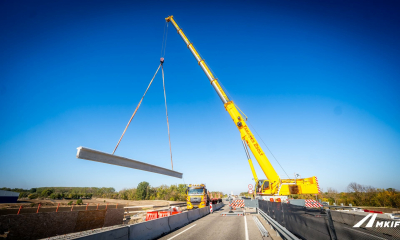
The hoisting of units 3 and 4 took place in October, when the bridge elements were lifted onto auxiliary vehicles. Since then, the contractor's specialists have completed all the welding joints, as the structure had to be extended across its entire cross-section. After that, they could begin lowering the vehicles. It may have seemed recently that the supports were still needed, but in fact the bridge was already above them and was not resting on them.
„It was particularly interesting that,” recalled Ádám Balogh, "the three carriages had to be lowered simultaneously, and the bridge bent 7 cm in the middle. We specified that the support structure should be lowered gradually in 2 cm increments and the load transferred to the bridge."
Currently, the demolition of the old bridge is underway alongside mobile diversions, which fortunately do not require permanent closures. At the beginning of next year, the bridge will undergo load testing, and by summer, motorists will be able to take possession of one of the most progressive bridges in our country.

Source: Link








One of Abony’s most important transport routes is to be redesigned

This is how flash floods on the vineyard-covered hills in the Pécs conurbation are being prevented

Order has been restored: production of the new Közlekedési Múzeum can now go ahead as originally planned

We took a look at how the refurbished Igazságügyi palota building turned out

Four new bridges to be built in the heart of the former industrial city

Rain gardens are coming to Budafok, with over 3,000 square metres of green space set to be developed

Contemporary art deco in Csopakon

Safer driving on the motorways: new digital signs for the MKIF
-

 Current at 2026. 09. 09.
A first-hand look at a career in engineering – Duna Group Szabadegyetem is back
-
Climate-X 2026. 09. 09.
Nyíregyháza Spartacus FC goes green – four hundred solar panels to be installed on the stadium roof
-
Bound track 2026. 09. 15.
Nearly 50,000 people travel on it every day – the refurbishment of the Cegléd main line continues
-
Current at 2026. 09. 09.
Rental flats, Rákosrendező, decentralisation – important ideas were put forward on the Real Estate Beach Conference stage