
Industry news
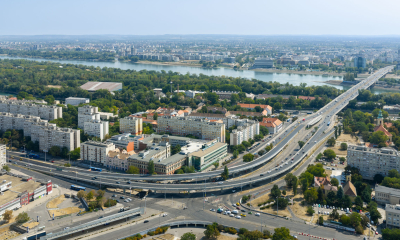
Whilst the city sleeps, work is underway on the Gubacsi Bridge – the renovation began with a night-time closure

Once most of the city had gone to sleep, the Gubacsi Bridge between Csepel and Pesterzsébet became a construction site. On Saturday 15 August, between 00:01 and 04:22, and then on Sunday 16 August from 00:01 until 8.00 am, the road crossing will be completely closed. During this period, Csepel can be accessed via the Kvassay Bridge or, from the south, for example, via the M0 motorway.
These night-time closures are part of the first phase of a complex engineering project. The necessary repair and maintenance work on the Gubacsi Bridge will be carried out in several phases: first, the movable joints will be addressed, and work is expected to continue on the expansion joints in October, by which time traffic will be restricted to one carriageway.
The heels are being refurbished and the expansion joints replaced
According to the public procurement documentation states that the tasks to be carried out include the refurbishment of the four movable cast-iron roller shoes on the 197.8-metre-long Gubacsi road bridge (marked C-2), as well as the replacement of three expansion joints.
The contractor was selected through the Budapest Közút Zrt. open tender procedure. Two tenders were received for the project, and the contract was awarded on 16 July 2026 to Híd-Tám Hídépítési Fővállalkozó, Tanácsadó és Szolgáltató Kft.. According to the contract notice, the contractor’s task is to draw up a temporary traffic management plan and have it approved by the designated organisations.
The clogs in Pesterzsébet were repaired more than twenty years ago
The primary function of bridge bearings is to transfer the bridge’s loads to the substructure, whilst also allowing for the necessary movements of the superstructure. This is necessary, amongst other things, due to temperature changes, as the bridge structure expands and contracts in response to weather conditions.
In the case of the Gubacsi Bridge, conventional cast-in-situ bearings have been installed at the abutments, whilst the expansion bearings feature a five-roller design.
The two structures on the Pesterzsébet side had already been repaired in 2002, as stated in the tender specifications: they were fitted with angle steel spacers to ensure the correct relative position of the rollers, and their anti-corrosion protection was also renewed. To do this, the superstructure was raised via the end girder, which also required the reinforcement of the end girder’s web and connections.
However, the more than two decades that have passed since then have taken their toll on the structures. The two bearing blocks at Pesterzsébet have once again become corroded and soiled, but according to the documentation, they remain operational, their condition is appropriate for the temperature conditions, and the angle steel spacers for the rollers are also present. However, the condition of the two movable bearings at the Csepel bridgehead, which had not previously been refurbished, is likely to be worse, and their rollers have also become dislodged.
The condition of the shoes and the error in the expansion are interrelated
The two most important tasks of the project are closely interlinked. According to the public procurement documentation, the corrosion and contamination that have developed on the abutments at the Pesterzsébet end of the bridge are primarily the result of the deterioration of the expansion joints above them: the structure is no longer watertight. In the next phase, therefore, the expansion joints will be addressed.
There are a total of four such elements on the bridge: one at each bridge abutment, and one each at the Gerber joints. The structure at the Gerber joint on the Csepel side was replaced in 2022, so the current project will see the remaining three expansion joints renewed. One 7.2-metre-long expansion joint will be replaced at each abutment, whilst the third new element will be installed at the Gerber joint on the Pesterzsébet side. The original expansion joints are single-lamella structures manufactured by Maurer, with a movement capacity of ±40 millimetres.
Traffic will be diverted to the Kvassay Bridge whilst the works are in progress
One of the most significant constraints on work organisation is the location itself. The Gubacsi Bridge provides a direct road link between Csepel and Pesterzsébet, so its complete closure will force road users travelling on this route to take a detour. According to information from BKK, buses travelling across the bridge will be diverted via the Közvágóhíd and the Kvassay Bridge during the closure, and the diversion could add more than ten minutes to the journey time between Csepel and Pesterzsébet.
The full closure has been scheduled for the night and early morning hours. During the first weekend, the Gubacsi Bridge will therefore be entirely in the hands of the specialists for a few hours, whilst in the autumn, structural restoration work and the replacement of the three expansion joints can continue under half-lane traffic restrictions.
Source: Link



Last-minute preparations before handover – This is how the refurbishment of the Flórián Square flyover came to an end

The 25,000-square-metre training centre at the Ludovika Campus, complete with a fire station and halls of residence, has been completed

A 184-kilometre road, a 362-metre bridge – A close-up look at road construction in Africa

A new co-CEO has joined KÉSZ Csoporth

Rain gardens are coming to Budafok, with over 3,000 square metres of green space set to be developed

Contemporary art deco in Csopakon

Hungary's biggest motorway upgrading programme is underway

Perhaps the world's most elegant McDonald's restaurant opens in Budapest
-

 What is being built? 2026. 07. 27.
Construction of Phase VIII of the Somfa Liget residential estate is underway using hybrid construction methods, prefabricated elements and the LEAN organisation model
-
Water management 2026. 07. 27.
Szeged is getting rid of its asbestos-cement and cast-iron pipes
-
What is being built? 2026. 08. 06.
Paks II.: What does the new milestone for Unit 5 mean in the context of the review?
-
Road building 2026. 08. 05.
The main road leading to a key tourist destination in Bihar is being upgraded using cold recycling technology


