Bound track
MÁV: Here is the 2026 track renovation list; obstacles to EIB-financed mega-projects have been removed

Following last week's meeting of the MÁV board, significant news on its official Facebook page.
He welcomed the fact that the board had accepted his proposal,
Thus, in the 2026 business plan, the amount of own resources available for track renovations has increased significantly, to approximately 60 billion forints. This exceeds the 2025 possibilities by 25 billion forints, he said, and then listed these.
Superstructure replacements, turnout replacements, bridge repairs
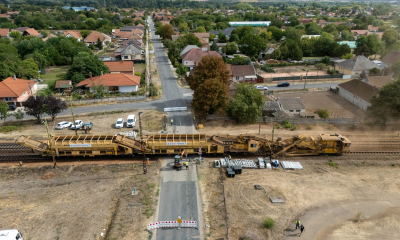
First, he mentioned the replacement of superstructures between Nyugati Railway Station (Városliget junction) and Kőbánya-Kispest, as well as the replacement of 10 sets of points at Kőbánya-Teher and Kőbánya-Kispest stations. The original track speed of 80 kilometres per hour will be restored on the section of track that is in very poor condition and is subject to 40-60 kilometre speed restrictions. This will improve timetable regularity and reduce journey times for suburban passengers on the Cegléd and Lajosmizse lines and long-distance passengers on the Szeged and Nyíregyháza lines, wrote the CEO.

„In 2026, we plan to replace approximately 40 worn-out turnouts from this programme at the network level, focusing on the busiest lines and stations. The programme has not yet been finalised, but the locations currently under discussion are Budapest-Kelenföld, Rákospalota-Újpest, Kőbánya-Kispest, Debrecen, Maglód, Újszász, Herceghalom and Biatorbágy. These are locations where trains are often forced to slow down due to a switch in poor condition, which leads to annoying delays and enormous energy losses due to the need to accelerate again,” wrote Zsolt Hegyi. .
Bridge repairs, ballast replacement, longitudinal rail replacement, level crossing reconstruction, turnout replacement and track regulation are planned on the Miskolc-Nyíregyháza line. The aim of the investment is to remove temporary speed restrictions on the section between Mezőzombor and Nyíregyháza and to restore the original 120 km/h track speed over the longest possible distance, he wrote.
Track construction, replacement of safety equipment to maintain a speed of 160 km/h
On railway line 60, between the stations of Gyékényes and Berzence, a 15-kilometre-long continuous welded rail track will be installed on the open line, with the installation of 10,000 new reinforced concrete sleepers and new long rails, ballast bedding along the entire length, and regulation to restore the original 80 km/h track speed and improve timetable regularity, at a cost of HUF 3 billion. This section is currently one of the worst in the country in terms of timetable regularity, but this will improve significantly in 2026, wrote Zsolt Hegyi.
One of the main causes of regular delays on Line 1 is the striking number of safety equipment malfunctions. A three-year programme is being launched, with insulation and component replacements and repairs to outdoor cabling scheduled for 2026, which is expected to significantly reduce the malfunctions causing delays.

Special maintenance work is also being carried out on sections of track currently upgraded to a speed of 160 kilometres per hour. These sections require special intervention in order to maintain a constant speed of 160 kilometres per hour.
According to Zsolt Hegyi, preparations are also underway for trains to travel between Szajol and Lőkösháza at a speed of 160 kilometres per hour from 2027, which will bring Békés County closer to Budapest.
This is how the loan application process with the European Investment Bank is progressing
He added that this fits in well with the approximately 800 billion forint infrastructure development programme jointly financed by the European Investment Bank (EIB) and the Hungarian state, for which the last administrative hurdle has also recently been removed.
This amounts to a total of 800+60 billion forints for track maintenance and renovation. With this significant sum, the likes of which have not been seen in the Hungarian railway sector for decades, „we can finally not only take a step forward, but also leap forward in the modernisation of the Hungarian railway infrastructure”.
– stated the chief executive officer.
Source: Link









One of Abony’s most important transport routes is to be redesigned

This is how flash floods on the vineyard-covered hills in the Pécs conurbation are being prevented

Order has been restored: production of the new Közlekedési Múzeum can now go ahead as originally planned

We took a look at how the refurbished Igazságügyi palota building turned out

Four new bridges to be built in the heart of the former industrial city

Rain gardens are coming to Budafok, with over 3,000 square metres of green space set to be developed

Contemporary art deco in Csopakon

Safer driving on the motorways: new digital signs for the MKIF
-

 Current at 2026. 09. 09.
A first-hand look at a career in engineering – Duna Group Szabadegyetem is back
-
Climate-X 2026. 09. 09.
Nyíregyháza Spartacus FC goes green – four hundred solar panels to be installed on the stadium roof
-
Bound track 2026. 09. 15.
Nearly 50,000 people travel on it every day – the refurbishment of the Cegléd main line continues
-
Current at 2026. 09. 09.
Rental flats, Rákosrendező, decentralisation – important ideas were put forward on the Real Estate Beach Conference stage