Bound track
One of the most spectacular elements of the Southern Circular Railway project – the bridge insertion on Bartók Béla út has begun – updated with video

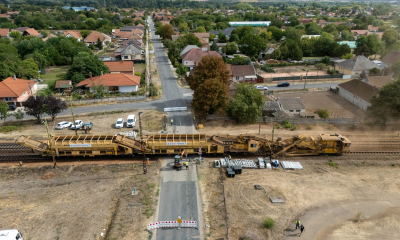
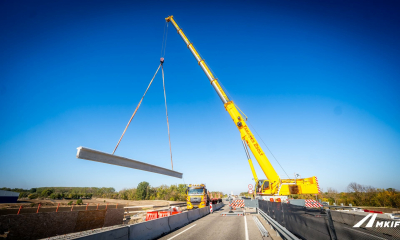
Following last week's Gubacsi út bridge installation last week, the Southern Circular Railway expansion project has reached another milestone: on 2 February, the installation of the new railway bridge on Bartók Béla út also began.
As part of the comprehensive Építési és Közlekedési Minisztérium investment, the railway between Ferencváros and Kelenföld stations will be expanded to three and four tracks, respectively, under the general construction contract V-Híd Zrt.. During this process, railway bridges will be built and renovated at two locations in Pest and five locations in Buda.

Among these, the Karolina út junction is now the focus of attention: here, as part of phase II of the Southern Circular Railway, two double-track steel bridges are being built over Bartók Béla út, replacing the old crossing.

The first new bridge is currently being installed, and the investor held a press conference on Monday morning to discuss the work process: the details were presented by Ministerial Commissioner Balázs Norbert Kovács.

The bridge currently under construction will also undergo lateral expansion.
One of the key objectives of the project is to replace the two existing tracks at the Bartók Béla út junction on the Southern Circular Railway with four tracks that will curve over the road and tram tracks. To this end, two new double-track superstructures will be built, the second of which will replace the old bridge currently in operation, the approval plans for which were prepared by Speciálterv.

Another important element of the project is that the support structure will be increased by 15-15 metres, meaning that the crossing will be approximately 90 metres long, compared to the previous 60 metres. For this reason, the bridge currently being installed will be built on a temporary bridgehead north of its final location, where it will temporarily ensure the continuity of rail traffic.

Once traffic has been diverted to the new bridge, the existing southern bridge will be demolished and a new bridge will be built in its place. At the same time, the northern bridge will also be moved sideways: once the substructure and superstructure on the southern side have been completed, the northern bridge will be moved into its final position next to the new southern bridge using a technique known as cross-sliding.

After completion of the entire construction, the temporary bridgeheads will be dismantled.
Greater load capacity with lower weight
At Monday's press event, it was also revealed that the new four-track structure will be Hungary's first two-track „network” railway bridge, which is not only a structural feat but also a visual experience – it will be illuminated in the evening.
Balázs Norbert Kovács also explained one of the key advantages of the network system: the slanted mesh structure can bear greater loads and span larger gaps with a smaller bridge mass. This means that the new bridge will be able to carry a rail axle load of 22.5 tonnes.

„The crossing thus complies with EU regulations on core rail network corridors and military mobility networks,” he said.

The push bar ensures that traffic does not have to be stopped.
The ministerial commissioner also discussed the details of the pushing technology used for the northern bridge structure: according to this, the contractor will also use a pushing pipe for this structure. This extends the bridge structure, allowing temporary supports to be built at greater distances, while the structure retains its rigidity and stability.

The essence of this pushing technology is that the bridge structure is put into place in one piece, without significantly disrupting road, tram, pedestrian and bicycle traffic or stopping traffic. The bridge is pushed into place using a pushing beam laid on the assembly area and permanent and temporary supports required for the pushing process.
Congestion on the capital's roads will be reduced by 60,000 cars per day
Responding to question Magyar Építők, Balázs Norbert Kovács revealed that one of the benefits of the greater span will be that the traffic corridor passing under the bridge can be expanded to include cycle paths.

Finally, he emphasised the importance of developing the Southern Circular Railway, pointing out that commuters will be able to switch to public transport without having to pass through congested main stations. This will reduce congestion on the capital's roads by 60,000 cars per day and cut carbon dioxide emissions, which contribute to the greenhouse effect, by many thousands of tonnes.
The ministerial commissioner summarised as follows:,
The construction of the Bartók Béla út railway bridge is perhaps the most spectacular element of the Southern Circular Railway: „It faithfully reflects what characterises the entire project: it is based on solutions used for the first time in Hungary; its size and significance make it one of the largest investments; and it is also a 21st-century development project.”
Source: Link








One of Abony’s most important transport routes is to be redesigned

This is how flash floods on the vineyard-covered hills in the Pécs conurbation are being prevented

Order has been restored: production of the new Közlekedési Múzeum can now go ahead as originally planned

We took a look at how the refurbished Igazságügyi palota building turned out

Four new bridges to be built in the heart of the former industrial city

Rain gardens are coming to Budafok, with over 3,000 square metres of green space set to be developed

Contemporary art deco in Csopakon

Safer driving on the motorways: new digital signs for the MKIF
-

 Current at 2026. 09. 09.
A first-hand look at a career in engineering – Duna Group Szabadegyetem is back
-
Climate-X 2026. 09. 09.
Nyíregyháza Spartacus FC goes green – four hundred solar panels to be installed on the stadium roof
-
Bound track 2026. 09. 15.
Nearly 50,000 people travel on it every day – the refurbishment of the Cegléd main line continues
-
Current at 2026. 09. 09.
Rental flats, Rákosrendező, decentralisation – important ideas were put forward on the Real Estate Beach Conference stage