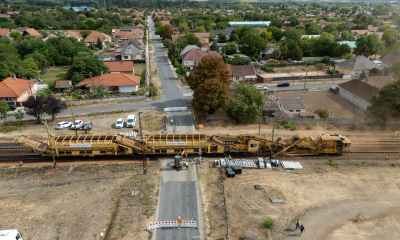
What is being built?
The Lord of the Danube has been rejuvenated - Work on the Kvassay water pipeline and pumping station in Budapest will soon be completed

The National Water Authority and the Middle Danube Valley Water Authority presented the works at the Kvassay pumping station, which are nearing completion, at a press tour. The construction was carried out by Colas Alterra Zrt. and STRABAG Generálépítő Kft.. On behalf of STRABAG, Gergely Kiss is participating in the work as deputy project manager, having replaced project manager Gergely Papp at the beginning of 2024. The experts are currently working on the cladding tasks, and the giant Danube project will be fully completed after the trial run.

The navigation lock, completed in 1911 at the northern tip of Csepel Island, and the subsequent intake lock and power plant, inaugurated in 1962, play a key role in almost all areas of water management, and their reliable operation is therefore crucial.

The Lord of the Danube gets new power
More than a century old, the complex is also known as the Lord of the Danube because of its complex tasks.
"The Kvassay sluice is the first order flood protection line for the Budapest-Baja flood protection basin. The waterworks ensures the controlled water level in the Ráckeve-Soroksár-Danube branch by means of a turbine in the power plant, which can also be operated as a pump"
- presented the significance of the monument Jososos Örsi, Chief Engineer, Deputy Technical Director of the Central Danube Valley Directorate.

The complex will be used to feed the Danube Valley's fish ponds and irrigation systems with up to 60-70 million cubic metres of water per year.
The facility also has a key role in regulating water quality. It would cause ecological problems if there were not enough fresh water in the Danube tributary, as the water treated by the South Pest Wastewater Treatment Plant flows into the river along this stretch.
This tributary is also the source of water for the Danube-Tisza area, the Sandhavnian area. The Kvassay sluice and its surroundings are a popular destination for water hikers and anglers.
Emergency 2018: the lowest water level ever recorded on the Danube
The decision on the comprehensive renovation and development of the Kvassay dam was taken in 2018 after the Danube broke water level records one after the other, said Zsolt Stoichev, head of the Flood Protection Department of the National Water Directorate General.

The lowest water level ever recorded at Budapest was 51 centimetres in autumn 1947, but in 2018 the record was broken with a water level of 33 centimetres. During the period of water shortage, the water level in the Ráckeve-Soroksár branch of the Danube was 50 centimetres higher than in the Great Danube: this meant that the main branch could not gravity flow water into the tributary.
The pumps installed were unable to transfer the water from the Danube to the tributary at low water levels. A new pumping station was decided upon as a long-term and cost-effective solution. It should be able to pump at least 30 cubic metres per second from the main branch of the Danube to the Ráckeve branch of the Danube even at a water level 50 centimetres below the lowest water level measured so far, up to 17 cm at the Budapest water level.

Modernisation of one of the oldest Hungarian water facilities
Sixty years after the inauguration of the power plant in 1962, another major project is being completed at the Kvassay complex.
As part of this project, the Kvassay consortium's specialists renovated it in two large phases:
- the turbines and related engineering of the power plant,
- the supply valve for the group of works,
- the crane tracks,
- upgraded the building's energy system,
- a new pumping station was built, with suction and discharge works and piping,
- renovation of the listed sluice building and the service dwelling near the complex, as well as the beam storage, and
- the sedimentation system was modernised.
As part of the upgrades, the control of seven pumping stations supplying water to irrigation channels along the Ráckeve–Soroksár branch of the Danube was integrated into the renewed webscada control system. This means that a single specialist can monitor and, if necessary, start up the pumps along the 60-kilometre stretch of riverbank at the touch of a button.
28 thousand cubic metres of soil were removed during the construction of the worksite
The construction can be divided into two major parts, the first of which started in early 2022, said Dán Martin, the Colas Alterra Zrt. project lead engineer. The first part was completed with the construction of the flood protection gap wall, the laying of the downstream pipes and the construction of the structure. The two pipes that were laid through the gap wall and the south and north chambers were closed after their construction, while the suction side elements of the project were constructed. The construction of the first phase had to be completed in time for the World Athletics Championships in September 2023, as the works area is adjacent to the stadium and the construction could not interfere with the World Championships.

After the world event, the site was returned to the contractors, who in November 2023 prepared the site by excavating 28,000 cubic metres of earth for the construction of the suction-side pipeline and structure.From mid-December 2023, a flood wave that lasted until mid-January hampered the work. The construction of the largest ice service in Hungary's history in the Danube riverbed started after the drainage and the clean-up.
Construction in the Danube riverbed at a depth of ten metres
The pumping station was built in the Danube branch at a depth of ten metres - Martin Dán shared details during the tour.
For the construction of the work area, a part of the riverbed was delimited with reed plates. An 80-metre wide and 100-metre long floating crane arrived in the tributary with a 100-tonne crawler crane on board, a 30-tonne long-rigger excavator and a reed-bed cutter.

Before the reed plates were removed, the bed, which is seven metres deep in this section, was probed in four places to determine where the clay would be located to reach the reed plates that would seal the water. Ten-metre slabs were driven into the bed.
After the 150-metre long, 7-metre wide base of the ice slab was completed, the gap between the rows of slabs was filled with 8,000 tonnes of stone to a depth of nine metres. To ensure safety, a 2×2 metre parapet was built to support the inner side of the reed slab wall.
The superstructure was fitted with 20-30 tonne excavators, and under their weight the slab line was moving outwards. A measuring station installed on the top of the slotted wall indicated the movement of the ice slab, measuring 150 points every half hour and recording any changes with millimetre accuracy.
Then they used pumps to remove the water from the ice tray and rescued the fish from the work area.

Several flooding incidents in the work area
8,000 cubic metres of sludge and clay were removed from the dewatered work area. Then they began building the base plate and the beams that would hold the clay in place. At that point, the June flood interrupted the work. Before the water reached the work area, they removed all the equipment from there and had to hand it over to the Danube. After the flood receded, the water was pumped out. An iron structure was built to concrete the bottom, which directs the water to the four pumps. Seven-metre-high concrete walls were built in the riverbed, from which aour previous article.

By September, the cartridge belts for the pumps were ready. The four pumps of the new plant will be served by two parallel pipes, each 1.8 metres in diameter, which will be joined in a 2.4 metre diameter pipe," said Dán Martin. The steel pipes have been given a 30mm-thick porcelain hardness surface treatment to meet the 100-year lifetime expected for water projects. This phase of the construction was also affected by a recent flood, with a tower crane in the embankment helping to build the pumping station, which was weighted down for the duration of the flood. After two weeks of sludge removal, the pumps were lifted into place.
The project has now reached a stage of completion where only the commissioning tests and paving work remain.

The turbine has been refurbished to the last screw
In the Kvassay project, the turbines of the power plant were renewed to perform their original function. On each turbine, the auxiliary controls and all the hydraulics were replaced. The turbine's rotor consists of three large yoke blades onto which water is directed by smaller blades on the outer edges of the turbine. Whether the plant's machines are in turbine or pump mode can be controlled by changing the position of the blades.

Turbine number two has been completely refurbished down to the last bolt. It was dismantled and transported in pieces and then put back into service after repairs. After modernisation, the turbine is now capable of generating electricity and, if necessary, pumping water from the Great Danube into the tributary.
The hydraulics of the 60-tonne machines have to be constantly cooled. During the refurbishment, a cooling circuit system was developed and installed that is capable of utilising the waste heat generated by the turbine. In summer, the river water is used for cooling, and in winter, the heat generated by the pump operation is used to feed the calorifiers that heat the power plant.
Forty-tonne waterfall airlock goes into action in case of emergency
Vibration diagnostics have also been installed separately for the two turbines. Above a threshold value, the turbine is automatically shut down by applying the brakes and the turbine shutdown valve is activated. A hydraulic system immediately releases the seven-metre wide and four-metre high barrier in front of the power plant building in the event of a turbine failure, to prevent any more water from reaching the blades. The first section of the sluice is free-falling, the system catches it before it descends and slowly lowers it to block the inflow of water. After the renovation, the system will be fully automated and will operate under 24-hour surveillance. The plant's refurbishment also included the replacement of the equipment's working cylinder, which keeps the 40-tonne sluice gate in the air.

Crane runways renovated and new raking machine guarantees operational safety
No foreign object with water can enter the turbines during the safe operation of the plant. However, the water flowing gravitationally in from the Great Danube brings with it a lot of floating debris. To remove the sediment, a new raking system has been installed, including a polyp canal that can also operate as a crane, which can lift the sediment out of the riverbed when the panels are closed. On the extended crane track, the new system can now transport this to the container by remote control.

The 40-tonne crane in the power plant building can now be operated by remote control. The hoist plays an essential role in the servicing and maintenance of the turbine, which weighs almost 60 tonnes, when it lifts the equipment out of its place in three sections.
The crane's rigging was also replaced afterwards, and the weight test required it to lift 44 tonnes from the ground level.
Before testing, structural engineers determined where the truck and its heavy load could stop in the power plant building. The floor of the building was covered with 3 cm thick steel slabs to distribute the weight on the concrete. The weight was then lifted off the ground and lifted into the air by the renewed crane.
The project also included the renovation of the 1906 landmarked art deco sluice handling building, the insert beam storage and workshop used to close the sluice, and the modernization of the water
workers' service housing.
Source: Link










One of Abony’s most important transport routes is to be redesigned

This is how flash floods on the vineyard-covered hills in the Pécs conurbation are being prevented

Order has been restored: production of the new Közlekedési Múzeum can now go ahead as originally planned

We took a look at how the refurbished Igazságügyi palota building turned out

Four new bridges to be built in the heart of the former industrial city

Rain gardens are coming to Budafok, with over 3,000 square metres of green space set to be developed

Contemporary art deco in Csopakon

Safer driving on the motorways: new digital signs for the MKIF
-

 Current at 2026. 09. 09.
A first-hand look at a career in engineering – Duna Group Szabadegyetem is back
-
Climate-X 2026. 09. 09.
Nyíregyháza Spartacus FC goes green – four hundred solar panels to be installed on the stadium roof
-
Bound track 2026. 09. 15.
Nearly 50,000 people travel on it every day – the refurbishment of the Cegléd main line continues
-
Current at 2026. 09. 09.
Rental flats, Rákosrendező, decentralisation – important ideas were put forward on the Real Estate Beach Conference stage