What is being built?
Zero depot, maximum speed – Prefabrication in an urban environment with the Leierrel

One of the newest residential developments on the Buda side, the Kelen Gate project, is a good example of how a large-scale residential property development can be carried out quickly, accurately and sustainably in a densely built-up urban environment. The entire investment and property development project is located on Vasút Street in District XI, next to Budapest-Kelenföld railway station and the newly built Etele Plaza.

The investor behind the 144-apartment condominium is FVB Invest Vasút Zrt. The condominium also houses 23 office spaces, 108 storage units and 92 basement parking spaces. According to the investor, the aim is not merely to construct a building, but to „create living spaces that will serve the needs of their residents for generations to come”..
The project is being implemented by Tenzio Kft., a company based in Szeged but also with a location in Budapest.
The company has been an active and dynamically developing player in the construction market for many years, with numerous successful residential, industrial and institutional projects completed nationwide. Tenzio Kft. now provides complex general construction services, placing great emphasis on professional competence, strict adherence to deadlines and flexible adaptation to customer requirements. Their professionally trained team and stable circle of subcontractors guarantee the implementation of high-quality technical construction and investment projects. The company's philosophy is centred on reliable project management, high-quality execution and a partnership approach.
A significant portion of the load-bearing structures are provided by Leier Hungária Kft. prefabricated reinforced concrete solutions.

Quick start, tight schedule
Construction began in January 2025 with the foundation work. The delivery of prefabricated shell walls for the basement began in early June. The project is currently nearing completion: delivery of the prefabricated elements for one of the five stairwells has already been completed, along with the 4th floor ceiling, and only the top floors of the remaining four stairwells remain to be completed.

The role of Leier in the project
During the construction of Kelen Gate, Leier will supply prefabricated curtain wall and curtain ceiling systems as well as Leier master panel ceilings for the project.
„Our tasks include the manufacture and delivery of a total of approximately 13,000 m² of wall elements and 13,000 m² of floor elements for the 144-apartment condominium. Crust walls have already been used at the basement level, but this technology is primarily used to construct apartment partition walls and main facade walls.”
said Gábor Takács, head of the Leier Hungária Kft. prefabricated reinforced concrete structures business unit.

Why prefabrication?
When selecting the technology, speed and accuracy were decisive factors, but the location proved to be just as important.
„In the case of Kelen Gate, there was practically zero on-site storage space available. For this reason, just-in-time delivery played a key role, which could best be achieved with prefabricated shell wall and shell ceiling systems.”
– emphasised Gábor Takács.
The prefabricated elements are manufactured in a factory environment with a high degree of prefabrication and millimetre-precise dimensions, which not only means faster installation but also fewer opportunities for errors on site.

Sustainability in tangible figures
One of the greatest advantages of prefabrication is waste reduction. In the case of the Kelen Gate, this is not just a theoretical advantage, but a quantifiable result.
This quantity of prefabricated walls represents the replacement of approximately 2,600 pallets of bricks. This in itself is a huge reduction in packaging waste, and when you factor in the cutting waste generated by average brick construction, it means that at least 90–100 tonnes of debris could have been avoided.„
– stated the business unit manager.
An additional advantage is that the shell walls come with pre-installed electrical junction boxes and protective piping, eliminating the need for subsequent chiselling and repair of the main walls, which further reduces on-site noise, dust and material loss.

Precise logistics with three tower cranes
One of the biggest challenges of the project was logistics. Three tower cranes had to be serviced simultaneously on the construction site, while wall and floor elements were being delivered at the same time.
„The key to success was continuous consultation with the contractor. We divided production and logistics between our two plants: the slabs came from Kiskunlacháza and the walls from Győr.”
– Gábor Takács informed.
During the project, a total of approximately 200 lorries of wall elements and 90-100 lorries of floor elements arrived at the site, involving more than 50 of our own vehicles and approximately the same number of subcontractors' vehicles. The traffic situation in Budapest was factored into the schedule in advance, and the contractor secured a site occupancy permit to ensure uninterrupted unloading.

Greener concrete, conscious manufacturing
The Leier contributes to sustainability not only through its design, but also through its manufacturing technology.
„We were among the first concrete manufacturers in Hungary to start using so-called green cement, which has a CO₂ footprint that is approximately 25% lower than that of traditional cement.”
– emphasised Gábor Takács.
In addition, since 2022, the Leier factories have been undergoing „greening” in the form of solar panel installations, building insulation upgrades, and energy efficiency improvements.

Comfort you can hear – or not
One of the outstanding technical advantages of Kelen Gate is its excellent acoustic performance. The 25 cm thick shell walls between flats provide airborne sound insulation of 60 dB, which significantly exceeds the enhanced requirement of 54 dB. The 56 dB value of the 20 cm thick facade walls is orders of magnitude better than the approximately 41 dB performance of a conventional 30 cm brick wall.

The future of prefabrication
Experience shows that demand for prefabricated structures is continuously growing, especially in the metropolitan residential and office markets.
„We are seeing in more and more projects that prefabrication is not a compromise, but a real win-win situation for the investor, the contractor and the manufacturer. Our goal is to make these solutions economical and competitive in every respect.”
– summarised Gábor Takács.
The Kelen Gate project is a good example of how prefabricated reinforced concrete structures can make the construction of urban residential buildings not only faster and more predictable, but also more sustainable and comfortable.
Source: Link




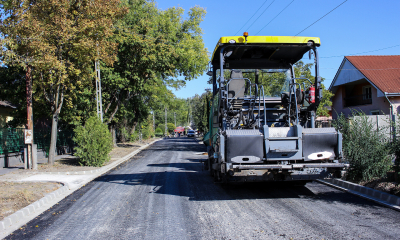


Reconstruction of the M1 motorway’s carriageway towards Győr can begin under the new traffic arrangements

Alpine engineering techniques are also being used to protect the railway in the Danube Bend

Instead of patchwork repairs – large-scale refurbishment work is under way on the dilapidated main roads in the Transdanubia region

The expansion joints on the Buda side of the Erzsébet Bridge were installed overnight

Four new bridges to be built in the heart of the former industrial city

Rain gardens are coming to Budafok, with over 3,000 square metres of green space set to be developed

Contemporary art deco in Csopakon

Safer driving on the motorways: new digital signs for the MKIF
-

 Current at 2026. 09. 09.
A first-hand look at a career in engineering – Duna Group Szabadegyetem is back
-
Bound track 2026. 09. 15.
Nearly 50,000 people travel on it every day – the refurbishment of the Cegléd main line continues
-
Climate-X 2026. 09. 09.
Nyíregyháza Spartacus FC goes green – four hundred solar panels to be installed on the stadium roof
-
Current at 2026. 09. 09.
Rental flats, Rákosrendező, decentralisation – important ideas were put forward on the Real Estate Beach Conference stage