
What is being built?
The town hall in Gödöllő has been renovated with a unique clock tower and rare masonry work.

The complex renovation and expansion of the Gödöllő Town Hall has been completed. During the investment, the existing building, constructed in the early 1980s, underwent a complete modernisation, while a new section of the building was added to create modern customer service areas. The construction was carried out by STRABAG.
The project presented numerous technical and organisational challenges, from construction in a confined city centre environment to lifting stone elements weighing several tonnes.

Two wings, three levels, internal garden
As a result of the development, a building complex consisting of two wings, two expansion units, a ground floor, first floor and attic serves the city's operations. The net floor area of the office building is 2,091 square metres. The inner garden is 215 square metres.
The building houses the offices of the town hall employees, with a customer service area on the ground floor and a conference and meeting room in the inner courtyard pavilion for local government meetings and ceremonies.
The original building previously served as a bank headquarters, which was completely rebuilt. The new customer service block was created in the area of the bank branch that remained in the building the longest, which was also designed by STRABAG. The plans were completed after the project had started, but the handover deadline coincided with the completion of the entire investment. Until the new documentation was ready, the experts mainly worked on the rest of the building and the façade.

Reinforced roof, re-insulated façade
During the first phase of construction, the roof structure was reinforced, the previously leaky facade insulation was removed, and the leaks were repaired so that interior work could begin. After that, facade insulation and interior construction proceeded simultaneously.
The conversion of the attic required significant structural work: the sagging roof structure was reinforced based on a structural assessment, some rafters were removed, and slanted beams and horizontal tie beams were installed. The attic now houses offices, social rooms, two ventilation machine rooms and the boiler room.

During the renovation of the entire building – both new and old parts – covering a gross area of approximately 2,700 square metres, significant roof reinforcement and roofing repairs were carried out. In addition to 925 square metres of tile roofing, 993 square metres of new facade insulation was installed – including the plinth – with the previous poor-quality layer structure being completely demolished. After demolition, levelling base plaster was applied, followed by 16–22 centimetres of thermal insulation and a new layer of plaster.
The façade was clad with 253 square metres of Tardos limestone. The joints and fixings of the previously installed aluminium windows and doors were repaired and fitted with internal and external vapour barriers, which significantly increases the comfort and operational efficiency of the building.

City centre logistics and just-in-time delivery
Due to the central location of the main square, the organisational area available was extremely limited. Deliveries had to be organised on a daily basis, using a „just in time” system. During the implementation, the farmers' market operating next to the building, the constant traffic on the main square, and the Christmas market, through which deliveries were also made periodically, were taken into account. In these cases, the work processes were scheduled for the early morning hours.
An additional difficulty was the inspection and repair of structures that had been built to an inadequate standard in the past – for example, reinforcing the roof structure, repairing the cladding or removing the deteriorated thermal insulation – which was a time-consuming task to coordinate and restore.

State-of-the-art engineering and special acoustics
The building's fresh air supply is provided by two central heat recovery ventilation units. In the event hall built in the inner courtyard, four exhaust and supply air ducts were installed in boxes and covered with carpentry structures. The ceiling was finished with Rigips Rigitone Active'Air acoustic cladding.
The design of the mechanical system was not part of the STRABAG contract. The City Council commissioned a mechanical contractor independent of Strabag to carry out the mechanical work. After disconnecting from the district heating system, the mechanical contractors installed two condensing gas boilers: one serves the old wing and the other serves the new wing. In addition, two Daikin VRV heating and cooling units were installed on the mechanical terraces. In addition to the radiator system, the VRV system can also heat the underfloor heating installed in the customer area.

Clock tower, Tardos stone and drop-pattern plaster
One of the most unique elements of the project is the new clock tower built in the central core of the building. The custom-made clock mechanism features LED lighting and programmable melodies, and its façade is covered with large-scale, assembled Tardos stone cladding. Lifting and securing the heavy elements – especially from scaffolding erected above the roof in winter weather conditions – posed a serious challenge.
The appearance of the building is also defined by the brick wall in front of the mechanical ventilation system, which is made of cut cone tiles and Tondach roof tiles embedded in mortar. Few contractors in the country undertake this type of brickwork, and the rainy, cold weather and long lead times made it difficult to complete the building.
The special facade plaster was applied in two layers, with a unique design: based on the facade plan, drop patterns were formed on the surface using special templates, applying a sgraffito effect that is rarely seen on modern buildings.
Source: Link

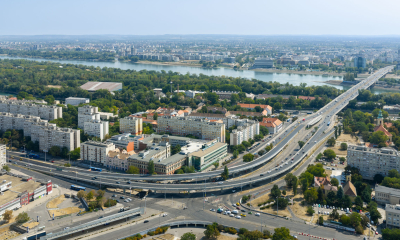


Last-minute preparations before handover – This is how the refurbishment of the Flórián Square flyover came to an end

The 25,000-square-metre training centre at the Ludovika Campus, complete with a fire station and halls of residence, has been completed

A 184-kilometre road, a 362-metre bridge – A close-up look at road construction in Africa

A new co-CEO has joined KÉSZ Csoporth

Rain gardens are coming to Budafok, with over 3,000 square metres of green space set to be developed

Contemporary art deco in Csopakon

Hungary's biggest motorway upgrading programme is underway

Four new bridges to be built in the heart of the former industrial city
-

 What is being built? 2026. 07. 27.
Construction of Phase VIII of the Somfa Liget residential estate is underway using hybrid construction methods, prefabricated elements and the LEAN organisation model
-
Water management 2026. 07. 27.
Szeged is getting rid of its asbestos-cement and cast-iron pipes
-
What is being built? 2026. 08. 06.
Paks II.: What does the new milestone for Unit 5 mean in the context of the review?
-
Road building 2026. 08. 05.
The main road leading to a key tourist destination in Bihar is being upgraded using cold recycling technology


