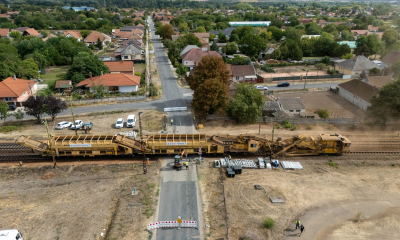
What is being built?
Science fiction in Łódź – the launch chamber of the tunnel boring machine for the high-speed railway under construction was unveiled.

One of the most ambitious infrastructure projects in Polish history is the CPK railway programme (full name: Centralny Port Komunikacyjny – Central Communication Port). This will create a multimodal transport hub connecting a huge new airport and a completely new national high-speed rail network (NSV).
The essence of the programme is that not only will an airport be built near Warsaw, but also a railway „spider web” that will make most of Poland's major cities accessible from the capital within 2.5 hours.
The most important element of the railway programme is the „Y” line, which connects Warsaw with Łódź as the backbone of the network, and then branches off to Wrocław and Poznań.
This will be the first truly high-speed section in Poland, where trains will reach speeds of up to 350 km/h.

The shield can be launched from the concrete hall
The launch chamber for the Retkinia TBM tunnel boring machine in Łódź is the first completed facility in the CPK railway programme. The project was reported on Budimex SA on its social media page, which carried out the geotechnical and foundation work on behalf of the investor, Port Polska.
The high-speed railway tunnel will be approximately 4.6 km long and approximately 14 metres in diameter, connecting the Retkinia launch chamber with the receiving chamber at Łódź Fabryczna station, allowing trains to travel at speeds of up to 160 km/h.
„Our task," they wrote, "was to design and construct the Retkinia launch chamber structure, enabling the safe operation of the TBM shield. As part of the project, we built membrane walls, among other things. These are key structural elements of the chamber, serving both to support earthworks and as foundations (they have a circumference of 438 metres, a thickness of 120 cm and can extend to a depth of up to 45 metres)."
Their responsibilities also included designing a horizontal filter barrier constructed using jet grouting technology at a depth of nearly 30 metres, which ensures the expansion of the walls at the bottom of the excavation pit.
A thrust block, also manufactured using jet grouting technology, was constructed for the TBM shield to ensure soil compaction and reinforcement, as well as the stability of the shield surface.

They had to install 30-tonne reinforcement cages.
Urszula Tomczak, lead designer and expert on Soletanche Polska, emphasised in the post that designing the TBM launch chambers was a complex engineering challenge. The wall sections through which the shield passes must be constructed with unique fibreglass reinforcement, which ensures the necessary load-bearing capacity during construction while allowing the shield to pass safely through the structure during excavation of the work pit.
Wojciech Walczak, Operations Director at Soletanche Polska, also emphasised that the most impressive elements of the Retkinia chamber project are the monumental slotted walls. This project was challenging not only because of the difficult geological conditions, but also because of the need to maintain the stability of the deep excavation pit and the precise installation of reinforcement cages weighing more than 30 tonnes per section.
Their team also designed and constructed the foundations for the TBM reception chamber at Łódź Fabryczna station. Currently, temporary steel supports, which are essential for earthworks and construction, are being installed at the facility.
Source: Link








One of Abony’s most important transport routes is to be redesigned

This is how flash floods on the vineyard-covered hills in the Pécs conurbation are being prevented

Order has been restored: production of the new Közlekedési Múzeum can now go ahead as originally planned

We took a look at how the refurbished Igazságügyi palota building turned out

Four new bridges to be built in the heart of the former industrial city

Rain gardens are coming to Budafok, with over 3,000 square metres of green space set to be developed

Contemporary art deco in Csopakon

Safer driving on the motorways: new digital signs for the MKIF
-

 Current at 2026. 09. 09.
A first-hand look at a career in engineering – Duna Group Szabadegyetem is back
-
Climate-X 2026. 09. 09.
Nyíregyháza Spartacus FC goes green – four hundred solar panels to be installed on the stadium roof
-
Bound track 2026. 09. 15.
Nearly 50,000 people travel on it every day – the refurbishment of the Cegléd main line continues
-
Current at 2026. 09. 09.
Rental flats, Rákosrendező, decentralisation – important ideas were put forward on the Real Estate Beach Conference stage