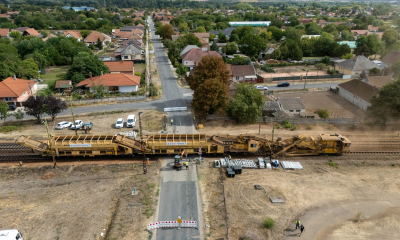
What is being built?
Another step towards a regional cycle network – a 720-metre cycle path is being built in Naszály

Naszály, nestled in the embrace of the Gerecse Mountains, boasts a beautifully restored watermill. The village’s landmark served as the filming location for several scenes in the 1959 film *The Poor Rich*, adapted from the novel by Mór Jókai. We previously reported we reported that the village had waited nearly 50 years for a paved road to provide access to Dunaalmás.

Their latest project involves the construction of a cycle path approximately 720 metres long along the Tata–Almásfűzitő road (No. 8138), in the area around Rákóczi Ferenc Street and Fenyves Street.
The development is being carried out by STRABAG Általános Építő Kft. , and will not only make transport within the village safer but also integrate the village into the region’s cycle network through the construction of further sections.

The aim is to link the different parts of the town
The municipality is developing its transport infrastructure through its own investment. The new cycle path being built along Rákóczi Ferenc Street and Fenyves Street will provide a safe link between the northern part of the town and the more extensive residential areas to the south, where the primary school is also located. The development may also boost the area’s appeal to tourists: plans envisage that, with further extension of this section in the future, a cycle path network could be established within the town centre, which could then, in the longer term, connect via Almásfüzitő to the EuroVelo 6 international cycle route network.

The work is being carried out in two phases
The 720-metre cycle path currently under construction will be built to a uniform width of 2.3 metres. Szabolcs Ádám, site manager for project STRABAG, told our website that the construction work has been divided into two phases. First, a section nearly 250 metres long was completed.

Work is currently underway to prepare the site for the resumption of construction. This involves clearing scrub and shrubs from an area of approximately 630 square metres; in some places, it has also been necessary to fell trees. Among the tasks carried out, vegetation threatening the clearance was also cleared in 20 instances. The project does not affect any nature conservation areas, and there was no need to relocate protected plants.

Significant earthworks are required to construct the track
Szabolcs Ádám explained that the construction work involves a significant amount of earthworks. For the section that has already been completed, 295 cubic metres of earth were excavated, whilst a further 504 cubic metres of earth need to be moved during the current phase of construction. As the excavated earth cannot be reused on site, it is being removed from the area.

This is how the cycle path is constructed
The structure of the new cycle path consists of a protective layer of mechanically stabilised material laid over compacted soil, topped by a 20-centimetre-thick base course of crushed stone. The asphalt layer consists of a 4-centimetre-thick binder course and a wearing course of the same thickness.
Rainwater drainage is ensured by the appropriate length of the track and a 2 per cent cross-slope, which aids the natural drainage of water towards the green areas alongside the road.

Smaller machines are operating in a confined workspace
Construction work in residential areas requires special planning. Due to the presence of telecommunications cables, rows of utility poles and green spaces, the work can only be carried out using smaller machinery.
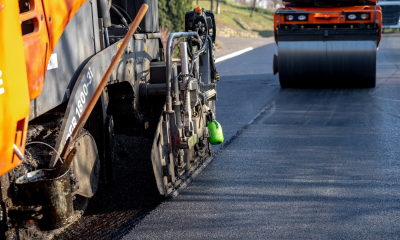
For example, the asphalt is laid using a small-scale finisher, a 2.5-tonne roller, a rotary excavator and two-axle lorries. Earthworks and the construction of the base course are carried out by two separate machine teams, allowing the work to proceed continuously without any technological downtime.
During the works, the contractor must also ensure the residents’ daily access: temporary backfilling is used at the gateways following the earthworks, which is removed again before the installation of each layer.

The new section of road could be completed by the start of summer
The works are scheduled for completion by 31 May 2026. In the longer term, the project could become an important part of the region’s cycling infrastructure. The urban section currently under construction will serve both the daily travel needs of local residents and the development of cycling tourism in the region.
Source: B LinkB










One of Abony’s most important transport routes is to be redesigned

This is how flash floods on the vineyard-covered hills in the Pécs conurbation are being prevented

Order has been restored: production of the new Közlekedési Múzeum can now go ahead as originally planned

We took a look at how the refurbished Igazságügyi palota building turned out

Four new bridges to be built in the heart of the former industrial city

Rain gardens are coming to Budafok, with over 3,000 square metres of green space set to be developed

Contemporary art deco in Csopakon

Safer driving on the motorways: new digital signs for the MKIF
-

 Current at 2026. 09. 09.
A first-hand look at a career in engineering – Duna Group Szabadegyetem is back
-
Climate-X 2026. 09. 09.
Nyíregyháza Spartacus FC goes green – four hundred solar panels to be installed on the stadium roof
-
Bound track 2026. 09. 15.
Nearly 50,000 people travel on it every day – the refurbishment of the Cegléd main line continues
-
Current at 2026. 09. 09.
Rental flats, Rákosrendező, decentralisation – important ideas were put forward on the Real Estate Beach Conference stage