Road building
The Czech Republic's most important motorway was completed three months ahead of schedule.

The Říkovice – Přerov section of the D1 motorway in the Czech Republic has been opened, according to STRABAG Česko's official Facebook page. According to a post dated 19 December, work on the project to complete the missing section of the motorway began almost exactly three years ago.
The investment has completed the country's longest and best-known motorway, which plays a key role in the road connection between Prague, Brno and Ostrava.
Bridges, noise barriers and complex engineering solutions
As part of the project, a bridge over the Bečva River, the Přerov–Olomouc junction, a 900-metre-long local road and the affected area of the Precheza factory landfill were built. During construction, a total of 10 motorway bridges and 2 ramp bridges, 3 level crossings and approximately 4 kilometres of noise barriers were built.
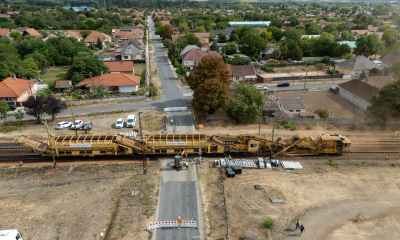
One of the most complex elements of the project was the 940-metre-long bridge near Dluhonice, which carries the motorway over the Bečva River, the Precheza chemical plant and the Olomouc–Přerov railway line.

Earlier transfer, EU funding
According to the Czech Ministry of Transport, the final section of the country's most important motorway was built in three years and opened to traffic three months ahead of the original schedule. The cost of construction, adjusted for inflation, was CZK 7.9 billion excluding VAT, a significant portion of which was covered by the European Union.
Transport Minister Ivan Bednárik emphasised that the new section will significantly relieve traffic congestion in the town of Přerov, while also reducing traffic on the D46 motorway.

Special foundations and modern technologies
The greatest challenge during the construction of the bridge was laying the foundations for the overpass, as the area has complex geological conditions and is located in the immediate vicinity of a chemical plant. Special technical solutions were used to ensure the long-term protection of the pillars. Approximately 8,500 tonnes of steel were used in the construction.
During the works, low-noise asphalt was laid and 3.25 million cubic metres of earth were moved for the embankments.

Environmental protection and urban decongestion
During the investment, special attention was paid to environmental considerations. The high embankments also serve as flood protection in case the Bečva River bursts its banks, and three frog crossings were also constructed.
According to Radek Mátl, CEO of ŘSD, the opening of the D1 section in Přerov will reduce truck traffic by approximately 70 per cent, which will bring about a noticeable improvement in the city's liveability and traffic safety.

More than half a century of history has come to an end
The history of the D1 motorway dates back to the period before the Second World War: one of the first structures, the Šmejkalka Bridge, was completed in 1939. However, the foundation stone for the first section between Prague and Mirošovice was not laid until 1967, and the motorway was opened in 1971.
The motorway between Prague and Brno was completed in 1980 and underwent comprehensive modernisation between 2013 and 2021. The newly opened section marks the end of several decades of construction work on the D1 motorway.
Source: Link









One of Abony’s most important transport routes is to be redesigned

This is how flash floods on the vineyard-covered hills in the Pécs conurbation are being prevented

Order has been restored: production of the new Közlekedési Múzeum can now go ahead as originally planned

We took a look at how the refurbished Igazságügyi palota building turned out

Four new bridges to be built in the heart of the former industrial city

Rain gardens are coming to Budafok, with over 3,000 square metres of green space set to be developed

Contemporary art deco in Csopakon

Safer driving on the motorways: new digital signs for the MKIF
-

 Current at 2026. 09. 09.
A first-hand look at a career in engineering – Duna Group Szabadegyetem is back
-
Climate-X 2026. 09. 09.
Nyíregyháza Spartacus FC goes green – four hundred solar panels to be installed on the stadium roof
-
Bound track 2026. 09. 15.
Nearly 50,000 people travel on it every day – the refurbishment of the Cegléd main line continues
-
Current at 2026. 09. 09.
Rental flats, Rákosrendező, decentralisation – important ideas were put forward on the Real Estate Beach Conference stage