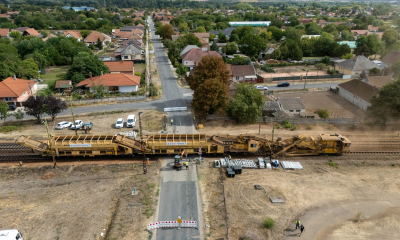
Road building
The pavement of Liszt Ferenc International Airport can be rebuilt on an area the size of a football pitch.

Public procurement announced by Budapest Airport Liszt Ferenc International Airport for the design and implementation of the reconstruction of taxiway K and the connection of the engine test area.
The successful bidder will have 199 days to complete the project, for which applications are being accepted until 23 March.
It has to serve larger machines.
The K and A5 taxiways outside the runway safety area, involving the renovation of pavements, utilities and terrain conditions on certain sections of the N and A6 taxiways, designed and constructed in full compliance with international and domestic regulations, as well as the Lufthansa apron – Engine test facility.
The design and construction work is justified by the need to increase capacity, improve technical conditions and enhance air traffic safety, as well as by increased traffic and the growing size of aircraft. Another important consideration is ensuring compliance with Regulation (EU) No 139/2014, which requires full consideration of the Code E and Code F aircraft mix.
The investment affects asphalt pavement covering an area the size of a football pitch.
The contractor must review the width of the road surface and kerbs, as well as the line of the turning circles at junctions, and, if necessary, widen the road surface and/or kerbs and adjust the junction areas.
Based on preliminary estimates, the task includes widening the concrete pavement of the taxiway, the construction of new outdoor basalt paving on an area of approximately 4,500 m², and the demolition of the existing asphalt kerb and widening of the kerb with the construction of new paving, with asphalt paving on an area of approximately 7,800 m².
The replacement and renovation of the relevant public utilities, rainwater drainage systems, lighting cables and components, and electrical utilities are also part of the task.
Based on preliminary estimates, connecting the engine test rig will require the construction of a new concrete pavement covering an area of approximately 680 m² and a new asphalt pavement covering an area of approximately 180 m². The task includes the construction of a sewer line made of plastic pipes with a diameter of DN110-DN400 over a length of approx. 811 metres and reinforced concrete pipes with a diameter of DN500-DN1000 over a length of approx. 424 metres, of which 102 metres is DN 1000 reinforced concrete sewer.
Source: Link







Reconstruction of the M1 motorway’s carriageway towards Győr can begin under the new traffic arrangements

Alpine engineering techniques are also being used to protect the railway in the Danube Bend

Instead of patchwork repairs – large-scale refurbishment work is under way on the dilapidated main roads in the Transdanubia region

The expansion joints on the Buda side of the Erzsébet Bridge were installed overnight

Four new bridges to be built in the heart of the former industrial city

Rain gardens are coming to Budafok, with over 3,000 square metres of green space set to be developed

Contemporary art deco in Csopakon

Safer driving on the motorways: new digital signs for the MKIF
-

 Current at 2026. 09. 09.
A first-hand look at a career in engineering – Duna Group Szabadegyetem is back
-
Climate-X 2026. 09. 09.
Nyíregyháza Spartacus FC goes green – four hundred solar panels to be installed on the stadium roof
-
Bound track 2026. 09. 15.
Nearly 50,000 people travel on it every day – the refurbishment of the Cegléd main line continues
-
Current at 2026. 09. 09.
Rental flats, Rákosrendező, decentralisation – important ideas were put forward on the Real Estate Beach Conference stage