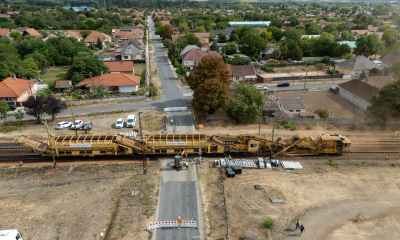
Road building
Once a country lane, this street in Terézváros – now undergoing a transformation – conceals a mysterious synagogue

Terézvárosi Vagyonkezelő has entered into a framework agreement with Penta Általános Építőipari Kft.. Under the agreement, next call for proposals, the „Terézváros 2030 Programme” will continue, under which the complete resurfacing and tree planting of several public spaces, as well as traffic-calming measures, may be implemented.

From Gardens to a Global City
Dessewffy Street is a true reflection of Budapest’s development; at the end of the 18th century, it was nothing more than a dirt track. It was lined with gardens and small farmsteads: spacious courtyards and small houses set at right angles to the streets defined the character of the neighbourhood.
The rapid development of our capital city and the proximity of the boulevard then brought about a change in the character of the street: the former single-storey, almost rural-style buildings were gradually replaced by historicist apartment blocks set back from the street. The street’s residents began to include the emerging middle class of Pest: craftsmen, merchants and intellectuals moved here. In 1874, it was given its present name (its first known name was Három Szív utca) in honour of Count Emil Dessewffy (1814–1866), a conservative politician, economist and former president of the Hungarian Academy of Sciences.
Perhaps the most remarkable feature of the street is the building at number 23. From the outside, it appears to be a simple apartment block in Pest, but its inner courtyard, surrounded by high walls, conceals one of Budapest’s oldest Orthodox synagogues, which is still in use today.
The section of road could be completely resurfaced
Penta has 54 million forints and two months to carry out the work, which involves renovating the road and pavements on the section of Dessewffy Street between Hajós Street and Nagymező Street.
The tasks include
- the milling of the existing asphalt surface,
- structural reinforcement in the relevant sections, followed by
- the laying of a new layer of asphalt surfacing;
- the reconstruction of the existing pavement, which is surfaced with mastic asphalt, and the kerb – which is damaged and raised in places – on both sides of the street (using stones suitable for reconstruction).
- Instead of mastic asphalt, a pavement made of paving stones is being laid.
Source: Link








One of Abony’s most important transport routes is to be redesigned

This is how flash floods on the vineyard-covered hills in the Pécs conurbation are being prevented

Order has been restored: production of the new Közlekedési Múzeum can now go ahead as originally planned

We took a look at how the refurbished Igazságügyi palota building turned out

Four new bridges to be built in the heart of the former industrial city

Rain gardens are coming to Budafok, with over 3,000 square metres of green space set to be developed

Contemporary art deco in Csopakon

Safer driving on the motorways: new digital signs for the MKIF
-

 Current at 2026. 09. 09.
A first-hand look at a career in engineering – Duna Group Szabadegyetem is back
-
Climate-X 2026. 09. 09.
Nyíregyháza Spartacus FC goes green – four hundred solar panels to be installed on the stadium roof
-
Bound track 2026. 09. 15.
Nearly 50,000 people travel on it every day – the refurbishment of the Cegléd main line continues
-
Current at 2026. 09. 09.
Rental flats, Rákosrendező, decentralisation – important ideas were put forward on the Real Estate Beach Conference stage