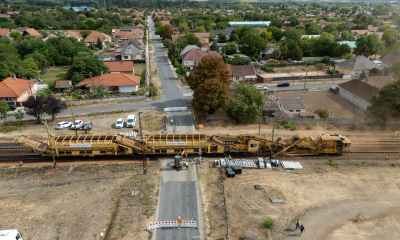
Road building
Road refurbishments in Heves County – modernisation of four-digit roads nears completion

The two roads undergoing renovation play a significant role in the life of the region. Road 2416 is used primarily by residents of the Eger conurbation. The importance of Road 2417 is further enhanced by the fact that it is also used for transport from the quarry operating in the Kisnána area.

Extensive renovation work has been carried out on the section between Eger and Egerszalók
On Road 2416, the resurfacing work took place on the rural section between Eger and Egerszalók, between kilometre markers 40+200 and 42+767.
Upon taking over the worksite, the contractor found the road surface to be in a state of disrepair: the road edges had crumbled away, the entire surface was cracked and potholed, the verge had subsided, and the rainwater drainage ditches and culverts were silted up. Comprehensive repairs were required along the affected 2,567-metre stretch of road.

The road has been widened
The works were divided into two main sections: a longer section was widened on both sides, increasing the carriageway width from 6 metres to 6.5 metres. The entire surface was then resurfaced to a depth of approximately 25 centimetres using the remix method, before being sealed with two layers of asphalt. Two bus stops were also refurbished along this section.

On another, shorter, winding section of Road 2416, the carriageway was widened on one side; the surface was milled to the required profile, and two layers of asphalt were then laid. Here, a roadside drainage channel was created, a raised kerb and a „K”-shaped kerb were installed, and the rainwater drainage system was also refurbished.

Nearly five thousand tonnes of asphalt were laid
A total of 16,685 square metres of road surface is being resurfaced on Road 2416. During the works, approximately 4,800 tonnes of asphalt were laid. In addition, a 5,134-metre-long crushed stone verge was constructed, kerbs were installed along nearly 280 metres of the road, and 300 metres of guardrails were fitted.

Torrential downpours put the experts to the test
Traffic was managed during the works by closing half the carriageway and using traffic lights. According to experts at STRABAG, the work was hampered not so much by the complexity of the construction tasks as by the wet weather: during the widening works, torrential downpours on several occasions prevented the required load-bearing capacity values from being met. After drainage, it was often necessary to wait for the layers to dry out, and it was also necessary to replace the waterlogged sections.

The roadworks between Kápolna and Verpelét will affect three villages
The road surface is being resurfaced on the Kápolna–Verpelét road (No. 2417) between kilometre markers 0+083 and 5+135. On this stretch of more than 5 kilometres, heavy goods vehicle traffic in particular has left a visible mark: rutting and mesh cracking have developed in the road surface. The focus of the works was on resurfacing the road.

Following the profile milling, the specialists from STRABAG laid two layers of asphalt on the sections affected by the works. Approximately 11,200 tonnes of asphalt were used for the resurfacing of Road 2417.
The works also affected the villages of Kápolna, Tófalu and Aldebrő, where there are numerous gateways and road junctions, each of which required a bespoke design.
As part of the project, the eight bus stops along the section were also refurbished. The bus bays were given a CP concrete surface, whilst the platforms were fitted with new kerbstones and an asphalt surface. The technical handover of the road in question began at the end of June.

The tarmac came from Füzesabony
The two projects are linked from a construction management perspective, as the asphalt for both sites was supplied from the asphalt mixing plant in Füzesabony. The production and transport logistics had to be scheduled in coordination with the operation of the asphalt mixing plant.

According to the experts at STRABAG, one of the keys to the project’s success was precise scheduling and constant communication. Daily coordination between the client and the contractor – whether on site or by telephone – played a significant role in ensuring that the work progressed according to schedule.
Source: Link








We took a look at how the refurbished Igazságügyi palota building turned out

An arena powered exclusively by green energy is set to be built in Romania: construction of the stadium is already underway

Reconstruction of the M1 motorway’s carriageway towards Győr can begin under the new traffic arrangements

Alpine engineering techniques are also being used to protect the railway in the Danube Bend

Four new bridges to be built in the heart of the former industrial city

Rain gardens are coming to Budafok, with over 3,000 square metres of green space set to be developed

Contemporary art deco in Csopakon

Safer driving on the motorways: new digital signs for the MKIF
-

 Current at 2026. 09. 09.
A first-hand look at a career in engineering – Duna Group Szabadegyetem is back
-
Climate-X 2026. 09. 09.
Nyíregyháza Spartacus FC goes green – four hundred solar panels to be installed on the stadium roof
-
Bound track 2026. 09. 15.
Nearly 50,000 people travel on it every day – the refurbishment of the Cegléd main line continues
-
Current at 2026. 09. 09.
Rental flats, Rákosrendező, decentralisation – important ideas were put forward on the Real Estate Beach Conference stage