Current at
The M1 motorway is being placed on flexible foundations

At the board meeting of the ÉVOSZ Civil Engineering Section, Tamás Retz, Deputy State Secretary of the Ministry of Energy, presented the status of the water management subsidy system, while Antal Varga, member of the board and deputy CEO of Duna Aszfalt Zrt., outlined the next steps in the renovation of the M1 motorway.

Flood protection along the Danube and Tisza rivers is almost complete
Deputy State Secretary Tamás Retz held a professional briefing on the country's water and wastewater management. As we learned from his presentation, from 1 August 2024, the professional management of the water sector will also fall under the remit of the Ministry of Energy.
Over the past decade, we have spent approximately 450 billion forints on flood protection investments. As a result, our flood protection preparedness on the Danube and Tisza rivers can be considered nearly 100%. There are perhaps a dozen or so necessary interventions that still need to be carried out along the rivers, and these will be implemented in the near future.„
– emphasised, pointing out that in the next funding cycle, the focus can therefore be on water retention and replenishment. Such projects were already being planned during the KEHOP period, and now they can enter the implementation phase under KEHOP+.
„In addition to the Homokhátság and Észak-Nyírség projects (which will have a total value of around 400 billion forints), the Eastern Main Canal will also be dredged, and several lowland reservoirs may also be reconstructed,” he explained.

Developments worth billions may be launched
In accordance with EU directives, an extended producer responsibility system will also be introduced in water management, obliging cosmetics and pharmaceutical manufacturers to contribute to the financial costs of building and operating water treatment plants. An important element is that water treatment plants in large cities and certain priority areas must be upgraded to level 4 treatment (the step after biological treatment, which serves to remove micropollutants).
„The transition to this will generate development costs amounting to several thousand billion forints, the financing of which still raises questions,” concluded Tamás Retz.
2 million tonnes of asphalt processed in three years
Antal Varga, Deputy CEO of Duna Aszfalt Zrt., spoke about the stages of the M1 motorway expansion, in which the company is playing a significant role. He began by highlighting some key figures that illustrate the scale of MKIF Magyar Koncessziós Infrastruktúra Fejlesztő Zrt.'s activities to date. In 2022, 1,237 kilometres of motorway were taken over for operation, which has now reached nearly 1,300 kilometres.
Under the concession agreement, the Concession Company was required to bring those sections where necessary up to the same technical standard as the rest between 2022 and 2025. The Duna Group also played a major role in this professional task. During the largest expressway renovation in Hungary's history, 2 million tonnes of asphalt were used on the network managed by the MKIF Zrt. over a period of three years. This amount is close to the country's total annual consumption.

An eight-lane motorway is needed on one of Europe's most important transport corridors
While at the turn of the millennium, 10-15 thousand vehicles used the M1 motorway daily, this number increased to 80-100 thousand vehicles in 2025, while the road was not significantly improved.
„We plan to have three full-width lanes and a smart hard shoulder that can be used as a full-value traffic lane (ITS) on both sides, with track structure layers suitable for main track traffic, so it can be opened as needed,” summarised Antal Varga.
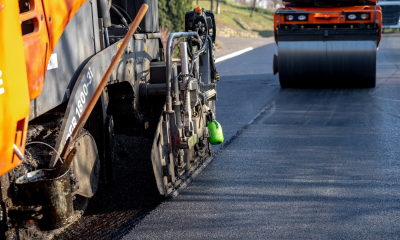
A 32 cm layer of asphalt will be laid on the entire road surface. During the most intensive period of construction, 20,000 tonnes of raw materials will need to be moved each day, resulting in 6,000 tonnes of asphalt per day.
They are building a flexible track structure.
A particularly interesting feature is that the surface will not be covered with a hydraulic binder, but with continuously distributed crushed stone. Experts expect this to provide much better fatigue resistance due to the flexible track structure:
„There will be no cracks caused by the expansion movements of hydraulic binder paving bases,” said the deputy CEO. This will enable the construction of much more durable, heavy-duty roads that will remain resistant over a long period of time.
This road structure was tested in real-life conditions on the M4 motorway section in Törökszentmiklós, where experience has shown good results.
Already well known in the West, this technology is still unusual here at home.
„In order to create a truly durable road, we had to abandon the semi-rigid structure. The alternative would have been a completely rigid concrete track structure, but the designers found it more practical to move towards a flexible base,” said Szabolcs Rosta, innovation director at Duna Group. He added about the technology:
„Above a certain asphalt thickness, this flexible track structure is capable of withstanding the axle loads imposed on it without suffering fatigue damage, as the elongation of the lower asphalt layer can be kept below the fatigue limit – provided, of course, that the upper layers are replaced at appropriate intervals.”

Germany, the USA and Australia have long been building this type of track structure, which can withstand heavy traffic – this is encouraging for the M1 as well. The director drew attention to the difficulties associated with this:
„However, an important condition for the road to function properly is that the crushed stone base must be constructed very precisely, which requires even stricter technical discipline than before.”
Koch Domonkos, innovation engineer at MKIF Zrt., previously spoke to our newspaper about crushed stone base and milled asphalt used in the expansion of the M1 motorway. innovation engineer at MKIF Zrt., rel="noopener">in more detail in an interview.
Source: Link










One of Abony’s most important transport routes is to be redesigned

This is how flash floods on the vineyard-covered hills in the Pécs conurbation are being prevented

Order has been restored: production of the new Közlekedési Múzeum can now go ahead as originally planned

We took a look at how the refurbished Igazságügyi palota building turned out

Four new bridges to be built in the heart of the former industrial city

Rain gardens are coming to Budafok, with over 3,000 square metres of green space set to be developed

Contemporary art deco in Csopakon

Safer driving on the motorways: new digital signs for the MKIF
-

 Current at 2026. 09. 09.
A first-hand look at a career in engineering – Duna Group Szabadegyetem is back
-
Climate-X 2026. 09. 09.
Nyíregyháza Spartacus FC goes green – four hundred solar panels to be installed on the stadium roof
-
Bound track 2026. 09. 15.
Nearly 50,000 people travel on it every day – the refurbishment of the Cegléd main line continues
-
Current at 2026. 09. 09.
Rental flats, Rákosrendező, decentralisation – important ideas were put forward on the Real Estate Beach Conference stage