Road building
Hungary’s newest asphalt mixing plant can produce up to 2,500 tonnes a day

A new asphalt mixing plant, equipped with the very latest technology available, has been built near Kisigmánd; it will meet the enormous demand for asphalt in the surrounding area and for the expansion of the M1 motorway.
Hungary’s most advanced asphalt mixing plant – equipped with state-of-the-art technology that meets international standards and optimised for recycling – has been commissioned near Kisigmánd, close to the Komárom junction on the M1 motorway. The new plant will primarily serve the M1 motorway expansion works being carried out by MKIF Magyar Koncessziós Infrastruktúra Fejlesztő Zrt..

As Balázs Sebestyén, Technical Director of Mészáros M1 Útépítő Kft., pointed out: „Two asphalt mixers will fully supply the asphalt required for the reconstruction of the main carriageway on the Bicske–Concó section. One is located in Kisigmánd, the other in Bicske, which is still under construction. However, in the event of a simultaneous high demand for asphalt – for example, during the realignment of access roads and the construction of motorway junction branches – it may be necessary to deploy additional asphalt mixers.”
Our country’s newest mixing plant was built with an investment of 7 billion. In this regard, Tamás Németh, Chief Executive of MKIF Magyar Koncessziós Infrastruktúra Fejlesztő Zrt., emphasised:
„A state-of-the-art facility has been established here, where top-quality asphalt is produced using the very latest technology. We can rely fully on this asphalt mixing plant for a project of such a large scale as the M1 motorway extension.”
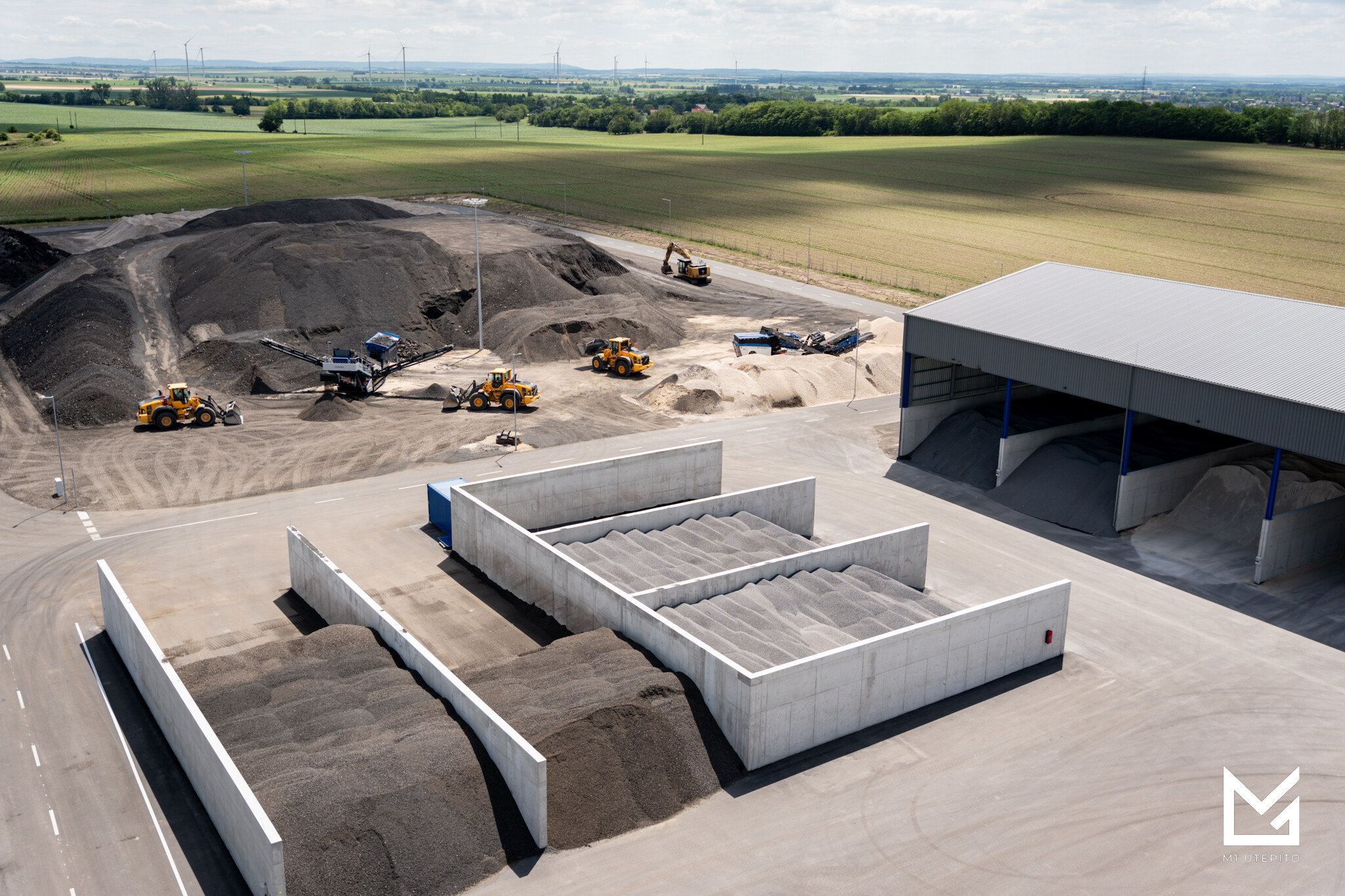
The machine has a rated capacity of 300 tonnes per hour
Gyula Máyer, site manager, who oversaw the entire construction and licensing process for the site, said: „We have installed a machine here that is unique in Hungary, and which is particularly unique in its ability to recycle demolished asphalt in line with international trends.”
Earthworks on the site began at the end of 2024; construction of the asphalt mixing plant started in April 2025, and trial production also began in the autumn on the 7-hectare site. The site comprises an office block, a well-equipped service centre, a laboratory building, the 36-metre-high asphalt mixing plant standing on 53 piles, and a partially covered storage area.
With just nine staff members at the plant, they are able to produce up to 300 tonnes of asphalt per hour.
Three bitumen storage tanks at the site, each with a storage capacity of 80 tonnes, ensure the plant’s supply, but provision has also been made for the installation of further bitumen tanks. This is necessary because the recycling technology requires the use of several different types of bitumen.
„Ensuring the energy supply during construction was a major challenge, as the machine has significant gas requirements in addition to its electricity needs. It is capable of heating the stone using natural gas, and, if necessary, diesel and coal dust. This means the plant can operate using up to three different energy sources. ”Interestingly, the burner heads can essentially be switched to a different energy source within a short time by a control operator. This is one of the safeguards ensuring continuous operation,” pointed out Gyula Máyer.

An innovative design guarantees efficiency
A brief overview of how the asphalt mixing plant works: The stones of various sizes that arrive are loaded into feed hoppers using front-loaders. The feed hoppers discharge each size of stone in specified quantities onto a conveyor belt, which then transports them to the drying drum. In the drum, the aggregate is heated to approximately 180–200 degrees Celsius, and all impurities and dust are removed. From there, a hot elevator carries the stones to the top of the machine, where they are sorted through screens. After sorting, they are stored in so-called hot hoppers. From the hoppers, they are weighed and fed into the mixing drum, where they are mixed with bitumen.

Unlike most mixers, the one built here has two towers. One ensures the flow of the aggregate described above to the mixing drum, whilst the other feeds in the recycled asphalt. This mixer has a so-called parallel drum, which heats the graded milled asphalt at a height of approximately 30 metres and places it into a separately insulated storage bin. What makes this machine unique is that the mixing drum is positioned beneath the tower feeding the milled asphalt, making hot feeding a technically advantageous solution.
Due to its bitumen content, milled asphalt becomes very sticky when heated. In previous technological solutions, the recycled material was fed into the mixer from the side, where it would stick and had to be cleaned off. The innovation introduced by the machine manufacturer is that the mixing unit has been positioned beneath the milled asphalt storage hopper.
„In Hungary,” added Gyula Máyer, “the standard currently permits a dosage of 30%, but we also produced a 50% mixture during trial production, which we have installed at our site. In Western Europe, a 60–80% mix ratio is not uncommon either, but there are countries where a ratio of 100% has already been targeted. It is important to emphasise that all the properties of the asphalt produced in this way met the technical requirements.”
„Based on its knowledge of the quality of the raw materials, the new machine is capable of producing its own asphalt mix design and can also determine the correct proportions of different types of bitumen,” the expert pointed out.
In order to mix 300 tonnes of asphalt per hour, in line with the mixer’s rated capacity, the mixing drum must be emptied into the hopper every 48 seconds. „The plant has already produced tens of thousands of tonnes so far this year, but the real peak demand is only just beginning. We can mix 4 tonnes of material at a time, which we can then transfer into the machine’s four finished-product storage silos, with a combined capacity of 300 tonnes.”

They are capable of carrying out instrumental examinations that are unique in this country
The first material test at the local laboratory took place in January – as Péter Nagy, the laboratory manager, explained in detail. The laboratory’s main activities are in-plant production control – that is, quality assurance for the mixing plant – and the design of asphalt mixtures.
„Although we are currently able to produce 33 different types of asphalt, these are mostly made up of the same four main components: aggregate, bitumen, limestone powder and additives. The classification of additives provides a fairly precise description, but we have to constantly monitor changes in the other three raw materials due to the nature of the minerals and adjust the mixing ratios accordingly. ”We need to stay up to date with this,„ emphasised the laboratory manager. He added: ”Furthermore, we test bitumen every 300 tonnes and crushed stone every 2,000 tonnes, as required by the standard. I would also highlight the void content and compaction of the asphalt as important characteristics; after all, if an asphalt mix is very compact, rutting can easily occur later on; and if it is very porous, it may crack in winter.”
Three specialised machines also assist the laboratory’s work and are indispensable for carrying out type testing: one of these is a large hydraulic fatigue testing machine with outstanding specifications in Hungary, capable of „fatiguing” asphalt beams up to one metre in length, so to speak. The machine tests the given layer’s susceptibility to „fatigue” at four points, at 30 Hz in accordance with Hungarian regulations, and at three different load levels. The second piece of equipment, the so-called rutting tester, simulates the rutting caused by the repeated wheel loads of road vehicles and tests the mixture’s resistance to permanent deformation. This device passes over the sample 10,000 times with a load of 700 N at 60 °C. The third piece of equipment is used to test the modulus of rigidity of the layers, demonstrating the extent to which the mixtures undergo deformation under a given load.
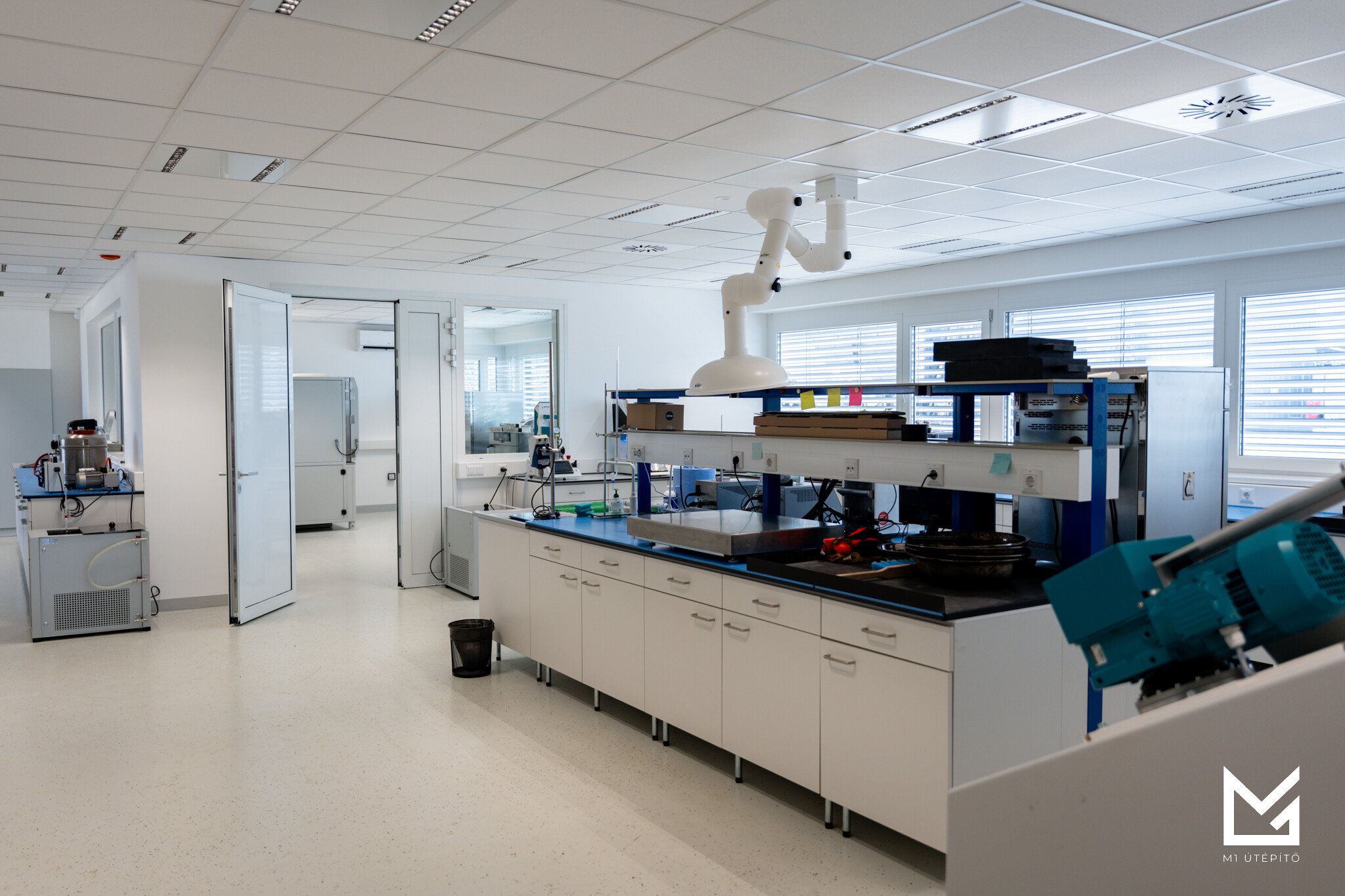
Further equipment is also being procured, such as apparatus for testing the rheological properties of bitumen (editor’s note: the rheological properties of bitumen describe how the material behaves under the influence of load, temperature and time), or machinery suitable for carrying out mechanical destructive testing on crushed stone.
The laboratory’s research could prove of long-term and wide-ranging benefit to road builders, and their new research programme is a prime example of this:
„We have launched a very exciting innovation programme in partnership with Széchenyi István University in Győr: the aim of our innovation programme is to establish a scientific basis for the use of mixtures with a high recycled asphalt content. During the tests, we are analysing the performance of 25 different mixtures to gain an accurate picture of how the proportion of recycled material affects the durability and long-term behaviour of road surfaces. We are confident that the results will not only enable more cost-effective and sustainable road construction, but will also provide manufacturers and contractors with a reliable basis for decision-making.”
We previously wrote an interesting article the use of milled asphalt in line with international trends; and on the innovations relating to the MKIF motorway, whilst the pavement inspection was covered THIS interview, as reported by the company’s young specialists.
Source: Link










One of Abony’s most important transport routes is to be redesigned

This is how flash floods on the vineyard-covered hills in the Pécs conurbation are being prevented

Order has been restored: production of the new Közlekedési Múzeum can now go ahead as originally planned

We took a look at how the refurbished Igazságügyi palota building turned out

Four new bridges to be built in the heart of the former industrial city

Rain gardens are coming to Budafok, with over 3,000 square metres of green space set to be developed

Contemporary art deco in Csopakon

Safer driving on the motorways: new digital signs for the MKIF
-

 Current at 2026. 09. 09.
A first-hand look at a career in engineering – Duna Group Szabadegyetem is back
-
Climate-X 2026. 09. 09.
Nyíregyháza Spartacus FC goes green – four hundred solar panels to be installed on the stadium roof
-
Bound track 2026. 09. 15.
Nearly 50,000 people travel on it every day – the refurbishment of the Cegléd main line continues
-
Current at 2026. 09. 09.
Rental flats, Rákosrendező, decentralisation – important ideas were put forward on the Real Estate Beach Conference stage