Road building
Hungarian road construction could take a major step forward: a fleet of machines equipped with new digital support systems has made its debut in trial operation

Duna Group to test the Wirtgen Group fifth-generation road construction machine fleet on a road improvement project on the M3 motorway, which was equipped with a comprehensive digital tracking system.
The system comprising the upgraded Vögele asphalt pavers (commonly known as ‘finishers’ – Ed.) and HAMM road rollers has opened up new horizons for the group: based on these positive experiences, Duna Group has decided to go ahead with this innovative investment, and the first set of machinery purchased is due to arrive in March.

We spoke to the two experts overseeing the May trials – Szabolcs Rosta, the company’s Head of Concessions and Innovation, and Dániel Wolf, Chief Engineer for Concessions and Innovation at Duna Aszfalt Zrt. – about the most exciting benefits of the technology.
The Duna Group also played a key role in the previous dimensional shift
„This latest development has significant precedents in the Duna Group,” pointed out Szabolcs Rosta. „Our company already played a leading role in testing the previous generation of 3D technology in Hungary back in 2018.” He added,
The new system is now in its fifth generation and provides continuous information on, amongst other things, the condition of the work area, installation, material quantities, temperature and compaction.

„We work more safely, build with greater precision, and are able to manage and monitor the work based on more information” – this is how Dániel Wolf briefly summarised the most important advances.
There’s no need for a USB stick; everyone sees the same data straight away
Szabolcs Rosta highlighted the simultaneous accessibility of data as one of the advantages of the latest-generation machine network, which is fundamentally changing the way work is organised. „In the past, we sometimes had to send data to the relevant colleagues on a USB stick.”.
Now the information is available practically instantly and simultaneously: the machine operator at the finisher, the road roller operator and the process engineer in the office can all see exactly the same information straight away.”
Szabolcs Rosta described the smart paving system – that is, smart integration – as one of the most important elements of the new system. „It creates a shared information environment in which the various participants in the workflow can work from the same dataset.”
From now on, there’s no need to keep correcting the steering
Another significant innovation is the automatic steering and control of the paving width. The finisher is able to follow the specified route based on survey data, whilst automatically regulating the paving width.

„This makes life much easier for the machine operator: they don’t have to constantly make small steering adjustments to correct the machine’s position, but can instead focus more on the entire work process,” said Dániel Wolf.
Workplace safety is also making great strides
The system is also capable of adapting to the existing edge of the cladding.
The expert drew particular attention to the Edge Detect function, which detects the edge of the existing flooring and automatically adjusts the width of the plank accordingly. This can be particularly useful when widening floors or joining them to existing flooring.
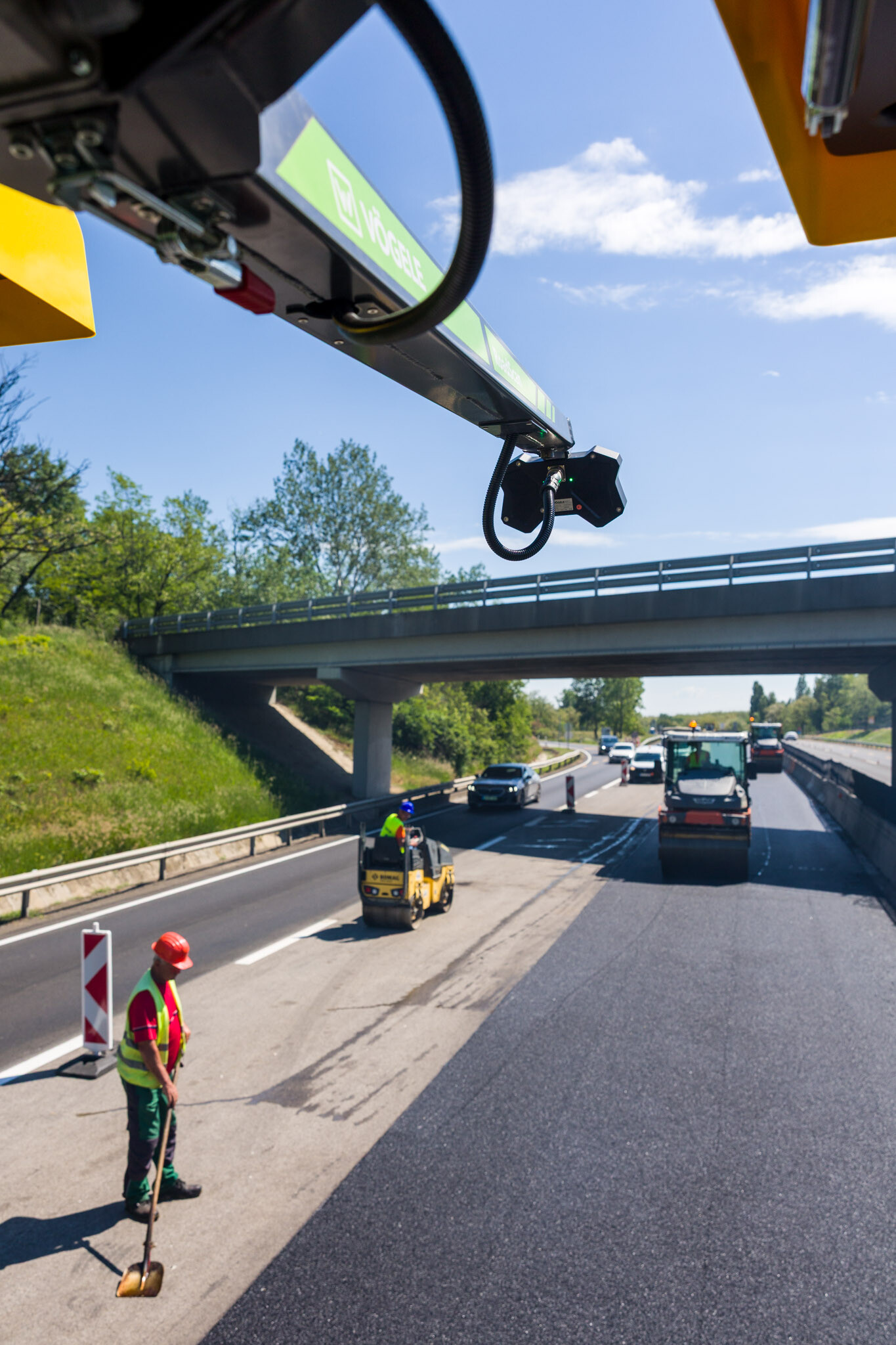
This function is significant not only from a technological perspective, but also in terms of health and safety. Previously, in certain situations, the machine operator had to walk alongside the machine, in an area close to the traffic, in order to check or adjust the position of the platform. The automated system takes over part of this task. „So the same technology improves both installation accuracy and workplace safety at the same time,” pointed out Dániel Wolf.
Ordering materials is becoming faster and more precise
One of the most striking changes brought about by the new technology is in the foreman’s work. „At the start of the day, he can record the planned length of the installation; he can also specify the type of layer being laid, the planned thickness, as well as the type of material and the associated quantity data,” explained Dániel Wolf.

He added that, as the process progresses, the machine continuously calculates the daily output based on the incoming data.
„This means you can not only see how far the installation has progressed, but also estimate how much more material will be needed. This is particularly important on a milled surface, where the layer thickness is not uniform throughout. Overall, this allows materials to be ordered more quickly and accurately, resulting in less waste”
– explained Dániel Wolf.
The energy thus freed up can be channelled into quality assurance
Compared with previous practice, this also makes work organisation considerably easier. „Under the previous asphalt laying procedure, the site manager had to use a measuring wheel to constantly monitor the length of road section laid by each transport vehicle,” added Szabolcs Rosta. „Now all this can be monitored directly on the finisher’s display.”.
This means that the site manager does not have to concern themselves with the mechanical monitoring of the installation, but can instead focus more on ensuring that compaction is carried out correctly, that the machine settings are correct, and that the installation temperatures comply with the specifications.”
„Based on our experience, the new production line has made the foreman’s job considerably easier, whilst allowing us to place greater emphasis on quality assurance,” summarised Szabolcs Rosta.
Fifth-generation quality assurance can even enable immediate action
Quality assurance is also a key area in the new system from another perspective. „In road-building practice to date, we take samples at specific points – every 3,000 square metres – which we then analyse under laboratory conditions, and from this we subsequently draw conclusions about the quality of the entire surface,” explained Szabolcs Rosta.

The smart page and smart compact systems, on the other hand, provide continuous data from almost the entire surface, even in a 5×5 cm grid. „Among other things, they measure the temperature on the finisher and the roller, and also provide automatic density measurement on the roller.
”These do not replace laboratory tests, but they provide much more information and a more relevant picture – and they do so immediately. This means we can spot problems whilst the work is in progress and can even take immediate action.”
In addition to all this, the fact that the system leaves a digital trail of the entire construction process also opens up new possibilities in quality assurance and documentation. „Previously, we mainly inspected the finished surface; now we have much more information available about the construction process itself.”
The system has also proven itself in live operation
The fact that the above innovations do not merely work in theory has been conclusively demonstrated by the results of the work carried out on the M3 motorway using the new machine train. The road resurfacing project, which involved field testing the machine train, took place in the spring of 2026 in the Bag and Mogyoród areas of the M3 motorway, as part of the road safety resurfacing programme. The Duna Group resurfaced a section of approximately five kilometres in ten weeks using the innovative machine train hired for this purpose.

„We’ve managed to create a surface of exceptionally high quality!” emphasised Szabolcs Rosta.
„Based on the IRI international evenness index, the section of the M3 motorway has been one of the most successful renovation projects of recent years. As a result, we were able to exceed the limit specified in the client’s contract MKIF not by a factor of two, but by a factor of three.”
The reputation of the road-building profession could also reach new heights
In addition to professional values, another important point that emerged during the interview was that, thanks to this innovative system, jobs in the road construction sector could become more attractive.
„Automated systems can be of particular importance in a working environment where machine operators are required to concentrate continuously for 10–12 hours a day, whilst performing monotonous tasks, sometimes in extreme weather conditions”
– pointed out Szabolcs Rosta. „What’s more, they help with training and enable more precise work, even for those with less experience,” he added. „Overall, employees are much more willing to operate machines fitted with such systems than those of the previous generation. We experienced this first-hand during our ten-week stint on the M3 motorway.”
According to Dániel Wolf, there was also a noticeable increase in interest in the new technology amongst his younger colleagues.
„This is important because today the question is no longer just about which machinery can be used to build roads efficiently, but also about what sort of working environment can be provided for our colleagues, and how we can make the profession more attractive to young people. And with this new fleet of machinery, we are taking a major step towards ensuring that road construction is seen as a modern, technology-driven profession rather than gruelling physical labour!”
Source: Link





The ‘Mushroom’ will remain in Örs vezér Square – the detailed plans for the square’s regeneration may be finalised

Hungarian road construction could take a major step forward: a fleet of machines equipped with new digital support systems has made its debut in trial operation

A cooling vest, greener tarmac and digital work management: this is how the STRABAG is responding to climate change

A centre is being built for couples struggling with infertility under project Debreceni Egyetemen

Rain gardens are coming to Budafok, with over 3,000 square metres of green space set to be developed

Four new bridges to be built in the heart of the former industrial city

Contemporary art deco in Csopakon

Safer driving on the motorways: new digital signs for the MKIF
-

 Climate-X 2026. 09. 22.
From the heating plant to the library – solar panels are to be installed on eight local authority buildings in Kiskunfélegyháza
-
Climate-X 2026. 09. 26.
The first municipal thermal power station in Transylvania is under construction
-
Bound track 2026. 09. 24.
Major renovation work is set to begin on the Buda section of tram line 6
-
What is being built? 2026. 09. 22.
They would not only modernise the debreceni Nagyállomást, but also develop it into a modern transport hub